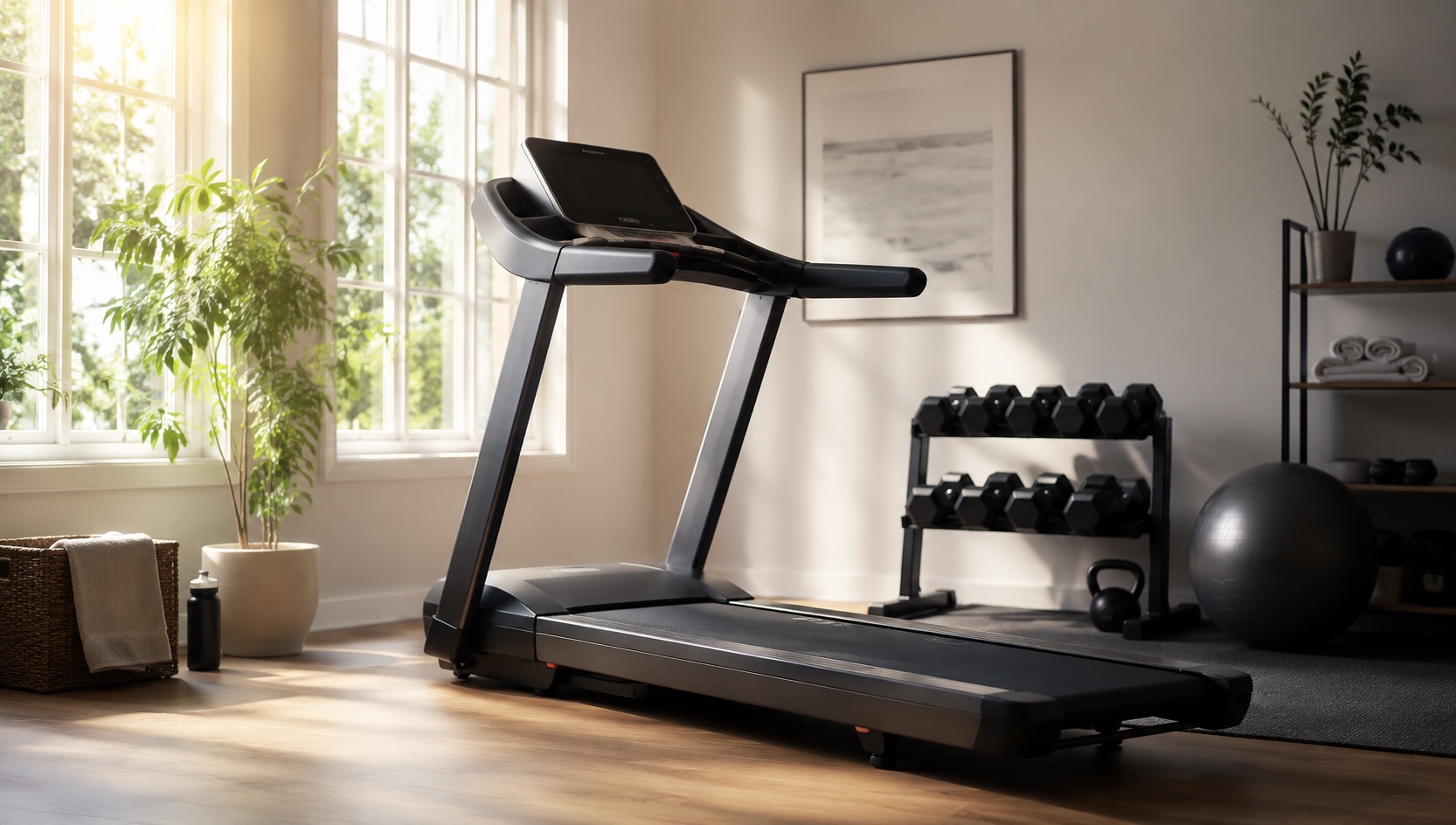
Best Walking Pads and Budget Treadmills from Chinese Brands (2026)
Living in an apartment and wanting a treadmill used to mean compromise: either you sacrifice half your living room to a bulky machine, or you give up on indoor running entirely. Walking pads changed that equation. These ultra-compact, foldable treadmills from Chinese brands fit under a desk or behind a couch, and the best ones can handle legitimate running speeds.
But “walking pad” covers everything from a $200 device that maxes out at 6 km/h to a $550 folding treadmill that hits 12 km/h with an incline. The category is confusing, the quality varies wildly, and the marketing is often misleading. Let me cut through the noise and tell you which ones actually work for runners.
Walking Pad vs. Treadmill: What’s the Difference?
The terms get used interchangeably, but there’s a meaningful distinction:
Walking pads are designed primarily for walking. They’re ultra-thin (under 15cm folded), very compact, and typically max out at 6-8 km/h. They fit under standing desks, weigh 20-30 kg, and prioritize space-saving over running capability.
Compact/folding treadmills can handle running speeds (10-12+ km/h), have higher weight capacities, slightly larger decks, and fold for storage. They’re still much smaller than traditional treadmills but slightly larger than true walking pads.
For runners, you want the latter category unless you’re purely interested in desk walking for active recovery days. If you just need something to get steps in while working, a true walking pad is cheaper and takes less space.
The Budget Contenders
WalkingPad R2 - $550
WalkingPad (by KingSmith) essentially created this category, and the R2 is their runner-focused model. It hits 12 km/h max speed, folds in half for storage, and has a running belt wide enough (44 cm) to feel comfortable at faster paces. The deck uses a 4-layer cushioning system that’s noticeably easier on joints than running on concrete.
At 12 km/h (7:30/mile pace), this handles easy runs, recovery runs, and most tempo work for recreational runners. It won’t work for sprint intervals, but for steady-state running in your apartment, it’s the best compact option available. It connects to the KS Fit app for speed control and basic workout tracking.
The folding mechanism is smooth and the folded footprint is remarkably small - it stands vertically against a wall when stored. Build quality is the best in this class, with a weight capacity of 110 kg and a belt that’s held up over hundreds of hours of use based on available data.
WalkingPad A1 Pro - $400
The A1 Pro is the pure walking pad: ultra-thin (12.9 cm height), 6 km/h max speed, designed to slide under a standing desk and stay there. For runners, this isn’t a training tool - it’s an active recovery tool. Walk for 30-60 minutes on rest days to get blood flowing without impact. Use it during work calls to avoid being sedentary.
At $400, it’s not cheap for a walking-only device, but the build quality and thinness justify the price. It’s genuinely thin enough to use under most standing desks without modification, and quiet enough to use during video calls without colleagues noticing.
Best for: runners who want active recovery walking on rest days and a way to avoid sedentary work hours. Not for actual running training.
Goplus 2-in-1 - $300
The Goplus 2-in-1 offers the most versatility at this price point. It has two modes: walking mode (up to 6 km/h) with the handlebar folded down, and running mode (up to 12 km/h) with the handlebar raised. This means you can use it as a desk treadmill during work and a running treadmill during training.
At $300, the trade-offs are predictable: the deck is narrower (40 cm), the cushioning is basic, and the motor is louder than WalkingPad options. But it works. 12 km/h is achievable, the belt is long enough for running strides, and the dual-mode design genuinely adds value if you’ll use it for both walking and running.
Build quality is adequate. It’s not as refined as the WalkingPad - the folding mechanism feels less precise, and the materials are more plasticky. But for $300 with running capability, it’s the value leader.
Sperax Walking Pad - $250
Sperax offers a compact walking pad with speeds up to 8.5 km/h - fast enough for brisk walking and light jogging but not real running. It’s slim, quiet, and has a decent app that tracks distance and calories. The LED display shows speed, time, and distance during use.
At $250, it’s positioned between pure walking pads and running-capable devices. The 8.5 km/h max means very slow jogging is possible, making it slightly more versatile than 6 km/h options for runners who want to do gentle recovery jogs. But don’t expect to do any real training on this.
Best for: budget-conscious buyers who want walking + very light jogging capability.
Urevo Spacewalk E1 - $200
The most affordable option that’s still worth buying. The Urevo Spacewalk E1 is a basic walking pad with a 6 km/h max, compact design, and remote control operation. It’s simple, minimal, and gets the job done for under-desk walking.
At $200, you’re getting a functional tool for active recovery and daily step accumulation. The build is basic but adequate, and it runs quiet enough for office use. Don’t expect running capability or premium features - this is a straightforward walking pad at the lowest reasonable price point.
The Premium Benchmark: NordicTrack EXP 7i - $800
For context on what $800 buys: a full-size folding treadmill with 20 km/h max speed, automatic incline/decline, iFit integration (streaming coaching), a 7-inch touchscreen, and a running deck designed for proper marathon training. It’s a real treadmill - just one that folds up when not in use.
If you have the space and budget, a proper folding treadmill is always going to be better for serious training than a walking pad. The NordicTrack handles sprint intervals, long runs, and everything in between. The walking pads above are compromises optimized for space - excellent compromises, but compromises nonetheless.
Comparison Table
| Device | Price | Max Speed | Foldable | Deck Width | Weight Cap | Noise | Best For |
|---|---|---|---|---|---|---|---|
| WalkingPad R2 | $550 | 12 km/h | Yes (half) | 44 cm | 110 kg | Quiet | Running in apartments |
| WalkingPad A1 Pro | $400 | 6 km/h | Flat fold | 42 cm | 100 kg | Very quiet | Desk walking |
| Goplus 2-in-1 | $300 | 12 km/h | Handlebar fold | 40 cm | 100 kg | Moderate | Budget running + walking |
| Sperax Walking Pad | $250 | 8.5 km/h | No | 40 cm | 100 kg | Quiet | Walking + light jog |
| Urevo Spacewalk E1 | $200 | 6 km/h | No | 38 cm | 90 kg | Quiet | Basic walking |
| NordicTrack EXP 7i | $800 | 20 km/h | Yes (deck) | 50 cm | 136 kg | Moderate | Full training |
Practical Considerations for Apartment Runners
Noise and neighbors. Walking pads at walking speeds (under 6 km/h) are nearly silent - your downstairs neighbor won’t know. Running at 10-12 km/h creates impact noise. If you’re in an apartment with thin floors, add a treadmill mat underneath and avoid running during quiet hours. The WalkingPad R2’s cushioning system helps, but no compact treadmill is completely silent at running speeds.
Space requirements. Measure before you buy. Walking pads typically need about 150 x 55 cm of floor space when deployed and fold to roughly 80 x 55 cm for storage. Make sure you have clearance for your stride length - the belt should be at least 120 cm long for running, which all running-speed options here provide.
Weight limits. Budget walking pads typically support 90-110 kg. If you’re near the upper limit, go for the WalkingPad R2 or NordicTrack. Running generates 2-3x body weight in force per stride, so a device rated for 100 kg standing won’t last as long with a 90 kg runner at full speed.
Maintenance. All walking pads need occasional belt lubrication (every 30-50 hours of use). Use silicone treadmill lubricant, not WD-40. This is a 5-minute job that dramatically extends belt life.
For our full treadmill recommendations including full-size models, check our best folding treadmills for apartments guide. If budget isn’t the primary constraint, our best treadmills for runners 2026 covers premium options. Looking for the sweet spot? See our best treadmill under $1000 roundup. And if you’re wondering whether treadmill running is worth it at all, our treadmill vs outdoor running comparison breaks down the pros and cons.
See how we compare products for our full research methodology.
Frequently Asked Questions
Can you actually run on a walking pad?
Only on models rated for running speeds. The WalkingPad R2 (12 km/h) and Goplus 2-in-1 (12 km/h) can handle genuine running. Devices maxing out at 6-8 km/h are walking/light jogging only. For actual training runs - tempo work, easy miles, recovery runs - you need at least 10 km/h capacity and a belt length of 120+ cm. No walking pad will handle sprint intervals or speed work above 12 km/h.
How loud are walking pads? Will my neighbors complain?
At walking speeds (4-6 km/h), walking pads are essentially silent - around 40-50 dB, which is quieter than a normal conversation. At running speeds (10-12 km/h), impact noise increases to 55-65 dB. Your downstairs neighbors may notice running, especially in apartments with thin floors. Solutions: use a treadmill mat, run during reasonable hours, and consider the WalkingPad R2 which has the best cushioning for noise reduction in this category.
Are walking pads durable enough for daily running?
For daily running at moderate speeds (8-10 km/h) and reasonable duration (30-45 minutes), the WalkingPad R2 and Goplus 2-in-1 are designed to handle this with proper maintenance. Expect the belt to last 1000-2000 km before needing replacement (belts are available as spare parts). The motor should last 3-5 years with regular use. Cheaper options (sub-$250) may wear out faster under daily running stress and are better suited to walking use with occasional jogging.
Do I need a standing desk to use a walking pad?
No. Walking pads work in several configurations: under a standing desk (the designed use case), in front of a TV for easy walks, or as a standalone exercise device. For running, you definitely don’t want a desk overhead - you need arm swing and upright posture. Many runners use their walking pad for desk walking during work and running sessions in the evening with the desk moved aside or in a different room position.
What’s the best walking pad for a runner who also wants a desk treadmill?
The Goplus 2-in-1 at $300 is specifically designed for this dual use case. The handlebar folds down for desk mode (walking up to 6 km/h) and raises up for running mode (up to 12 km/h). If budget allows, the WalkingPad R2 at $550 is better built and can also function as a desk treadmill when used at walking speeds - though its folded height means it may not fit under all standing desks.