Fourth Frontier X3 Initial Review: My First Week of Running
Tested by Jos. Initial findings as of 5 October 2026.
Follow-up, 26 October: Read our four-week Frontier X3 and HRM Sports Bra review for interval testing, the latest battery observation, Garmin pairing and Sarah’s bra experience.
The Frontier X3 arrived on 28 September, a week before its public launch. Since then, I have used it for four runs totalling 62.4 km and around five hours and 24 minutes, according to my Garmin recordings.
My early impression is positive. Once I found the right strap fit, it sat comfortably through my runs. Switching it on has been simple, and I have not needed to recharge it. Running alongside my Garmin Forerunner 570 also gave me something interesting to look at afterwards: similar heart-rate trends for much of each run, but differences in how the readings followed changes in effort.
There is still plenty to test, especially the features that might justify choosing the X3 over a simpler chest strap.
Disclosure: Fourth Frontier provided the Frontier X3 for testing at no cost as part of a collaboration covering this initial article and a later long-term review. The brand may provide feedback on product facts and presentation; final opinions, conclusions and recommendations remain with RunnersPicks.
Update: During our initial testing, our review account exposed ECG waveform viewing and export functionality. Fourth Frontier has since confirmed that ECG waveform viewing and exports are not part of the retail Frontier X3 offering. We have updated this review accordingly.
Reader discount: Fourth Frontier has provided RunnersPicks readers with 30% off the Frontier X3 using code RUNNERSPICK30. Purchases through our link may earn us an affiliate commission at no extra cost to you.
What this first week covers
A minor back injury kept most of my testing at lower intensity, with a little tempo running. I have not yet tested structured intervals or the monitor’s response to repeated sharp changes in effort.
| Date | Distance recorded by Garmin | Garmin recording time |
|---|---|---|
| 29 September | 14.02 km | 1:14:13 |
| 2 October | 21.11 km | 1:45:37 |
| 4 October | 12.26 km | 0:58:30 |
| 5 October | 15.01 km | 1:25:14 |
Times are Garmin timer durations, rounded to the nearest second. The 2 October run included a manual pause of approximately 20 seconds, excluded from its timer duration.
For all four runs, the Forerunner 570 recorded heart rate independently using its wrist sensor. I deliberately did not connect the Frontier as an external Garmin heart-rate sensor. Pairing and the resulting Garmin workflow will be part of the next review.
Fit: one adjustment run, then comfortable
My first run was partly a fitting exercise. I repositioned the strap several times while working out how it should sit, so I would treat that outing as a getting-to-know-it run rather than my best example of the monitor in use.
Once I found the right fit, the strap sat very well and did not bother me on the subsequent runs. That includes my longest outing of approximately one hour and 46 minutes. Comfort has not been something I have had to think about since that first adjustment run.
I did forget one basic step: wetting the contact areas before the later runs, as the instructions recommend. Those recordings tend to look more disturbed near the start and clearer later. My suspicion is that sweating helped the contact settle, but I cannot confirm that from these runs alone.
Next time, I will wet the contact areas before heading out. It is a straightforward variable to control as I keep testing.
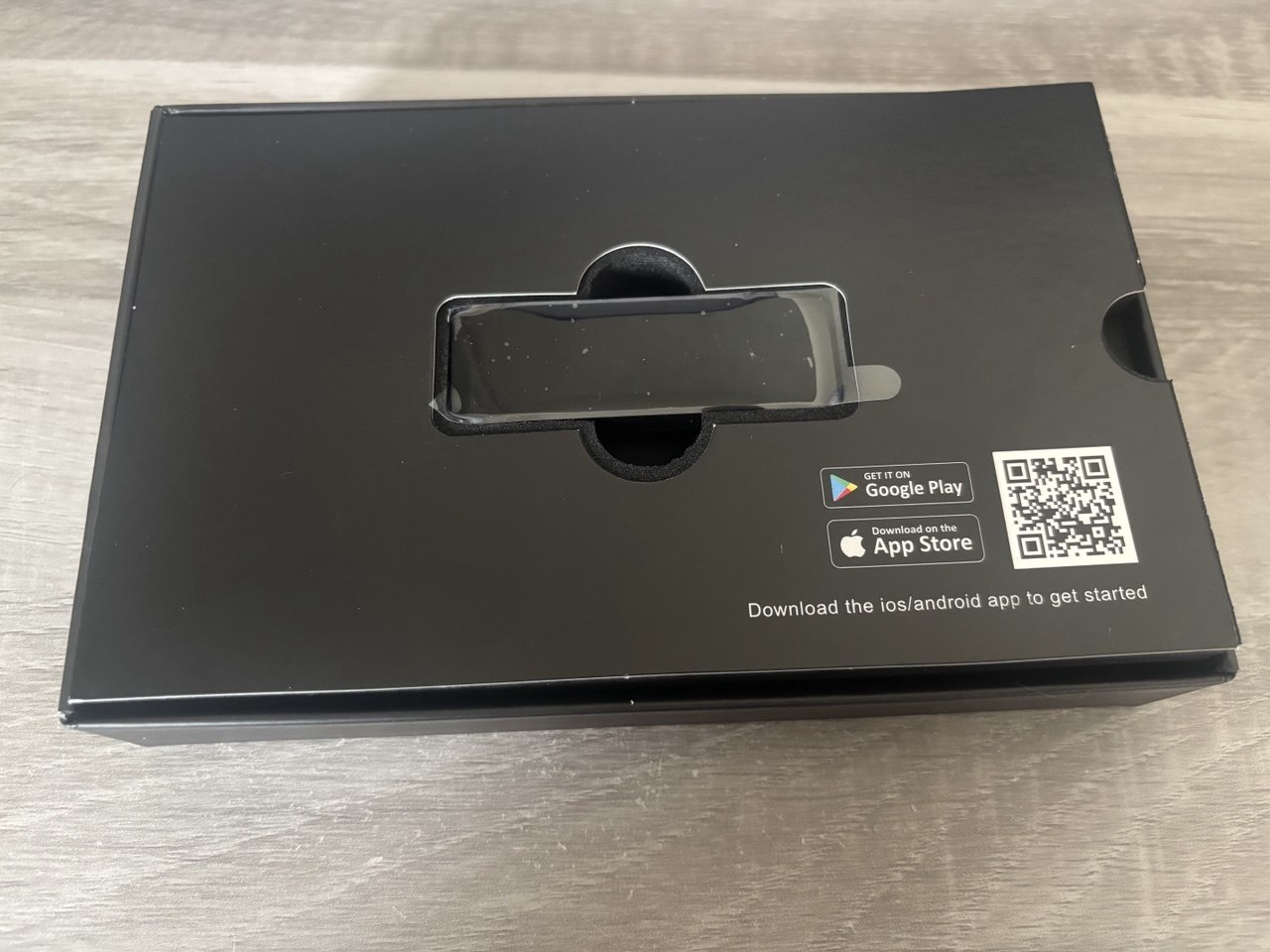
The sensor in its packaging, alongside the instructions for downloading the companion app.
Switching it on has been simple
Pressing the blue button to switch it on has been simple in practice. Mine is ready in roughly three seconds.
I have not run into any real frustrations with the basic workflow. I suspect pairing it with Garmin will make it fit into my running routine more smoothly, but that is something I still need to try.
Frontier X3 heart rate alongside the Garmin Forerunner 570
For much of these runs, the two heart-rate readings followed each other closely once I was past the opening minutes. The 4 October run is a useful example: both show the rise as effort increases and the drop when I ease off again.
The most interesting part comes around minute 47 of the 4 October run, when I slowed down and reduced the effort. The X3 reading appears to come down more quickly, while Garmin wrist HR takes a little longer to follow. Both capture the general rise and fall, but that difference is more interesting to me than agreement during a perfectly steady stretch. When I change pace or ease off to recover, I want to see that change reflected in the reading.
This is an observation from this run, not proof that the X3 is always faster or more accurate. Garmin is not ground truth. The graph uses summary points and averaged Garmin data, so it cannot establish exact reaction times or which sensor was right when they disagreed.
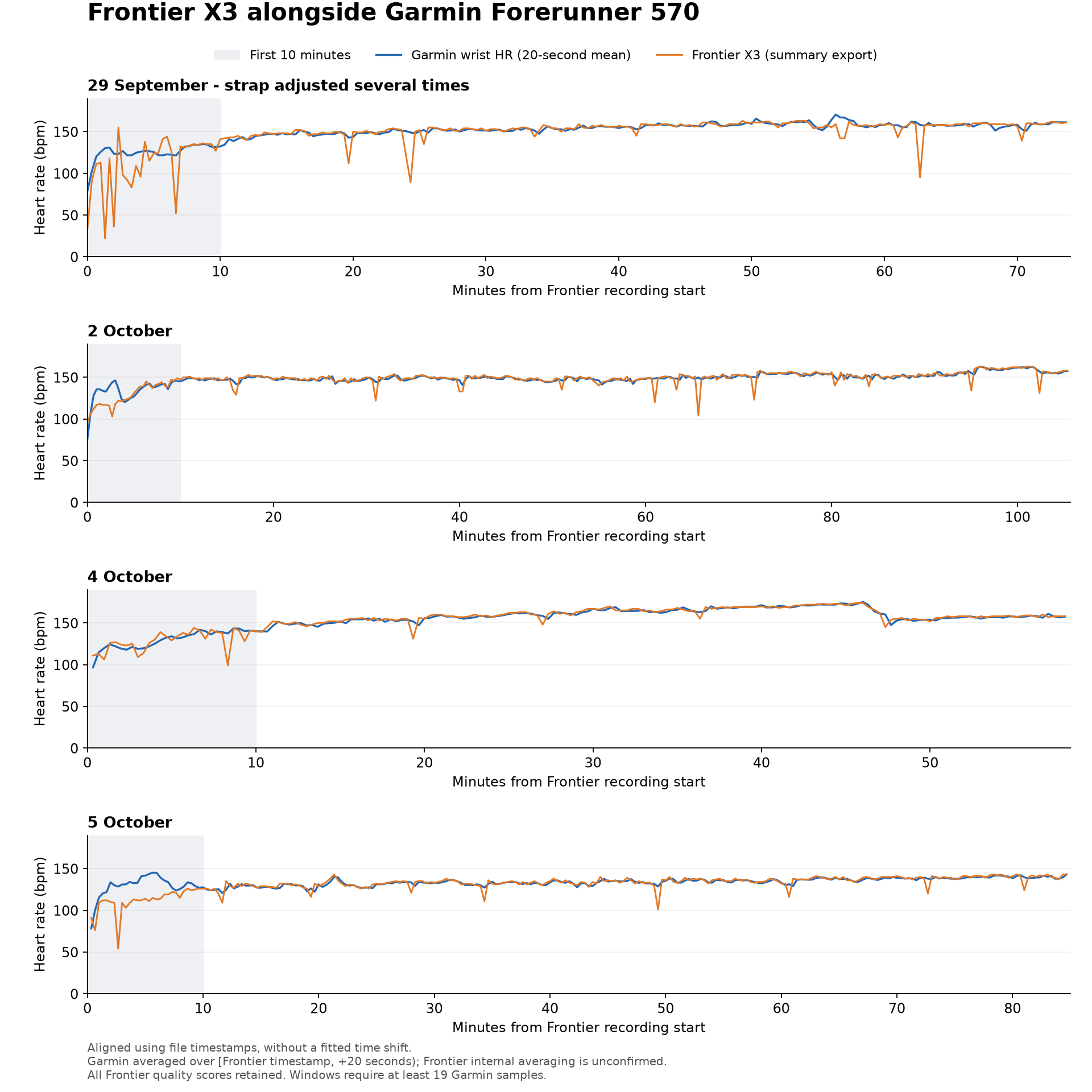
Orange: available Frontier summary points. Blue: corresponding Garmin wrist-HR averages. The shaded area marks the first ten minutes.
There are also short disagreements that I want to investigate further. Around minute 66 on 2 October, for example, the Frontier summary briefly shows 104 bpm while Garmin averages roughly 150 bpm over the corresponding window. Similar dips appear elsewhere, including after the opening phase.
The table puts those differences into numbers. Mean absolute difference is simply the average gap between the two readings, whether the X3 was higher or lower.
| Run | Mean absolute difference over matched windows | After the first 10 minutes |
|---|---|---|
| 29 September | 5.6 bpm | 3.2 bpm |
| 2 October | 3.0 bpm | 2.4 bpm |
| 4 October | 2.6 bpm | 1.9 bpm |
| 5 October | 4.0 bpm | 2.1 bpm |
All four runs show smaller differences when the first ten minutes are set aside. I was adjusting the strap during the first run, forgot to wet the contact areas before the later ones, and the early recordings look less settled.
That does not explain every disagreement, but it gives me a clear variable to control next time: a properly fitted strap with the contact areas wetted before I start.
The comparison uses the available Frontier summary points alongside corresponding Garmin data from the two independent recordings. The full-run column includes the opening ten minutes.
Structured intervals are planned from next week, which should give me a better opportunity to compare how the two readings follow repeated changes in effort.
Battery: still showing 95% after four runs
The X3 arrived showing 95% battery. After four runs and 62.4 km, it still shows 95%, and I have not recharged it.
Charging has not been something I have needed to think about yet, although this first week does not establish full battery life.
The basics now, Premium later
Most of my first week has been spent looking at heart rate and the basic session data. Fourth Frontier lists breathing rate, HRV, training load and strain alongside heart rate in its standard offering. I am still working out which of those extra numbers I will actually return to after a run. For context on using heart rate in training, see our heart-rate zones guide.
According to the manufacturer’s Premium information, the subscription adds metabolic estimates, ventilatory-threshold zones, readiness and sleep analysis. Mine was activated on 5 October, so those features belong in the next stage of testing.
What I will test next
First, I want to repeat the heart-rate comparison with the contact areas wetted properly before every run. My back is feeling better, so I plan to add structured intervals from next week and see how the readings follow repeated changes in effort.
Garmin pairing is another practical part of the next stage: how smoothly does the X3 work as an external heart-rate sensor, and does that make it easier to use on a normal training day?
I also want to try longer wear, including overnight sessions, and test sleep, readiness and recovery features as they become available and I gain enough experience with them.
The HRM Sports Bra will be tested separately by our female tester once it arrives. Her testing will add a different perspective on fit and comfort.
More time should also help answer the battery question, explain the remaining short heart-rate disagreements and show which extra metrics are worth paying attention to.
My early verdict
I have enjoyed this first week with the X3. Once fitted, it has been comfortable, simple to switch on and free of any major annoyance. It has already given me enough interesting data that I want to keep it on for the next round of runs, especially with harder intervals planned from next week.
It is still too early to judge Premium or whether the X3 is worth the extra cost over a simpler chest strap. Harder sessions, overnight wear, Garmin integration and longer-term use should help me work that out. For now, I am looking forward to putting more runs into it.
If the X3 looks like a fit for your training, RunnersPicks readers can get 30% off using code RUNNERSPICK30.
FAQ
How much running is this Frontier X3 initial review based on?
Four runs during the first week, covering 62.4 km and around five hours and 24 minutes according to Garmin. Most running was at lower intensity, with some tempo work. Structured intervals are planned from the following week.
Was the Frontier X3 feeding heart rate to Garmin?
No. My Forerunner 570 used its own wrist sensor throughout these runs, and the X3 recorded independently. Garmin pairing will be tested separately.
Was the Frontier X3 comfortable on longer runs?
Once I adjusted the fit during the first run, the strap did not bother me on subsequent outings. The longest run so far lasted approximately one hour and 46 minutes.
Has the Frontier X3 needed charging during this test?
It arrived showing 95% and still showed 95% after four runs and 62.4 km, without a recharge. That is an early indicator observation, not a full battery-life test.
Is Frontier Premium worth it yet?
It is too early for me to say. Premium was activated on my account on 5 October, and its additional analysis needs more hands-on use before I can judge it against the basic experience.