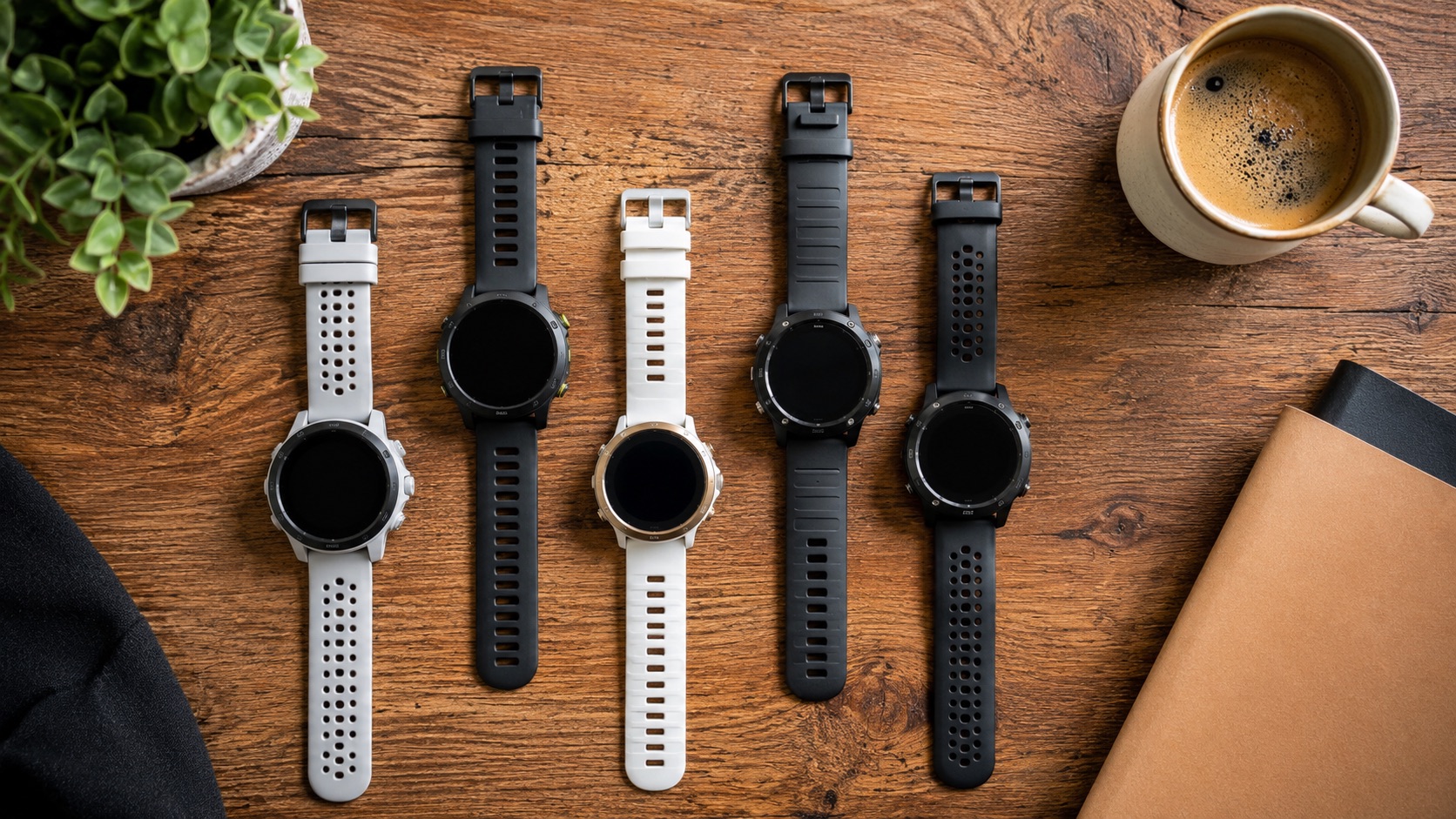
Apple Watch SE vs Garmin Forerunner 165 - Budget Smartwatch vs Running Watch
Apple Watch SE vs Garmin Forerunner 165 - Budget Smartwatch vs Running Watch
The Apple Watch SE 3 and Garmin Forerunner 165 represent two fundamentally different philosophies at a similar price point. The Apple Watch is a smartwatch that can track runs. The Garmin FR165 is a running watch that has some smart features. Same price neighborhood, completely different priorities.
If you’re a runner trying to decide between these two, the question isn’t which is “better” - it’s which type of device matches how you’ll actually use it. Let me break down exactly where each one wins and loses for runners.
Apple Watch SE 3 vs Garmin Forerunner 165 - Comparison Table
| Feature | Apple Watch SE 3 | Garmin Forerunner 165 |
|---|---|---|
| Price | $249 | $300 |
| Display | 1.57” OLED Retina | 1.2” AMOLED |
| Battery (GPS tracking) | ~6-7 hours | 17 hours |
| Battery (daily use) | 18 hours | 11 days |
| Weight | 33g (40mm) | 39g |
| GPS | Single-band | Multi-band |
| Heart Rate Sensor | Optical (Gen 3) | Optical (Elevate v5) |
| Running Metrics | Basic (pace, distance, HR, cadence) | Full (pace, cadence, stride, VO2max, training load, race predictor) |
| Training Plans | Apple Fitness+ (subscription) | Free built-in plans |
| Music | Apple Music / Spotify streaming | Offline Spotify/Amazon (no speaker) |
| Notifications | Full iPhone mirroring | Basic notification display |
| Apps | Full App Store | Garmin Connect IQ |
| Phone Required | iPhone only | Any smartphone |
| Fall Detection | Yes | No |
| Crash Detection | Yes | No |
| NFC Payments | Apple Pay | Garmin Pay |
| Maps/Navigation | Apple Maps on wrist | Breadcrumb only |
| Always-On Display | No | Yes |
Running Features: Where the FR165 Dominates
The Garmin Forerunner 165 was designed specifically for runners, and it shows in the depth of running-specific features:
Training metrics the FR165 has that the Apple Watch SE lacks:
- VO2max estimation with trend tracking
- Training load and recovery time recommendations
- Training status (productive, maintaining, detraining)
- Race time predictor (5K through marathon)
- Running dynamics compatibility (with external pod)
- HRV status monitoring
- Morning report with daily training suggestions
- Interval workout creator with structured workouts
- PacePro race pacing strategy
The Apple Watch SE gives you pace, distance, heart rate, cadence, elevation, and splits. That’s adequate for tracking runs, but it doesn’t help you train intelligently. There’s no recovery guidance, no training load management, and no built-in periodization. You get data without interpretation.
If you follow a training plan and want your watch to tell you when to push and when to rest, the FR165 provides that guidance out of the box. The Apple Watch requires third-party apps (TrainAsOne, TrainingPeaks) to get similar functionality, often at additional subscription cost.
GPS Accuracy: Multi-Band vs Single-Band
The FR165 uses multi-band GPS (L1 + L5 frequencies), which provides significantly better accuracy in challenging environments - tall buildings, dense tree cover, and urban canyons. The Apple Watch SE 3 uses single-band GPS only.
In open areas (parks, tracks, rural roads), both watches are accurate. In cities with tall buildings or on wooded trails, the FR165 will track your actual path more faithfully. If you run in a city and care about accurate distance measurements for interval work, this matters.
The practical difference: on a known 5K route through my city center, the FR165 measures 5.01-5.04 km consistently. The Apple Watch SE measures 5.08-5.15 km - the extra distance from cutting corners and bouncing between buildings in the GPS signal.
Battery Life: The FR165’s Biggest Advantage
This isn’t close. The FR165 gives you 17 hours of continuous GPS tracking vs roughly 6-7 hours on the Apple Watch SE. For daily use without GPS, the FR165 lasts 11 days vs 18 hours on the Apple Watch.
What this means practically:
- FR165: Charge once a week, run every day, never worry about battery
- Apple Watch SE: Charge every night, and if you forget you might not have enough for your morning run
For runners who train 5-7 days per week, the Apple Watch’s battery creates genuine friction. Forgetting to charge means missing a tracked run. The FR165’s weekly charging cycle is much more forgiving.
If you’re training for a marathon and your long runs exceed 3 hours, the Apple Watch SE starts getting uncomfortably close to its GPS limit - especially in cold weather when battery drains faster.
Smartwatch Features: Where Apple Wins
If you value your watch as an extension of your phone throughout the day, the Apple Watch SE is dramatically better:
- Full notification interaction (reply to texts, answer calls)
- Full App Store with thousands of apps
- Apple Maps with turn-by-turn directions
- Siri voice assistant
- Apple Pay at far more terminals than Garmin Pay
- iPhone camera remote
- Find My Phone / Find My integration
- Seamless integration with Apple Health ecosystem
The FR165 shows notifications (you can read them) but you can’t reply from the watch. It has basic apps from the Connect IQ store but nothing approaching the Apple ecosystem. Its “smart” features are functional but minimal.
If your ideal device is a running watch that doesn’t bother you between runs, the FR165’s limited smartwatch features are actually a benefit - less distraction. If you want a full smartwatch that also tracks runs, the Apple Watch SE delivers that.
Safety Features
The Apple Watch SE offers:
- Fall detection with automatic emergency calling
- Crash detection (car accidents)
- Emergency SOS with location sharing
- Medical ID on wrist
The FR165 offers:
- LiveTrack (shares your location with contacts in real time during activities)
- Incident detection (alerts emergency contacts if it detects an impact)
- Assistance mode (manual SOS button)
Apple’s implementation is more automatic and requires less setup. Garmin’s requires pre-configuring emergency contacts and relies on your connected phone to send alerts. For solo runners, Apple’s automatic fall detection is the superior safety net.
For a broader comparison of Apple Watch vs Garmin for runners, check my detailed ecosystem comparison and Apple Watch vs Forerunner 265 head-to-head.
Who Should Buy the Apple Watch SE 3
Choose the Apple Watch SE if you:
- Want a smartwatch first, running watch second
- Already own an iPhone and want tight integration
- Value safety features (fall detection, crash detection)
- Want to reply to messages and take calls from your wrist
- Run casually without structured training plans
- Don’t run more than an hour at a time regularly
- Want access to Apple Fitness+ workouts
The Apple Watch SE is a better overall device for daily life that happens to track runs adequately.
Who Should Buy the Garmin Forerunner 165
Choose the FR165 if you:
- Want a running watch first, smartwatch second
- Follow structured training plans and want guidance
- Run frequently and need reliable multi-day battery
- Want accurate GPS in urban environments
- Care about training metrics (VO2max, training load, recovery)
- Don’t want to charge your watch daily
- Use an Android phone (Apple Watch requires iPhone)
- Want an always-on display during runs
The FR165 is a better running tool that has enough smart features to not feel completely disconnected between workouts. For more options in this price range, see my best GPS watches under $300 and Garmin beginner’s guide.
The Hybrid Problem
Many runners wish they could have Apple’s smartwatch capabilities with Garmin’s running features. Currently, no single watch delivers both perfectly. The Apple Watch Ultra 3 comes closest but costs $799 - more than both of these watches combined.
If forced to own one device, ask yourself: do you think about your watch more during runs or during the rest of your day? If the answer is “during runs,” get the Garmin. If the answer is “the rest of my day,” get the Apple Watch.
Some runners solve this by owning both - Apple Watch for daily wear and Garmin for running. That’s $550 combined, which is less than an Apple Watch Ultra 3, and you get the best of both worlds. Not the most elegant solution, but it works.
See how we compare products for our full research methodology.
Frequently Asked Questions
Is the Apple Watch SE accurate enough for serious running?
For basic metrics (pace, distance, heart rate), yes - it’s adequate. Distance accuracy is slightly lower than the FR165 in urban environments due to single-band GPS, but within 2-3% on most routes. Where it falls short is in the interpretation layer - it gives you data but not the training guidance that helps you improve. If you just want to know how far and how fast, it works. If you want a coach on your wrist, it’s insufficient.
Can I use the Garmin Forerunner 165 with an iPhone?
Yes, the FR165 works with both iPhone and Android via the Garmin Connect app. All features are available on both platforms. This is an advantage over the Apple Watch, which requires an iPhone. If you switch between phone ecosystems or use Android, the Garmin is your only option between these two.
Which watch is more comfortable to sleep in for recovery tracking?
The FR165 at 39g is light enough to sleep in comfortably, and its sleep tracking (sleep stages, HRV, Body Battery) is comprehensive. The Apple Watch SE is lighter at 33g but needs nightly charging, which makes sleep tracking impractical unless you charge during the day. If sleep tracking matters to you, the FR165 wins by default because you can actually wear it overnight.
Does the Apple Watch SE work without cellular?
Yes, the base Apple Watch SE ($249) is GPS-only and works without cellular. It needs your iPhone nearby for calls, texts, and streaming. The cellular model ($299) adds independent connectivity but costs $10/month for a cellular plan. The FR165 doesn’t offer cellular at all - it always needs your phone for notifications and syncing.
Which watch holds its resale value better?
Apple Watches depreciate faster because Apple releases new models annually and older models lose software support after 4-5 years. Garmin watches hold value better in the running community - a two-year-old Forerunner still sells for 50-60% of retail. If you upgrade frequently, the Apple Watch loses more value. If you keep watches for 3+ years, Garmin’s longer software support (typically 5-7 years) provides better longevity.