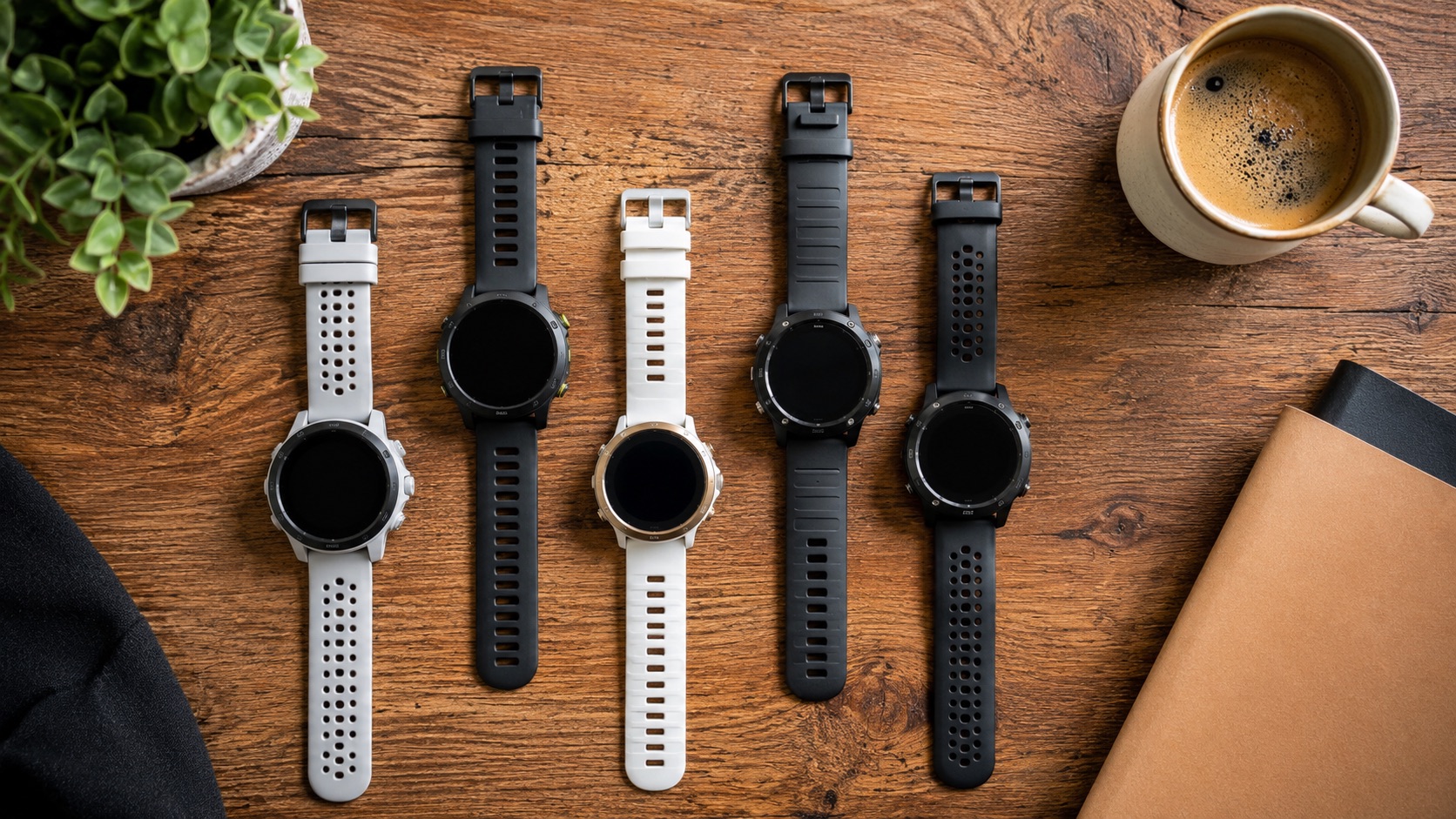
COROS Pace 4 vs Garmin Forerunner 165 - Best Budget GPS Watch?
COROS Pace 4 vs Garmin Forerunner 165 - Best Budget GPS Watch?
The COROS Pace 4 and Garmin Forerunner 165 are the two best GPS running watches under $400. They target the same runner: someone who wants serious training features without paying $450+ for a Forerunner 265 or COROS Pace Pro.
But they make very different trade-offs to hit their price points. The COROS prioritizes battery life and weight. The Garmin prioritizes software maturity and ecosystem. Understanding which trade-offs matter to you determines the right choice.
I’ve worn both watches side-by-side for two months of training - same runs, same wrist (alternating days). Here’s an honest comparison from a runner who has no brand loyalty.
COROS Pace 4 vs Garmin FR165 - Full Comparison
| Feature | COROS Pace 4 | Garmin Forerunner 165 |
|---|---|---|
| Price | $350 | $300 |
| Weight | 33g | 39g |
| Display | 1.3” AMOLED | 1.2” AMOLED |
| GPS Battery | 41 hours | 17 hours |
| Smartwatch Battery | 17 days | 11 days |
| GPS Type | Dual-frequency (all satellite) | Multi-band |
| Heart Rate Sensor | Optical | Optical (Elevate v5) |
| Music Storage | No | No |
| Offline Maps | No | No |
| Navigation | Breadcrumb + route import | Breadcrumb + route import |
| Training Plans | COROS app (free) | Garmin Coach (free) |
| Structured Workouts | Yes | Yes |
| Running Dynamics | With COROS POD 2 | With HRM-Pro Plus |
| VO2max | Yes | Yes |
| Training Load | Yes (EvoLab) | Yes (Training Status) |
| Recovery Time | Yes | Yes |
| HRV Monitoring | Yes | Yes |
| Race Predictor | Yes | Yes |
| Touch Screen | Yes + digital dial | Yes + buttons |
| Water Resistance | 5 ATM | 5 ATM |
| Phone Compatibility | iOS + Android | iOS + Android |
| NFC Payments | No | Garmin Pay |
Battery Life: COROS Wins Decisively
41 hours vs 17 hours of GPS tracking. That’s not a marginal difference - the COROS Pace 4 lasts 2.4x longer. In practical terms:
- FR165: Running 1 hour daily, you’ll charge every 2-2.5 weeks
- COROS Pace 4: Running 1 hour daily, you’ll charge every 5-6 weeks
For most daily runners, both watches go long enough between charges that it’s not a constant annoyance. But for ultrarunners, multi-day trail adventures, or people who genuinely hate plugging things in, the COROS advantage is massive.
The battery advantage also provides insurance. Forget to charge your COROS for a few days? No problem - it still has 60% left. Forget to charge your Garmin? You might find it dead on race morning.
In smartwatch mode (daily wear without GPS), the COROS lasts 17 days vs 11 days for the Garmin. Both are acceptable, but COROS requires less frequent attention to charging.
Weight: Featherlight COROS vs Slightly Heavier Garmin
At 33g, the COROS Pace 4 is among the lightest GPS watches ever made. The Garmin FR165 at 39g is also light, but the 6g difference is surprisingly noticeable - especially during speed work when you’re hyperaware of anything on your body.
The COROS achieves this by using a nylon fiber case (very tough but extremely light) and a slightly thinner profile. On the wrist, the Pace 4 genuinely disappears - you forget it’s there during runs. The FR165 is comfortable but has slightly more presence.
For most runners, 39g is plenty light and this isn’t a deciding factor. For runners who are highly weight-sensitive or who find watches distracting, the COROS wins this spec clearly.
GPS Accuracy: Both Excellent, Slight Edge to Garmin
Both watches support multi-band satellite reception. RunnersPicks does not have a retained controlled test across urban, suburban and trail environments, so the comparison below should be read as capability guidance rather than measured performance.
- Open roads and paths: Both are essentially identical - within 1% of each other and true distance
- Urban canyons: Garmin has a slight edge, likely due to more mature signal processing algorithms
- Dense tree cover: Nearly identical, both handle forest well
- Track running: Both are slightly off (typical for GPS watches on tracks), with the FR165 marginally closer to true distances
The differences are small enough that they wouldn’t change your training decisions. Both watches will accurately track your runs to within 1-2% in most conditions. If GPS accuracy is your absolute top priority, neither is wrong.
Training Features and Software
Both watches offer comprehensive training features, but they implement them differently:
Garmin’s strengths:
- Training Status algorithm is more nuanced (productive, maintaining, overreaching, detraining, etc.)
- Garmin Coach provides adaptive free training plans that adjust based on your performance
- Morning Report consolidates daily readiness information clearly
- Larger third-party integration ecosystem (Strava, TrainingPeaks, etc. all pull Garmin data seamlessly)
- More mature and refined software with fewer bugs
COROS’s strengths:
- EvoLab training metrics are clear and simple to understand
- Free structured training plans from professional coaches
- The COROS app is cleaner and less cluttered than Garmin Connect
- Firmware updates frequently add major new features at no cost
- AI Trainer feature provides workout suggestions based on your fitness and goals
For most runners, Garmin’s software ecosystem is more mature and has a larger community. If something goes wrong or you need help, there are ten Garmin forum threads for every COROS one. However, COROS is improving rapidly and their app experience is arguably simpler and less overwhelming for newer runners.
Display and Interface
Both have AMOLED displays that are bright, colorful, and easy to read outdoors. The COROS has a slightly larger screen (1.3” vs 1.2”) which gives a mild readability advantage.
Interface philosophy differs significantly:
- COROS: Digital dial (rotate to scroll) + one button + touchscreen. Elegant but requires learning the dial logic.
- Garmin: Five physical buttons + touchscreen. More buttons but immediately intuitive - each button has a clear purpose.
During runs, the Garmin’s button-only interaction (touch is disabled during activities by default) means no accidental screen touches from sweat or rain. The COROS uses its dial and button during activities, which also works well but is a different mental model.
If you’ve never owned a running watch before, neither has a steep learning curve. If you’re coming from a previous Garmin, the FR165 will feel immediately familiar. Coming from nothing, the COROS interface is arguably slightly more modern-feeling.
Music: Neither Has It
Both the COROS Pace 4 and Garmin FR165 lack onboard music storage. You cannot store Spotify playlists or MP3s on either watch. If you want to run with music and no phone, you need to step up to the Garmin Forerunner 265 ($450) or COROS Pace Pro ($400).
For runners who always carry their phone, this doesn’t matter. For those wanting phone-free music runs, it’s a shared limitation at this price point.
Payments: Garmin Only
The FR165 has Garmin Pay (NFC contactless payments). The COROS Pace 4 has no payment capability. If you like to stop for coffee mid-run or want to run without wallet/phone and still be able to buy water, Garmin wins this niche feature.
Ecosystem and Community
This is where Garmin’s decades of running watch experience show:
- Garmin Connect has millions of active users, which means robust course sharing, challenges, and community features
- Third-party app support (Connect IQ) adds watch faces, data fields, and apps
- Every running app and platform integrates with Garmin natively
- Garmin’s customer service and warranty support are well-established
COROS is growing but smaller:
- The COROS app community is active but less populated
- Third-party integrations are good (Strava, TrainingPeaks work) but not universal
- Fewer custom watch faces and add-on options
- COROS customer service is responsive but has a smaller support infrastructure
If you use niche running platforms or want maximum compatibility, Garmin’s ecosystem is safer. If you use Strava and the native app, COROS covers your needs fine.
For more budget GPS watch options including newer Chinese brands, see my budget GPS watch roundup. For a broader comparison at all price points, check the full GPS running watch guide.
Who Should Buy the COROS Pace 4
- Runners who prioritize battery life above all else
- Weight-sensitive runners who want the lightest possible watch
- Ultrarunners or trail runners needing 40+ hours of GPS
- Runners who appreciate a clean, simple app experience
- People who dislike frequent charging
- Budget-conscious runners who don’t need Garmin Pay or music
For a comparison with the next step up in COROS’s lineup and how it compares to Garmin’s mid-range, see my FR265 vs COROS Pace 4 analysis.
For a broader current-generation decision, see the Suunto Run 2 vs COROS PACE 4 vs Garmin Forerunner 170 comparison, including maps, music and ecosystem trade-offs.
Who Should Buy the Garmin Forerunner 165
- Runners who value software maturity and ecosystem size
- Garmin users upgrading from an older Forerunner
- Runners who want Garmin Coach adaptive training plans
- People who want NFC payments on their wrist
- Runners in the Garmin ecosystem (other family members use it, etc.)
- Those who prefer physical button interfaces during runs
For more on where the FR165 fits in Garmin’s lineup, see my best watches under $300.
My Verdict
The FR165 at $300 is the better value for most runners, simply because Garmin’s software ecosystem is more mature and the $50 savings adds up. The training features you interact with daily (training status, morning report, Garmin Coach) are more refined and helpful.
However, the COROS Pace 4 is the better hardware at its price point - lighter, longer battery, larger display. If battery life and weight are your top priorities, the $50 premium is justified. If you’re starting fresh with no ecosystem loyalty, the COROS offers impressive capability in an impossibly light package.
Both are excellent. You won’t regret either choice.
See how we compare products for our full research methodology.
Frequently Asked Questions
Is the COROS Pace 4 worth $50 more than the Garmin FR165?
It depends on what you value. If battery life (41h vs 17h GPS) and weight (33g vs 39g) are your priorities, yes - the COROS delivers significantly better hardware specs. If software maturity, ecosystem size, and NFC payments matter more, the Garmin FR165 at $50 less is the better deal. Neither is overpriced for what it offers.
Which watch has better heart rate accuracy?
Optical heart-rate performance varies by fit, skin contact, temperature and workout intensity. Use a chest strap when precise interval or threshold data matters; this page cannot support a universal 2–3 BPM range or a measured winner.
Can I use either watch for triathlon?
Both support multisport modes including swimming, cycling, and transitions. The COROS Pace 4 has a slight advantage for triathlon due to its longer battery (important for Ironman distances) and lighter weight. The FR165 works perfectly for sprint and Olympic distance triathlons. Neither has open-water maps or advanced cycling metrics, so serious triathletes may want to step up to the COROS Pace Pro or Garmin FR265.
Do either of these watches have maps?
The COROS Pace 4 currently supports downloaded landscape and topographic maps plus route navigation. The Garmin FR165 offers course/breadcrumb navigation without Garmin’s full onboard map layer. This is now a genuine navigation difference between the two watches.
Which watch gets better software updates?
COROS is known for aggressive free updates that add major features (they’ve added new training modes, new metrics, and UI overhauls through firmware updates). Garmin updates are more incremental and conservative, but also more stable - less risk of bugs introducing problems. Both watches will receive meaningful updates for 3-5 years after purchase.