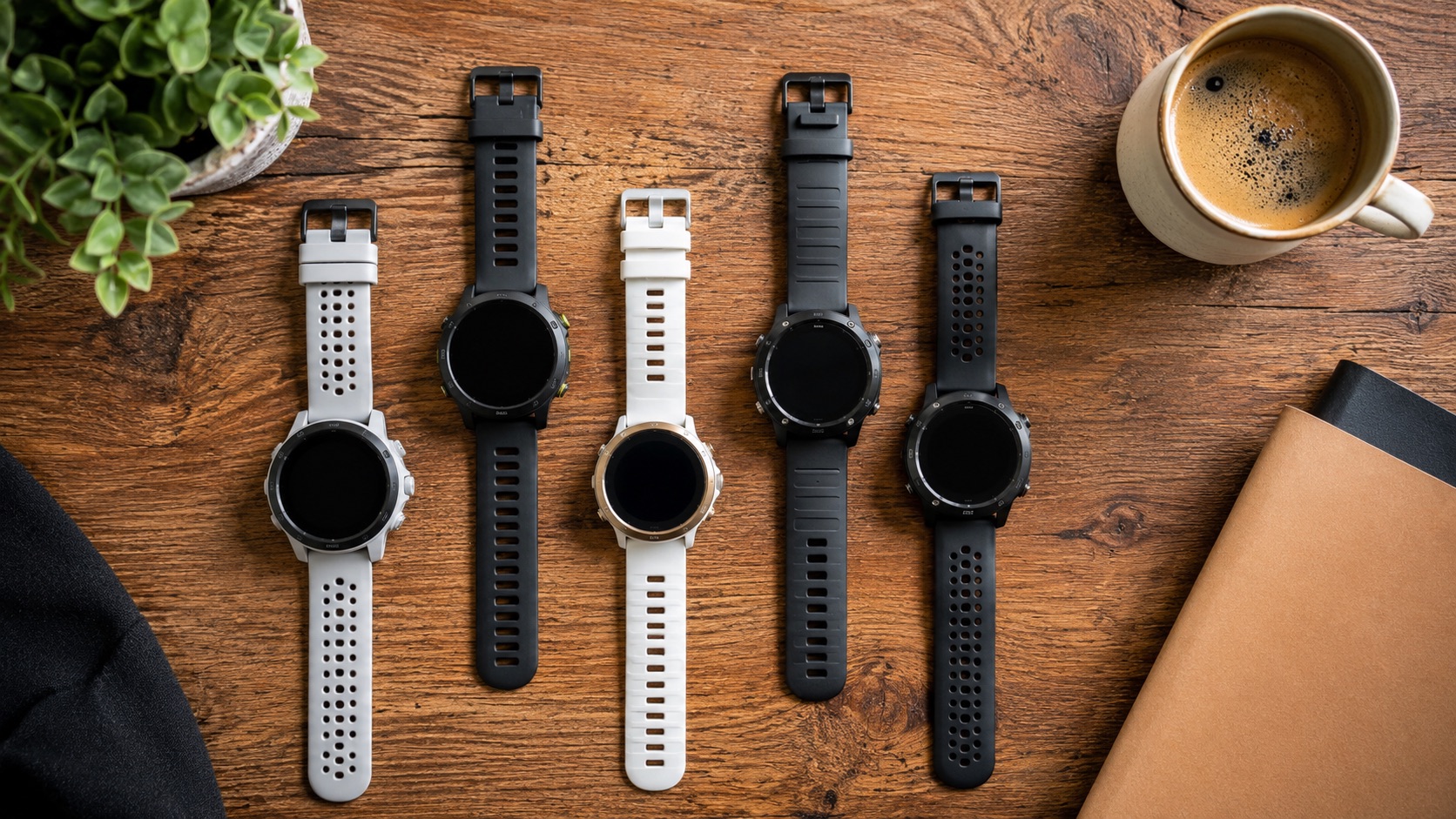
Garmin Forerunner 570 vs COROS Pace 4: Mid-Range Watch Showdown
The mid-range running watch market is where most runners actually shop. If you’re new to running watches entirely, our best Garmin watch for beginners guide is a good starting point before diving into comparisons like this one. You want serious training features without paying flagship prices. The Garmin Forerunner 570 ($399) and COROS Pace 4 ($349) both target this sweet spot, but they take very different approaches to what a running watch should be.
Garmin bets on ecosystem, training intelligence, and smartwatch features. COROS bets on battery life, simplicity, and value. Both have loyal followings, and both have legitimate strengths. Let me break down exactly what you get with each and which one makes sense for your specific running life.
August 2026 update: The PACE 4 now supports COROS Live Tracking and expanded sleep reporting. Live Tracking still requires a connected phone with the COROS app running in the background, so this closes the basic location-sharing gap without making the PACE 4 a phone-free safety device.
Spec Comparison Table
| Feature | Garmin Forerunner 570 | COROS Pace 4 |
|---|---|---|
| Price | $399 | $349 |
| Weight | 47g | 39g |
| Display | 1.3” AMOLED, 416 x 416 | 1.3” AMOLED, 416 x 416 |
| Touchscreen | Yes | Yes |
| Physical Buttons | 5 | 2 |
| GPS Type | Multi-band (dual-frequency) | Multi-band (dual-frequency) |
| GPS Battery Life | 24 hours (GPS-only) | 41 hours (All Systems High) |
| Smartwatch Battery | Up to 11 days | Up to 19 days |
| Music Storage | Yes (8GB) | Yes (8GB) |
| Offline Maps | No | No |
| Heart Rate | Elevate V5 (optical) | Optical (new sensor) |
| Training Readiness | Yes | No |
| HRV Status | Yes | Yes |
| Running Power | With accessory | Wrist-based (native) |
| Running Dynamics | With accessory | Wrist-based |
| Race Predictor | Yes | Yes |
| Training Load | Yes (7-day focus) | Yes (EVOSS) |
| Recovery Time | Yes | Yes |
| VO2 Max | Yes | Yes |
| Body Battery | Yes | No |
| Garmin Pay / NFC | Yes | No |
| Water Rating | 5 ATM | 5 ATM |
| Connectivity | Bluetooth, ANT+, WiFi | Bluetooth |
Battery Life: COROS Wins Decisively
This is the biggest difference between these two watches and the reason many runners choose COROS.
COROS rates the Pace 4 for up to 41 hours in All Systems (High) GPS mode. Garmin rates the Forerunner 570 for up to 24 hours in GPS-only mode. Those modes are not identical, but the published endurance gap still translates to practical advantages:
- Week-long training blocks: The Pace 4 can handle a full week of running (1 hour daily) without charging. The FR 570 needs a charge mid-week.
- Long runs: For runs over 3 hours, the Pace 4 uses a smaller percentage of its battery. Over a 50K or 50-mile race, this matters.
- Travel: Going away for a weekend? The Pace 4 will track all your runs and still have battery when you get home. The FR 570 might need a charge.
In daily-use mode, COROS rates the Pace 4 for up to 19 days versus Garmin’s up-to-11-day smartwatch rating for the FR 570. Actual use depends on display and activity settings.
The trade-off: The FR 570 has an AMOLED display that’s more power-hungry. COROS has managed to deliver AMOLED with better battery, which is an engineering achievement. Garmin’s battery is still good, but COROS is in a different league here.
Training Features: Garmin’s Ecosystem Advantage
This is where Garmin fights back. The Forerunner 570 includes several training features that the Pace 4 either lacks or implements differently.
Training Readiness
Garmin’s Training Readiness gives you a morning score (1 to 100) based on sleep quality, HRV, recovery status, and recent training load. It tells you whether today is a good day to push hard or back off. The FR 570 has this feature.
COROS has training load and recovery metrics, but doesn’t offer the same unified “readiness” score. You need to interpret multiple data points yourself. For runners who want a simple “go/no-go” signal, Garmin’s approach is more user-friendly.
HRV Status
Both watches track heart rate variability. Garmin presents HRV as a status (balanced, unbalanced) with trend data over weeks. COROS shows HRV data but the presentation is more raw.
For runners who use HRV to guide training decisions, both watches provide the data. Garmin just makes it easier to interpret.
Music Storage
Both watches have 8GB of music storage and support Spotify, Amazon Music, and other streaming services offline. This is a draw. You can leave your phone at home and run with music on either watch.
Running Power
COROS builds running power directly into the watch from the wrist. No accessory needed. You get power data on every run from day one.
Garmin requires an external accessory (Running Dynamics Pod or compatible chest strap) to get running power data. This adds $50 to $150 to the total cost. For a $399 watch, that stings.
If running power is important to you, COROS saves you money and hassle.
Running Dynamics
Similar story. COROS tracks cadence, stride length, ground contact time, and vertical oscillation from the wrist. Garmin requires an accessory for these metrics.
For runners who want detailed form data, COROS is more convenient and cheaper.
GPS Accuracy: Both Excellent
Both watches use multi-band GNSS (dual-frequency GPS) with support for GPS, GLONASS, Galileo, and BeiDou. In practical testing, both deliver excellent accuracy:
- Track accuracy within 1 to 2 meters on open roads
- Minimal drift in urban environments
- Consistent pace data after initial satellite lock
The COROS Pace 4 occasionally locks on a few seconds faster, but the difference is negligible. For running, both watches will give you accurate distance, pace, and route data.
Neither watch has offline maps. Both support breadcrumb navigation where you can follow a pre-loaded GPX route. For actual navigation with map context, you’d need a Garmin Forerunner 965 or Fenix 8. Our Garmin Fenix 8 review covers what you get when you step up to a map-equipped watch.
Ecosystem and Apps: Garmin’s Broader World
Garmin’s ecosystem is significantly larger than COROS’s. This matters in several ways:
Connect IQ Store: Garmin’s app store has hundreds of watch faces, data fields, and apps. You can customize the FR 570 extensively. COROS has a growing app ecosystem but it’s much smaller.
Third-party integrations: Garmin connects to more platforms (Strava, TrainingPeaks, Final Surge, Komoot, and many more) with deeper integration. COROS connects to the major platforms but the integration is sometimes more basic.
Garmin Pay: The FR 570 supports contactless payments through Garmin Pay. COROS doesn’t have NFC payments. If you want to buy a coffee mid-run without your phone, Garmin wins.
WiFi: The FR 570 has WiFi for faster data sync. COROS relies on Bluetooth only. For runners who want their data uploaded immediately after a run, WiFi is convenient.
The flip side: COROS’s simpler ecosystem means the watch is easier to set up and use. Less configuration, fewer settings to tweak, more “just run.” Some runners prefer this simplicity. Our Polar vs Garmin for runners comparison explores another alternative if you’re shopping beyond these two brands.
Price and Value: COROS Takes It
At $349, the COROS Pace 4 is $50 cheaper than the Garmin Forerunner 570 at $399. But the value gap is bigger than $50:
- COROS includes wrist-based running power (Garmin requires a $50+ accessory)
- COROS includes running dynamics from the wrist (Garmin requires an accessory)
- COROS has significantly better battery life
- COROS is lighter (39g vs 47g)
If you add the cost of a running dynamics pod to the FR 570, you’re looking at $450+ vs $349 for the Pace 4. That’s a $100+ difference for watches that track the same core running data. See our Forerunner series pricing guide for the full cost picture across Garmin’s lineup.
Who Should Buy the Garmin Forerunner 570?
The FR 570 is the right choice if:
- You value the Garmin ecosystem. If you already use Garmin Connect, have other Garmin devices, or want the broadest app and watch face selection, staying in the ecosystem makes sense.
- You want Training Readiness and unified training guidance. Garmin’s morning readiness score is genuinely useful for runners who want simple go/no-go training signals.
- Garmin Pay matters. Contactless payments from the watch is a convenience feature that COROS doesn’t offer.
- You don’t mind buying accessories. If you were going to use a chest strap anyway (for heart rate accuracy), the accessory requirement for running dynamics is less of a penalty.
Who Should Buy the COROS Pace 4?
The Pace 4 is the better choice if:
- Battery life is a priority. COROS publishes 41 hours in All Systems (High) GPS mode versus Garmin’s 24 hours in GPS-only mode. The modes are not identical, but the endurance difference affects charging routines.
- You want running power and dynamics without accessories. COROS gives you everything from the wrist, saving you money and hassle.
- Value matters. At $349 with more features included, the Pace 4 offers better bang for your buck.
- You prefer simplicity. COROS’s simpler interface means less time configuring and more time running.
- You’re brand-agnostic. If you don’t have an existing ecosystem investment, COROS’s value proposition is compelling.
The Honest Verdict
Both are excellent mid-range running watches. The Garmin FR 570 has a better ecosystem, more polished training guidance, and Garmin Pay. The COROS Pace 4 has better battery life, includes more features out of the box, and costs less.
For most runners who just want to track their runs, follow a training plan, and see their progress, the COROS Pace 4 is the better value. The battery life advantage alone changes your daily experience with the watch. Check out Reddit’s favorite running watches to see what the community thinks.
For runners who are already in the Garmin ecosystem or who value the unified training readiness guidance, the FR 570 is worth the premium. The ecosystem and software experience are genuinely more polished.
For more on the mid-range market, see our Garmin Forerunner 170 vs 265 comparison and our COROS vs Garmin 2026 comparison.
Related reading: Garmin Forerunner 265 vs COROS Pace 4 | Garmin Forerunner 265 vs 965
FAQ
Does the COROS Pace 4 have maps like the Garmin FR 570?
Neither watch has full offline maps. Both support breadcrumb navigation where you can follow a pre-loaded GPX route. For actual map-based navigation, you’d need to step up to the Garmin Forerunner 965 or Fenix 8.
Can I use the COROS Pace 4 with Strava and TrainingPeaks?
Yes. The COROS Pace 4 syncs automatically with Strava, TrainingPeaks, and most other major fitness platforms. The integration is seamless, and your workouts will appear on these platforms just like they would with a Garmin watch.
Is the Garmin FR 570 worth $50 more than the COROS Pace 4?
It depends on what you value. If you want the Garmin ecosystem, Training Readiness, and Garmin Pay, the $50 premium is justified. If you prioritize battery life, wrist-based running power, and value, the COROS Pace 4 at $349 is the better deal. The total cost of ownership with COROS is lower because you don’t need to buy accessories for running dynamics.
Which watch is better for marathon training specifically?
Both are excellent for marathon training. The COROS Pace 4’s longer battery life is better for high-mileage weeks and long runs. The Garmin FR 570’s Training Readiness feature helps you manage training load across a marathon build. If you follow a structured plan from TrainingPeaks, both integrate well. The choice comes down to battery life vs training guidance.
Can I track heart rate swimming with these watches?
Both watches track heart rate during pool swimming, but optical wrist-based HR is less accurate in water than on land. For the most accurate swimming heart rate, a chest strap (like the Polar H10) is better, though not all chest straps work well in water. Both watches track pool distance, strokes, and SWOLF score accurately.