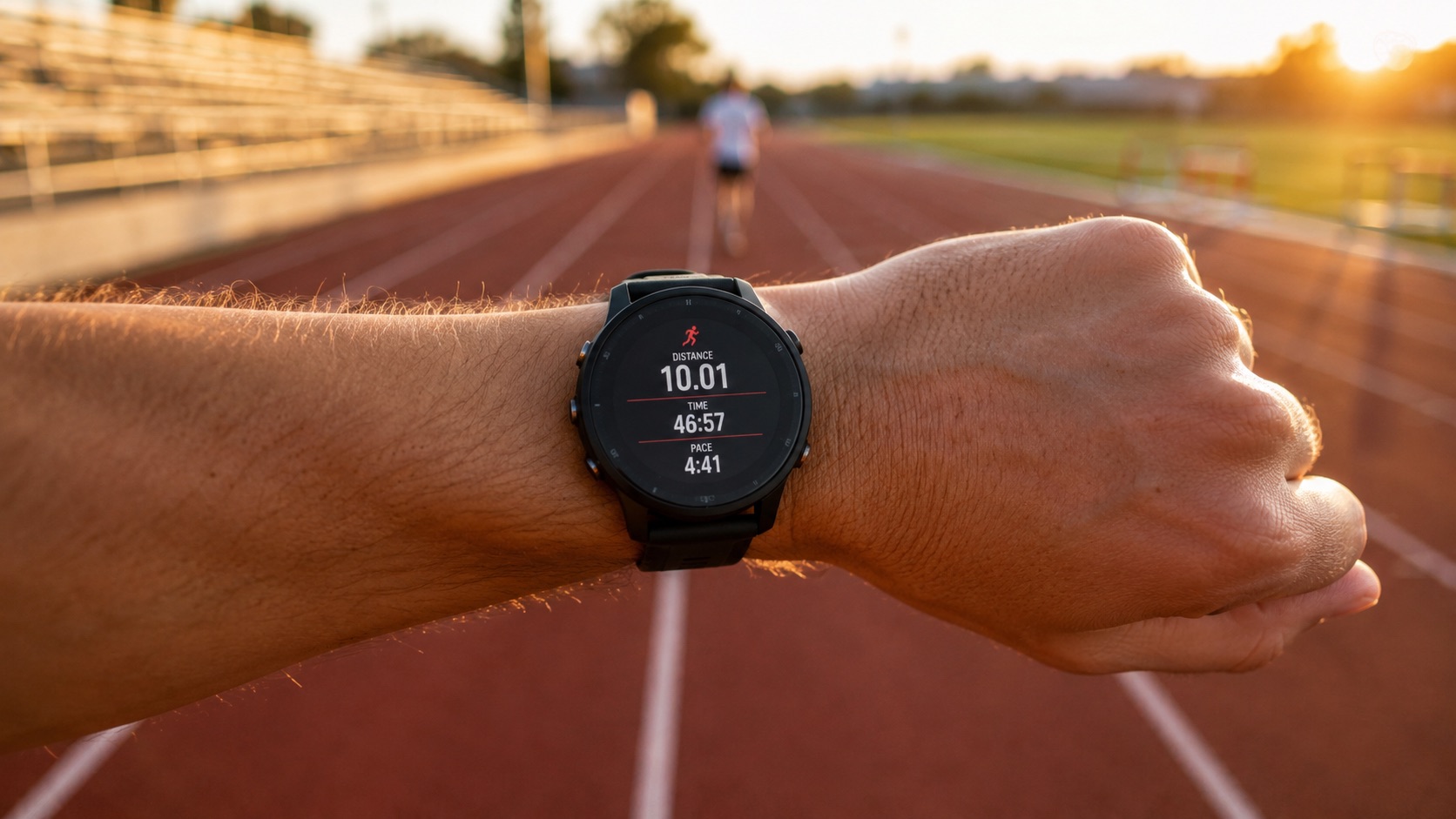
Polar Pacer Pro vs COROS Pace 4: Mid-Range Watch Showdown
If you’ve already ruled out Garmin and you’re deciding between Polar and COROS, this comparison is for you. The Polar Pacer Pro ($300) and COROS Pace 4 ($349) are both mid-range running watches aimed at serious runners who want training features without the Garmin price tag.
Both brands have loyal followings. Polar has decades of heart rate monitoring heritage. COROS has disrupted the market with exceptional battery life and value. Let me break down which one actually delivers better performance for your money.
Spec Comparison Table
| Feature | Polar Pacer Pro | COROS Pace 4 |
|---|---|---|
| Price | $300 | $349 |
| Weight | 41g | 39g |
| Display | 1.2” MIP, 240 x 240 | 1.3” AMOLED, 416 x 416 |
| Touchscreen | No | Yes |
| Physical Buttons | 5 | 2 |
| GPS Type | Multi-band (dual-frequency) | Multi-band (dual-frequency) |
| GPS Battery Life | 35 hours | 41 hours (All Systems High) |
| Smartwatch Battery | Up to 7 days | Up to 19 days |
| Music Storage | No | Yes (8GB) |
| Offline Maps | No | No |
| Heart Rate | Polar Precision Prime | Optical (new sensor) |
| Running Power | Wrist-based (native) | Wrist-based (native) |
| Running Dynamics | Running Index (wrist-based) | Wrist-based |
| Training Load | Training Load Pro + Orthostatic Test | EVOSS Training Load |
| Recovery Time | Yes | Yes |
| VO2 Max | Yes | Yes |
| HRV Status | Yes | Yes |
| NFC Payments | No | No |
| Water Rating | 5 ATM | 5 ATM |
Display: Night and Day Difference
This is the most obvious visual difference between these two watches.
Polar Pacer Pro: MIP Display
The Pacer Pro uses a 1.2-inch MIP (memory-in-pixel) display at 240x240 resolution. It’s perfectly functional for running: readable in direct sunlight, always-on, and power-efficient. But it looks dated compared to modern AMOLED screens.
The colors are muted, the resolution is noticeably lower, and it doesn’t have that modern smartwatch feel. For actual running use, the MIP display works fine. You can read your data at a glance during runs. But for daily wear and interacting with the watch, it feels like technology from 5 years ago.
COROS Pace 4: AMOLED Display
The Pace 4 has a 1.3-inch AMOLED display at 416x416 resolution. It’s bright, colorful, and genuinely pleasant to look at. The touchscreen makes navigation intuitive, and the always-on display is easy to read in all conditions.
The AMOLED does consume more battery than the MIP display, but COROS has managed this well. The Pace 4 still delivers excellent battery life despite the more power-hungry screen. If display quality is a priority, the Garmin Venu 4 also offers an AMOLED screen worth considering.
Verdict: The COROS Pace 4 wins this round decisively. The AMOLED display is a significant upgrade in daily use.
Battery Life: COROS Wins, But It’s Close
Both watches deliver excellent battery life, but the COROS Pace 4 edges ahead.
COROS Pace 4: 41 hours in All Systems (High) GPS mode, 19 days daily use Polar Pacer Pro: 35 hours GPS, 7 days smartwatch
The manufacturers publish different mode definitions, so the headline GPS figures are not a controlled like-for-like test. COROS rates Pace 4 for 41 hours in All Systems (High) mode and 19 days of daily use; compare Polar’s exact mode and settings before calculating a gap.
For runners who wear their watch 24/7 for sleep tracking and daily activity monitoring, the Pace 4’s longer smartwatch battery means less frequent charging. For runners who primarily use their watch for running and charge it regularly, the difference is less important.
Verdict: COROS wins on battery, but both are excellent.
Running Features: Both Excellent
Both watches are packed with running features. Here’s how they compare:
Running Power
Both watches offer wrist-based running power. No accessories needed. You get power data on every run from day one. This is a draw.
Polar has been doing running power longer and their algorithm is well-regarded. COROS’s implementation is newer but works well. Both provide useful power data for training and racing.
Training Load and Recovery
Both watches track training load and provide recovery recommendations. (If you’re new to these features, our best Garmin watch for beginners guide explains what to look for.) The approaches differ:
Polar: Training Load Pro separates cardio load from muscular load, giving you a more detailed picture of your training stress. The Orthostatic Test (available on the Pacer Pro) measures your heart’s response to position changes, providing insight into fatigue and readiness.
COROS: EVOSS Training Load provides a unified training load score with breakdowns by workout type. The recovery recommendations are straightforward and easy to interpret.
Polar’s approach is more detailed and scientific. COROS’s approach is simpler and more actionable. Which is better depends on how deep you want to go with your training data.
GPS Accuracy
Both watches use multi-band GPS (dual-frequency) with support for GPS, GLONASS, Galileo, and BeiDou. In practical testing, both deliver excellent accuracy:
- Track accuracy within 1 to 2 meters on open roads
- Minimal drift in urban environments
- Consistent pace data after initial satellite lock
The difference between these two is negligible. Both are accurate enough for serious training and racing. For a broader look at GPS watch accuracy across brands, see our best GPS running watches 2026 roundup.
Ecosystem and Apps
Polar: Scientific and Detailed
Polar’s ecosystem is built around their heart rate monitoring heritage. Polar Flow (the web and app platform) provides detailed training analysis, recovery tracking, and training plans. The data presentation is more scientific and detailed than COROS’s.
Polar also offers the Polar Running Index, which combines multiple metrics into a single score that tracks your running fitness over time. This is a unique feature that COROS doesn’t replicate.
The downside: Polar’s ecosystem is more complex and less intuitive than COROS’s. New users might find the data overwhelming.
COROS: Simple and Effective
COROS’s ecosystem is simpler and more user-friendly. The COROS app presents data clearly and makes it easy to understand your training load, recovery, and progress. The interface is modern and intuitive.
COROS also offers the EVOIX lab, which provides advanced training analysis for runners who want to go deeper. But the base experience is designed for simplicity.
The downside: COROS’s ecosystem is less detailed than Polar’s. Runners who want deep scientific analysis might find it too simplified.
Price and Value
At $300, the Polar Pacer Pro is $49 cheaper than the COROS Pace 4 at $349. But the value calculation is more complex than the price difference suggests.
COROS Pace 4 includes:
- AMOLED display
- Music storage (8GB)
- Wrist-based running power
- 14-day smartwatch battery
- Touchscreen
Polar Pacer Pro includes:
- MIP display
- No music storage
- Wrist-based running power
- 7-day smartwatch battery
- No touchscreen
For $49 more, the COROS Pace 4 gives you a significantly better display, music storage, and longer battery life. The Polar Pacer Pro’s main advantages are its more detailed training analytics and the Orthostatic Test.
Verdict: The COROS Pace 4 offers better value for most runners. The $49 premium buys you meaningful feature upgrades.
Who Should Buy the Polar Pacer Pro?
The Pacer Pro is the right choice if:
- You want detailed, scientific training data. Polar’s Training Load Pro and Orthostatic Test provide more granular data than COROS’s simpler approach.
- You prefer physical buttons. The Pacer Pro has 5 buttons and no touchscreen. Some runners prefer this for reliability during sweaty or rainy runs. The Garmin Forerunner 170 vs 265 comparison also covers the button vs touchscreen tradeoff.
- Budget matters. At $300, the Pacer Pro is cheaper than the Pace 4.
- You value Polar’s heritage. Polar has decades of experience in heart rate monitoring and training analytics.
Who Should Buy the COROS Pace 4?
The Pace 4 is the better choice if:
- You want the best display. The AMOLED screen is a significant upgrade over the Pacer Pro’s MIP display.
- Music storage matters. The Pace 4 has 8GB of storage for offline music. The Pacer Pro has none.
- Battery life is a priority. COROS publishes up to 19 days of daily use for the Pace 4, versus Polar’s stated figure for the Pacer Pro under its own conditions.
- You prefer simplicity. COROS’s ecosystem is more user-friendly than Polar’s.
- You want the best value. The $49 premium buys you meaningful feature upgrades.
The Verdict
The COROS Pace 4 is the better overall watch. The AMOLED display, music storage, and longer battery life make it a more capable and enjoyable watch to use daily. The $49 premium over the Polar Pacer Pro is justified by the feature upgrades.
The Polar Pacer Pro is the better choice for runners who prioritize detailed training analytics and prefer physical buttons over a touchscreen. If Polar’s scientific approach to training data appeals to you, the Pacer Pro is a solid watch at a lower price.
For most runners, the COROS Pace 4 is the better investment. The display and battery improvements alone change the daily experience with the watch. Check out what Reddit users recommend for running watches if you want community opinions before deciding.
For more watch comparisons, see our Garmin vs COROS 2026 comparison and our Polar vs Garmin for Runners article.
Related reading: Garmin Forerunner 570 vs COROS Pace 4 | Garmin Forerunner 265 vs COROS Pace 4
FAQ
Does the Polar Pacer Pro have music storage?
No. The Polar Pacer Pro does not have music storage. If you want to run with music from your watch, you need the COROS Pace 4 or a Garmin watch. The Pacer Pro can control music playback on your phone, but it can’t store music itself.
Which watch has better GPS accuracy, Polar or COROS?
Both watches use multi-band GPS and deliver similar accuracy. In practical testing, both track within 1 to 2 meters on open roads with minimal drift in urban environments. The difference is negligible for running.
Can I use the Polar Pacer Pro for triathlon?
Yes. The Polar Pacer Pro supports multisport mode for triathlon, and it tracks swimming, cycling, and running with automatic transitions. The COROS Pace 4 also supports triathlon mode. Both are capable triathlon watches at this price point.
Which watch is better for sleep tracking?
The COROS Pace 4 is better for sleep tracking due to its longer battery life. You can wear it for 10+ days without charging, which means consistent sleep tracking. The Polar Pacer Pro’s 7-day battery means you need to charge more frequently, which can interrupt sleep tracking.
Do I need a chest strap with either watch?
Neither watch requires a chest strap. Both offer wrist-based heart rate monitoring and running power. For the most accurate heart rate data during interval training, a chest strap (like the Polar H10) will be more reliable. But for most training, the wrist-based sensors are adequate.