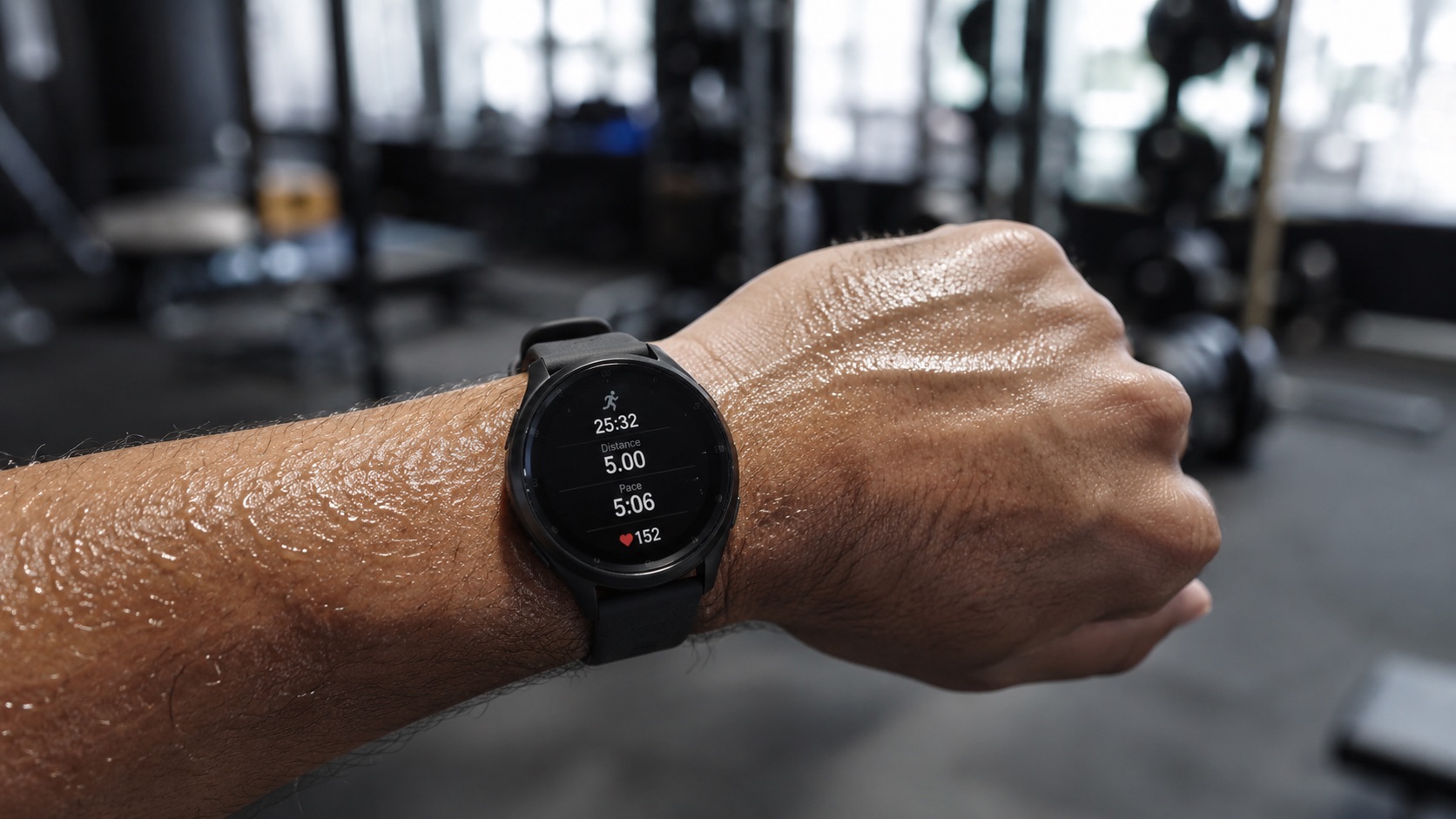
Garmin Forerunner 265 vs Fenix 8: Which Do You Actually Need?
The Garmin Forerunner 265 and Fenix 8 are both excellent GPS watches. One costs $450 and weighs 47 grams. The other starts at $799 and weighs 96 grams. That’s a $350 gap and double the weight on your wrist. The question isn’t which one is better. The question is which one you actually need, and whether the Fenix 8 justifies costing nearly twice as much.
I’ve spent serious time with both. Here’s what matters and what doesn’t.
Quick Specs
| Feature | Forerunner 265 | Fenix 8 |
|---|---|---|
| Price | $450 | $799+ |
| Weight | 47g (case only) | 96g (case only) |
| Case Size | 46mm / 42mm (265S) | 47mm / 42mm / 51mm |
| Display | 1.3” AMOLED, 416x416 | 1.4” AMOLED, 454x454 |
| GPS Battery | 20 hours (all-systems) | 48 hours (all-systems) |
| Smartwatch Battery | 13 days | 16 days |
| Maps | No onboard maps | Full topo + golf maps |
| Build | Fiber-reinforced polymer | Titanium or steel bezel, sapphire lens |
| Water Rating | 5 ATM | 10 ATM |
| Storage | 8GB | 32GB |
| Music | Yes | Yes |
| Touchscreen | Yes | Yes + buttons |
| Best For | Running, training | Adventure, multisport, ultrarunning |
That spec table tells you most of the story. The Fenix 8 is bigger, tougher, lasts longer, and has maps. The Forerunner 265 is lighter, cheaper, and does 90% of what a runner needs. The rest is context.
Build Quality and Durability
The Forerunner 265 has a fiber-reinforced polymer case with a Corning Gorilla Glass 3 lens. It’s fine. I’ve knocked mine against doorframes, trail branches, and one particularly aggressive shopping cart, and it still looks clean. The polymer case keeps the weight down to 47 grams, which is genuinely light for a watch this capable. You forget you’re wearing it during runs, and that matters more than most people realize.
The Fenix 8 is a different animal. You can get it with a titanium or stainless steel bezel and a sapphire crystal lens. Sapphire is dramatically harder than Gorilla Glass. It resists scratches that would mark up the 265 within weeks. The titanium bezel version shaves weight compared to steel, but you’re still looking at 96 grams on your wrist. That’s double the Forerunner 265.
Here’s my honest take: if you’re a road runner or even a casual trail runner, the 265’s build is perfectly adequate. If you’re scrambling over rocks, doing obstacle course races, or you’re the kind of person who beats up gear, the Fenix 8’s construction earns its keep. The 10 ATM water rating (vs 5 ATM on the 265) also matters if you’re into open water swimming or want to wear it for diving.
But for running? The 265’s build is not a weakness. It’s a deliberate choice to keep the watch light and affordable.
The Weight Question
This deserves its own section because it’s the single biggest daily difference between these watches.
47 grams vs 96 grams. You feel that on every single run. The Forerunner 265 sits on your wrist and you stop noticing it within a minute. The Fenix 8 is always there. It’s not uncomfortable, but it’s present. On long runs past the 90-minute mark, that extra weight becomes more noticeable, especially if you’re also carrying a hydration vest and the cumulative weight adds up.
Some runners don’t care. Some runners actually prefer the heavier feel because it feels like a “real watch.” That’s valid. But if you’ve ever complained about heavy gear on long runs, the Fenix 8’s weight is a legitimate consideration. It’s not a dealbreaker, but it’s real.
For perspective, the Forerunner 265 weighs about the same as a standard Casio. The Fenix 8 weighs about the same as a chunky automatic diver’s watch. If you’ve worn both types, you know the difference.
GPS Accuracy
Both watches use Garmin’s multi-band GNSS technology, which taps into GPS, GLONASS, Galileo, and other satellite systems simultaneously. In practice, accuracy is very similar between the two.
I tested them side by side on road runs, trail runs, and under tree cover. The Fenix 8 has a slight edge in dense tree canopy and around tall buildings, likely due to its larger antenna and newer chipset. But we’re talking about differences of 1-2% in total distance over a 10-mile run. For recreational runners, this is noise. You won’t notice it in your training data.
If GPS accuracy is your main concern, both watches are excellent. Neither will leave you wondering where you actually ran. The Forerunner 265 was already one of the most accurate GPS watches in its class when it launched, and the Fenix 8 is marginally better. Not enough to justify $350 more.
If you’re coming from an older Garmin and want a deeper dive into how the 265 compares to its predecessor line, our Garmin Forerunner 170 vs 265 comparison covers that upgrade path.
Maps and Navigation
This is the biggest functional difference.
The Fenix 8 has full onboard topo maps, trail maps, and even golf course maps. You can see a map on your wrist while you run, follow breadcrumb trails with actual geographic context, and search for points of interest directly from the watch. For trail runners, hikers, and adventure racers, this is transformative. Getting lost on an unfamiliar trail at mile 18 of an ultra is a problem that maps solve.
The Forerunner 265 has no onboard maps. It has breadcrumb navigation, which means you can follow a GPX route and see a line on a blank screen telling you where to go. It works. It’s functional. But it’s not the same as having a real map. You can’t see the trail network around you. You can’t zoom out and figure out an alternate route when the trail is washed out. You’re following a line.
If you run the same routes most of the time, maps don’t matter at all. You know where you’re going. If you travel and run in new cities, or if you trail run in areas with complex trail networks, maps are genuinely useful. Not essential, but useful.
My take: most runners don’t need maps. Trail runners who explore new routes regularly do. Ultrarunners who sign up for races on unfamiliar courses definitely do. It’s a feature that’s either irrelevant or very important, with little middle ground.
Battery Life
The numbers tell the story:
- Forerunner 265: 20 hours in all-systems GPS mode, 13 days in smartwatch mode
- Fenix 8: 48 hours in all-systems GPS mode, 16 days in smartwatch mode
The Fenix 8 lasts more than twice as long in GPS mode. For most runners, the 265’s 20 hours is plenty. A typical marathon takes 3-5 hours. Even a long training week of 8-10 hours of running still leaves battery to spare with daily charging.
But if you run ultras, the math changes fast. A 50-mile race can take 10-15 hours. A 100-miler takes 20-30+ hours. The Forerunner 265 will die before you finish. The Fenix 8 won’t. That’s not an opinion. That’s arithmetic.
Even for non-ultrarunners, the Fenix 8’s battery means you charge it once a week or less. The 265 needs charging every 4-5 days if you’re running regularly. Not a big deal, but the Fenix 8 is genuinely more convenient.
If you’re curious how the 265 stacks up against Garmin’s higher-end Forerunner, our Forerunner 265 vs 965 worth the upgrade? article covers that comparison in detail.
Training Features
Both watches have Garmin’s full suite of training tools: Training Readiness, Training Status, Training Load, HRV Status, race predictor, recovery time advisor, and suggested workouts. The core running experience is nearly identical.
The Fenix 8 adds some extras that matter to multisport athletes: dedicated profiles for climbing, skiing, surfing, and tactical activities. It has a built-in flashlight (which is surprisingly useful on early morning runs). It supports Dive mode. It has more granular settings for adventure sports.
But for running specifically? The training features are the same. You get the same VO2 max estimate, the same race time predictions, the same daily suggested workouts. The Forerunner 265 is a runner’s watch, and it does that job extremely well. The Fenix 8 is an everything watch that also runs extremely well.
Our Garmin Fenix 8 review for runners goes deep on the Fenix 8’s running-specific performance if you want the full picture.
Heart Rate Accuracy
Both use Garmin’s Elevate v5 optical heart rate sensor. Accuracy is good for steady-state running. It tracks with chest straps within 2-3 BPM during easy runs and tempo efforts. During intervals, there’s a slight lag (3-5 seconds) compared to a chest strap, which is normal for wrist-based optical sensors.
Neither watch has an obvious advantage here. They use the same sensor. If you need precise heart rate data for structured intervals, pair either watch with a chest strap. For everything else, the wrist-based sensor is fine.
The $350 Question
Let’s talk about what you’re actually paying for with that price gap.
The Fenix 8 at $799+ gives you:
- A tougher build (titanium/sapphire)
- Double the battery in GPS mode (48 vs 20 hours)
- Onboard maps
- 10 ATM water resistance
- A flashlight
- 32GB storage vs 8GB
- Multisport profiles for non-running activities
The Forerunner 265 at $450 gives you:
- The same GPS accuracy
- The same heart rate sensor
- The same training features
- Half the weight
- A bright AMOLED display
- Everything a runner needs
If you’re purely a runner who does road races, some trail running, and maybe a triathlon here and there, the Forerunner 265 is the smarter buy. You’re saving $350 and getting a lighter watch that does the same running-specific job.
If you’re an adventurer who runs, bikes, swims, hikes, climbs, and wants one watch for everything, the Fenix 8 makes sense. The maps, battery, and build quality justify the price for that use case.
If you’re a new runner trying to figure out which Garmin to start with, our best Garmin watch for beginners guide might be worth reading before you commit to either.
Who Should Buy the Forerunner 265
- Road runners who want accurate GPS and great training metrics
- Recreational runners training for 5Ks through marathons
- Runners who prioritize a lightweight watch
- Anyone who doesn’t need maps or multisport features
- Budget-conscious runners who’d rather spend the $350 difference on race entries and shoes
Who Should Buy the Fenix 8
- Ultrarunners who need 20+ hours of GPS battery
- Trail runners who explore unfamiliar routes and need maps
- Multisport athletes who also ski, climb, dive, or adventure race
- Runners who want the toughest build available
- People who hate charging their watch
Verdict
For most runners, the Forerunner 265 is the right answer. It’s $350 cheaper, weighs half as much, and does everything a runner needs. The GPS is excellent, the training features are comprehensive, and the AMOLED display is bright and easy to read mid-run.
The Fenix 8 is the better watch in absolute terms. It’s tougher, lasts longer, has maps, and handles more activities. But “better” doesn’t mean “worth it” for everyone. If you’re not using the maps, not running ultras, and not doing multisport, you’re paying a premium for features that sit unused.
Buy the Forerunner 265 and put the $350 toward a good pair of carbon racers. You’ll get more out of that than sapphire glass and topo maps you never open.
FAQ
Can the Forerunner 265 track ultras?
Technically yes, but the 20-hour GPS battery means it won’t last through a 100-miler or even a slow 50-miler. For ultras under 20 hours, it works. Beyond that, the Fenix 8 or the Forerunner 965 (which shares the 265’s platform with better battery) are better choices.
Does the Fenix 8 have the same running features as the Forerunner 265?
Yes. Both watches have identical training metrics, race predictors, suggested workouts, recovery advisor, and HRV tracking. The running experience is the same. The Fenix 8 adds multisport and adventure features on top.
Is the Forerunner 265 screen as good as the Fenix 8?
Both use AMOLED displays with similar brightness and clarity. The Fenix 8’s screen is slightly larger (1.4” vs 1.3”) and higher resolution (454x454 vs 416x416), but in daily use you won’t notice a meaningful difference. Both are excellent.
Can I use the Forerunner 265 for swimming?
Yes. The 5 ATM water rating means it handles pool swimming and surface water activities without issues. The Fenix 8’s 10 ATM rating is better for open water swimming and diving, but for pool laps, the 265 is fine.
Is the Fenix 8 worth $350 more than the Forerunner 265?
Only if you need the battery life, maps, or multisport features. For pure running, the Forerunner 265 gives you 90% of the experience at 56% of the price. The Fenix 8 is worth the premium for ultrarunners, trail explorers, and multisport athletes. For everyone else, the 265 is the better value.
Related Reading
- Garmin Forerunner 265 One Year Later
- Reddit’s Real Talk on Garmin vs COROS Battery Life