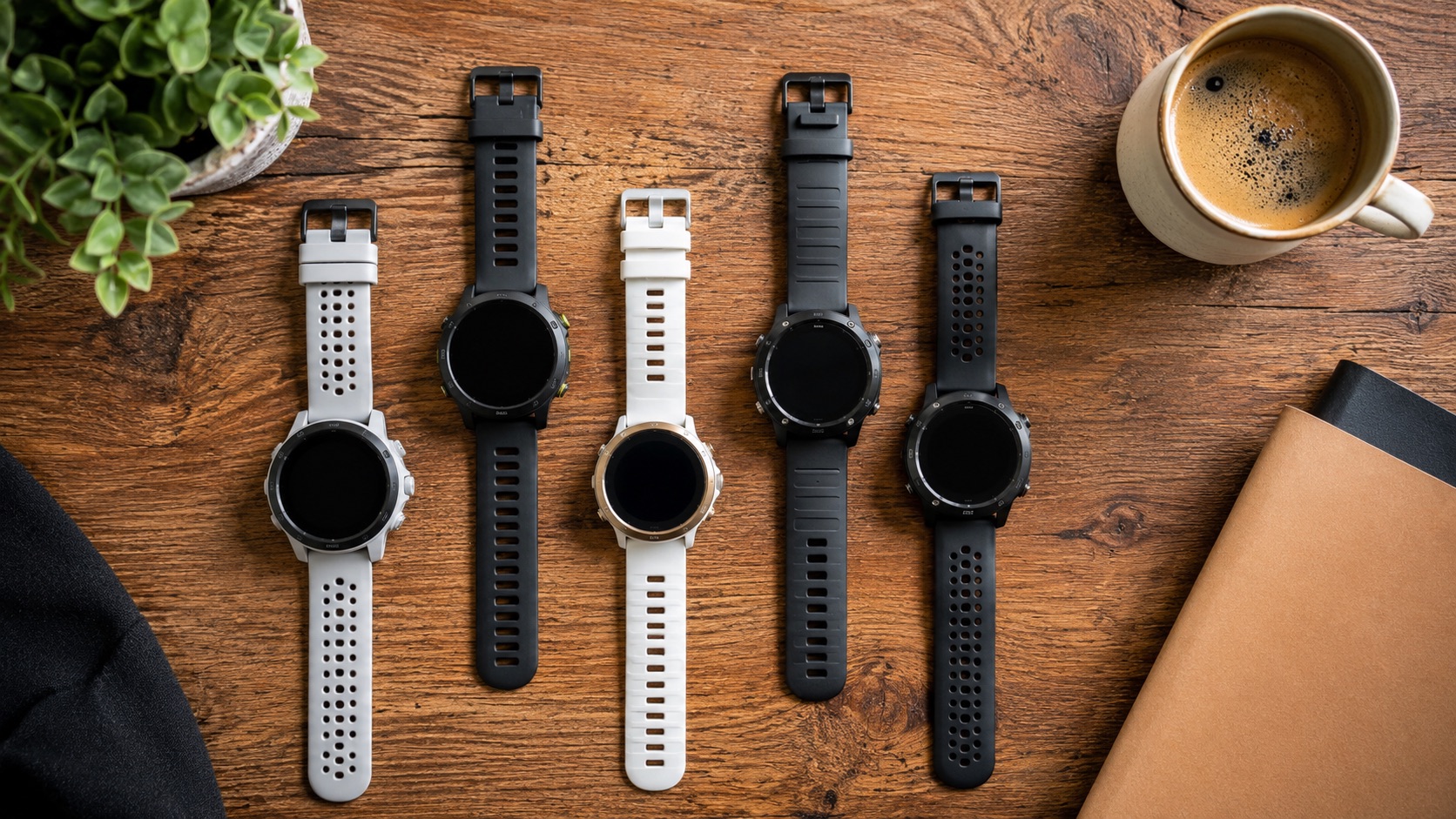
Garmin Forerunner 265 One Year Later: Still Worth It?
I bought the Garmin Forerunner 265 about a year ago and I’ve worn it every single day since. Not just for running. Grocery store, sleeping, working, swimming with the kids. Every day. That means I can actually tell you what holds up, what I stopped caring about after two weeks, and whether this watch is still worth $450 in 2026.
This is not an unboxing review. This is what happens after 365 days of real life with a GPS watch on your wrist.
The Battery After One Year
Let’s start with the number everyone worries about. Battery degradation.
When the FR265 was new, I got roughly 13 days in smartwatch mode with 24/7 heart rate, HRV during sleep, and about 4 GPS activities per week. Each run was 40 to 75 minutes, usually on multi-band GPS.
Right now, a year later, I’m getting about 11 to 12 days between charges under the same usage. That’s maybe a 10% drop, which tracks with what I’d expect from lithium-ion battery chemistry. It’s not alarming. I charge it once a week on Sunday morning while I drink coffee and it never drops below 30%.
During GPS activities specifically, I used to get around 14 hours on multi-band. Now I’m seeing closer to 12.5 to 13 hours. Still way more than I need for any training run or even a full marathon.
If you’re worried about battery life being a dealbreaker after a year, don’t be. This thing still lasts way longer than my old Venu SQ ever did even when it was brand new.
Physical Condition: Buttons, Screen, Strap
The screen is still in great shape. The Corning Gorilla Glass 3 has held up well. I have one tiny scratch near the 2 o’clock position that I can only see if I angle it under a bright light. For 365 days of daily wear including trail runs, playground duty, and general clumsiness, that’s solid. The AMOLED display itself hasn’t faded or developed any burn-in. Colors look the same as day one.
The buttons are where I notice age. The start/stop button on the upper right has developed a slightly mushier feel compared to the crisp click it had when new. It still works perfectly, no missed presses, but the tactile feedback is softer. The other four buttons feel pretty much the same. I’ve seen other runners report similar button wear on the FR265, so I think it’s a known thing rather than a defect with my unit.
The silicone strap is holding up but showing its age. There’s a slight discoloration where the buckle sits most days, and the strap hole I use has stretched maybe half a millimeter. The strap still works fine. I could replace it for about $15 but I haven’t bothered yet.
The heart rate sensor on the back looks clean and undamaged. No peeling, no cracks, no weird discoloration from sweat and sunscreen. That’s important because a degraded sensor makes the whole watch less useful.
Overall build quality: 8 out of 10 after one year. Not tank-level like a Fenix, but for a $450 running watch, it’s held up well.
Features I Actually Use (And Why)
After a year, my feature usage has settled into a clear pattern. Here’s what I rely on daily and weekly.
Training Readiness
This is the single most valuable feature on the watch for me. Training Readiness combines sleep quality, HRV, recovery time, and recent training load into one score that tells me how hard I should train today. I check it every morning before I decide what my run looks like.
When my Training Readiness is above 80, I know I can hit intervals or tempo work hard. Below 50? I’m doing an easy run or taking the day off. It’s not perfect. Sometimes it tells me I’m ready when my legs feel heavy, or it says I need recovery when I feel great. But about 8 out of 10 times, it matches how I actually feel during the run. That’s good enough to be genuinely useful.
For runners who want to understand the full ecosystem around this, I wrote about Garmin Body Battery and how it feeds into recovery tracking.
HRV Tracking
I didn’t think I’d care about heart rate variability when I bought the watch. Now it’s one of the first things I look at in the morning. Watching my 7-day HRV average trend upward over months gives me confidence that my training is working. When I overdid it in March (tried to add 20% weekly volume in two weeks), my HRV tanked before my legs caught up. Early warning system.
The overnight HRV measurement on the FR265 has been consistent. I’ve compared it against a chest strap a few times and the readings are close enough to trust for trend tracking. You don’t need clinical precision for this metric. You need consistency, and the FR265 delivers that.
Music
I run with music about 60% of the time. Having Spotify offline playlists on the watch means I leave my phone at home for easy runs. Pair it with my Shokz OpenRun headphones and I’m set. Loading playlists is slow (the Bluetooth transfer takes forever), but once they’re on the watch, playback is flawless. I’ve never had it skip or crash mid-run.
This feature alone is worth the price difference over the FR165 for me. Running phone-free is liberating.
Race Predictor and PacePro
I use Race Predictor as a rough benchmark, not as gospel. It currently says I can run a 39:30 10K. My actual PB is 41:42. So it’s optimistic by about 2 minutes. But the trend line is what matters. When it drops, my actual times follow within a few weeks.
PacePro I use for every race. Setting up a pacing strategy with automatic splits takes 2 minutes and it buzzes my wrist if I’m going too fast or too slow. During my last 10K, it kept me from going out at 3:50/km in the first kilometer when my plan was 4:05. That restraint probably saved me 30 seconds in the second half.
Daily Heart Rate and Steps
Boring features, but they work. The optical HR is accurate enough for resting and all-day monitoring. During runs, it’s about 2 to 3 bpm off from a chest strap on average, which is fine for easy runs and recovery days. For intervals and races I still wear a chest strap.
Step counting is step counting. I hit 8,000 to 12,000 most days. The watch counts them. Not much to say.
Features I Don’t Use
This list is just as important.
Maps and navigation: The FR265 has breadcrumb navigation but no full mapping. I tried it twice. Once on a trail run where I got confused by the tiny arrow on the screen. Once on vacation where I thought I’d explore a new route. Both times I pulled out my phone instead. The screen is too small for navigation when you’re running at pace. I know some runners love this feature but it’s not for me.
Running power: Same opinion I’ve had for a while. It’s a calculated estimate, not a direct measurement. Pace and heart rate tell me everything I need to know about intensity. I don’t need a third metric that’s derived from the first two.
Morning report: I turned it off after a week. I don’t want my watch to buzz when I wake up and give me a paragraph of data. I check Training Readiness and HRV in the Garmin Connect app while my coffee brews. That’s enough.
Advanced workouts and intervals on-watch: I build my workouts in Garmin Connect and sync them, but honestly I usually just run by feel with pace alerts turned on. The structured workout feature works fine technically. I just prefer less screen-checking during hard efforts.
Nap detection: It detects naps when I’m sitting on the couch reading. False positive machine. Turned it off.
The FR265 vs the Competition in 2026
The FR265 launched at $450 and it still sits there at full retail. But you can find it for $350 to $380 regularly now, and at that price, it’s a genuinely strong value.
If you’re comparing the FR265 against the newer Forerunner 570 vs 265, the 570 has a better sensor, longer battery, and more training metrics. But it costs $500. For most recreational runners, the FR265 does 90% of what the 570 does.
The Garmin Forerunner 170 vs 265 is also worth looking at. The 170 is the newer budget-friendly option, but it misses Training Readiness and some of the advanced training load features that make the 265 worth the extra money.
And if you’re wondering whether to go all the way up, my take on the FR265 vs 965 worth the upgrade is simple: the 965 is for people who need maps and multi-day GPS battery. If you don’t need those, save your money.
What Could Be Better
The touchscreen during runs: It’s too sensitive. Rain activates it. Sleeves activate it. I’ve had it pause my run, switch data screens, and once it somehow opened the music controls while I was doing intervals. You can lock the touchscreen, but then you lose the ability to scroll data screens by swiping. It’s a tradeoff I shouldn’t have to make. Garmin needs to improve rain rejection on the touchscreen.
GPS lock time: It takes 10 to 20 seconds to lock in my neighborhood. On open terrain it’s faster, maybe 5 to 8 seconds. But standing outside my house waiting for the watch to find satellites while it’s cold and I want to start running is mildly annoying every time.
Garmin Connect app: It’s fine. Not great, not terrible. The app is slow to sync sometimes, the UI feels cluttered with features I don’t use, and the social features are a poor man’s Strava. I use it because I have to, not because I enjoy it.
No LTE option: I know the FR265 isn’t the FR945 LTE, but in 2026 I’d love an LTE option in this form factor for safety during solo runs. Even just emergency SOS without a full cellular plan would be nice.
Would I Buy It Again Today?
Yes. With a small asterisk.
If I were buying a running watch today at the $400 to $450 price point, the FR265 would still be my pick. It does everything I need as a recreational runner training for 5K to half marathon distances. The screen is beautiful, battery life is great, Training Readiness is genuinely useful, and it’s comfortable enough to wear 24/7.
The asterisk is the FR570. At $500, it’s only $50 more than the FR265’s retail price and you get better sensors and more headroom. If I were buying today and not a year ago, I’d probably stretch the extra $50. But that doesn’t make the FR265 a bad purchase. It means the FR265 at $350 to $380 on sale is the real sweet spot right now.
The Verdict
After one year and roughly 1,800 kilometers of running with the Garmin Forerunner 265, here’s where I land:
What’s good: Battery still lasts 11 to 12 days. Training Readiness changed how I train. Music playback works perfectly. Screen looks brand new. GPS is accurate. The watch is light and comfortable.
What’s not: Button wear on the start/stop. Touchscreen is too sensitive in rain. GPS lock takes too long in my neighborhood. No LTE. Garmin Connect app is just okay.
Score: 8 out of 10. It’s not a perfect watch. But it’s a really good one that does its core job extremely well. For a recreational runner who wants smart training guidance without overcomplicating things, the FR265 delivers.
I’ll keep wearing mine until it dies or Garmin makes something so good I can’t resist. Neither has happened yet.
Related Reading
- Garmin Forerunner 265 vs Fenix 8: Which Do You Need?
- Reddit’s Real Talk on Garmin vs COROS Battery Life
FAQ
Is the Garmin Forerunner 265 still worth buying in 2026?
Yes, especially if you can find it for $350 to $380 on sale. It has Training Readiness, HRV tracking, music, and an AMOLED display. For recreational runners training for 5K to half marathon, it covers everything you need. The newer FR570 is better but costs $500.
How long does the Garmin Forerunner 265 battery last after one year?
After one year of daily use, my FR265 lasts about 11 to 12 days in smartwatch mode with 4 GPS activities per week. That’s roughly a 10% drop from the 13 days I got when it was new. GPS battery life dropped from about 14 hours to around 12.5 to 13 hours on multi-band mode.
What features do you actually use on the Garmin Forerunner 265?
Training Readiness, overnight HRV tracking, music playback via Spotify offline, Race Predictor, PacePro, and basic heart rate and step tracking. I don’t use maps, running power, the morning report, or nap detection.
Does the Garmin Forerunner 265 screen scratch easily?
The Corning Gorilla Glass 3 has held up well. After one year of daily wear including trail runs and playground visits, I have one minor scratch that’s only visible under bright light at certain angles. For a watch I’ve worn every day for 365 days, the screen durability is solid.
Should I buy the Garmin Forerunner 265 or wait for the FR275?
The FR275 hasn’t been announced yet and there’s no confirmed release date. If you need a watch now, buy the FR265, especially on sale. There will always be a newer model coming. The FR265 is a proven watch with mature software and that has real value over an unannounced product.