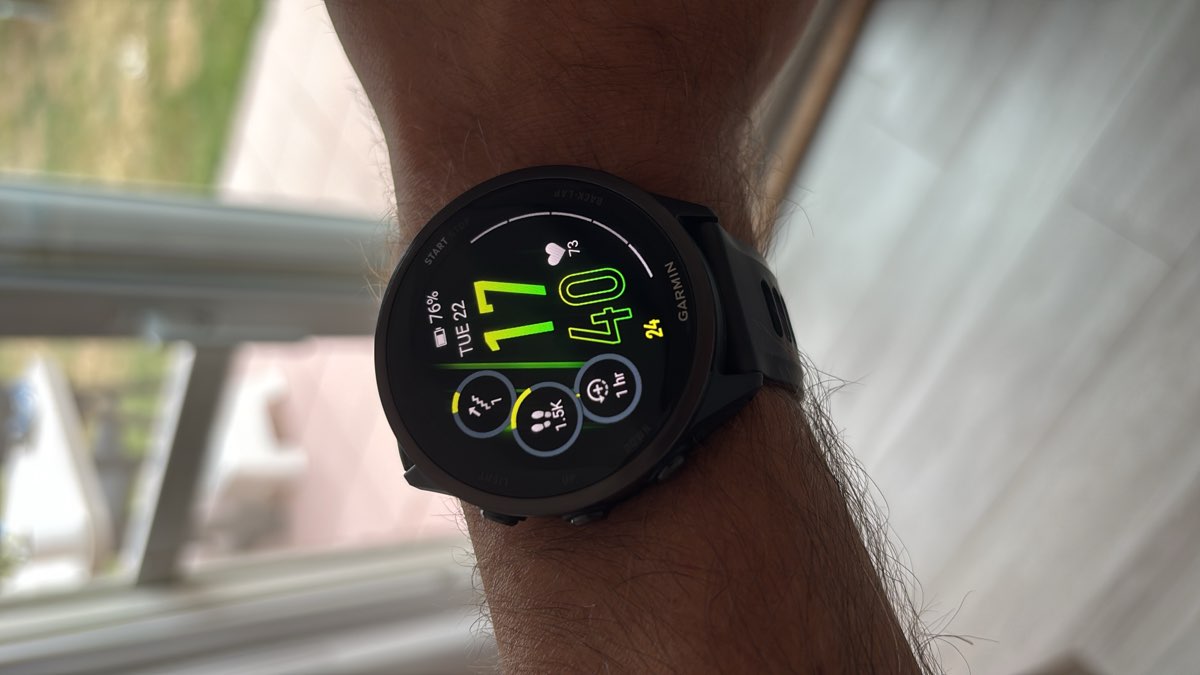
Garmin Forerunner 570 Review After 12 Months
I’ve worn the Garmin Forerunner 570 every single day for 12 months. Not just for runs. Every day. Sleep tracking, HRV, steps, the whole thing. I paid EUR 500 for it and I’m going to tell you exactly what’s worth it and what’s marketing fluff.
Why I Upgraded
My Garmin Venu SQ died. The battery just gave up after about two years. I didn’t want another Venu. I wanted a proper running watch with features that actually help me train better. The Venu SQ was fine, but it lacked a barometric altimeter, had no HRV tracking, and the running data was basic at best.
I looked at the Forerunner 265, the 570, and even the Fenix line. The 570 hit the sweet spot: all the running-specific data I wanted without the bulk of a Fenix. My wife has the Venu 3S and it’s a great lifestyle watch, but I wanted something built specifically for running performance.
If you’re comparing models, I’ve broken down the full Forerunner lineup with pricing.
What I Actually Use Every Day
Let me be brutally honest about which features earn their keep and which ones I never touch.
Features I Love
Running data (pace, HR, distance): Obviously. This is the core function and it does it flawlessly. GPS lock is fast, pace is accurate, heart rate is reliable enough for training zones. After 12 months of data I trust it completely.
Night Score: This one surprised me. It gives you a score for your sleep quality and I’ve found it correlates directly with how I feel during runs. Below 70? I know my intervals will suffer. Above 85? I’m usually feeling sharp. It’s become my daily decision tool for how hard to push.
HRV tracking: The Venu SQ didn’t have this and I didn’t know what I was missing. Watching my HRV trend over months gives me confidence that my training is working. When I was overtrained in early 2026, my HRV dropped for two weeks straight before I felt it in my legs. Early warning system.
VO2Max estimation: Garmin’s VO2Max has been surprisingly accurate for me. I’ve tracked it going from 48 to 56 over two years and every jump correlated with real performance improvements. I wrote more about whether Garmin VO2Max is actually accurate.
Lactate threshold data: This is the feature that justified the price for me. Seeing my lactate threshold pace improve over time, backed by real race results, gives me something concrete to train toward.
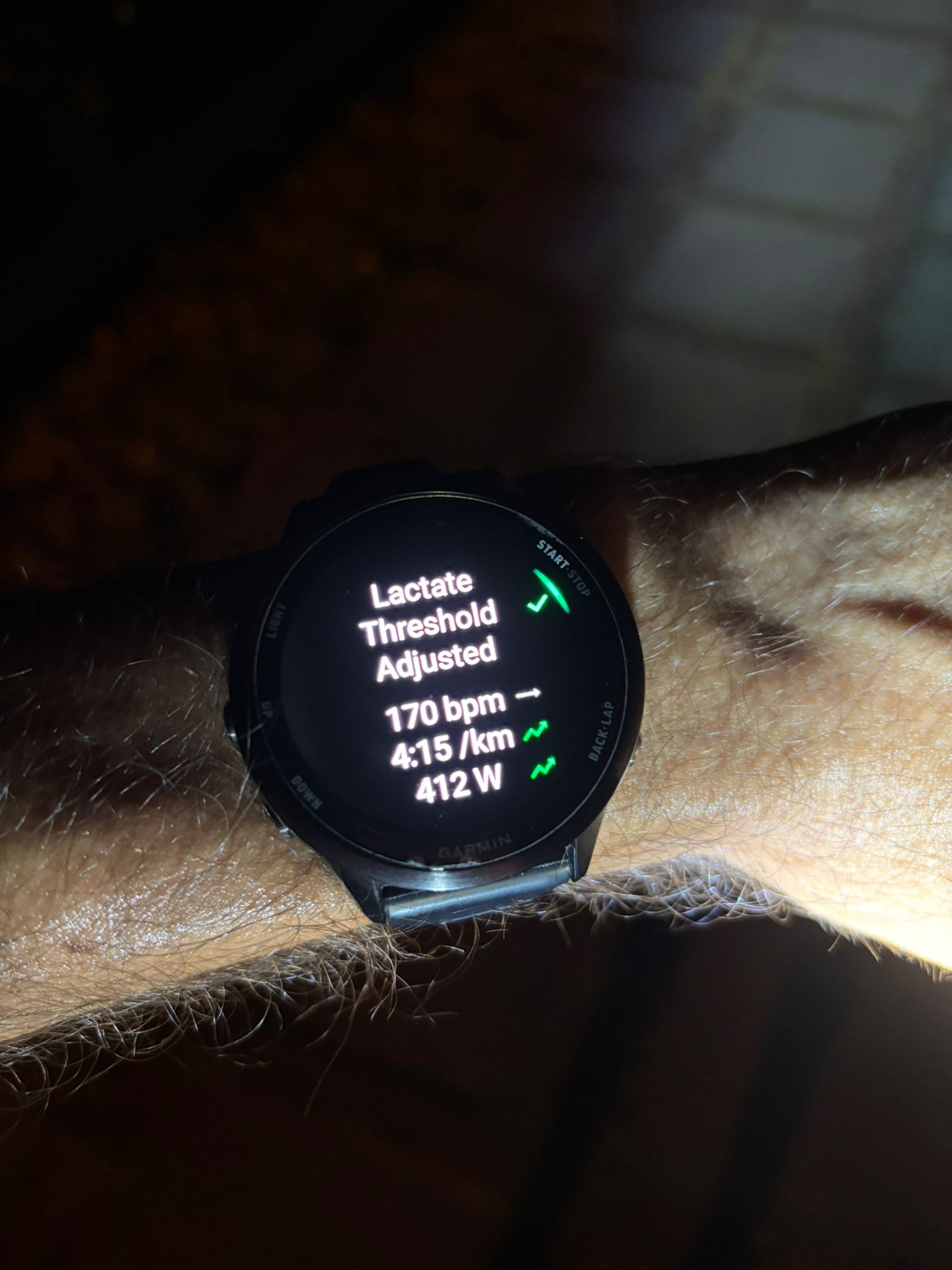
Running form parameters: Cadence, ground contact time, vertical oscillation. I don’t obsess over these daily, but when something feels off, I can check if my ground contact time has crept up or my cadence dropped. Useful for catching form breakdown during long runs.
Features I Ignore
Running power: I don’t use it. Full stop. It’s a calculated value based on pace, grade, and other inputs. It’s not measured at the sole like cycling power. Until there’s a foot pod that actually measures ground reaction forces, running power is an estimate dressed up as data. I don’t need another estimated metric when pace and heart rate tell me what I need to know.
Body Battery: I glance at it sometimes but I don’t make decisions based on it. Night Score is more useful.
Suggested workouts: I follow my own plan. The suggestions are fine for someone without a program, but I’d rather build my training around what I know works for me.
Watch faces: I use the default. I’ve tried maybe three others and always came back. The default shows time, date, steps, and battery. That’s all I need at a glance.
Battery Life
It charges once a week. That’s with GPS running 3-4 times per week (usually 45-80 minutes each), 24/7 HR monitoring, sleep tracking, and HRV. I charge it Sunday mornings while drinking coffee. Never think about it otherwise.
Compared to the Venu SQ which needed charging every 3-4 days, this is a massive upgrade. You stop worrying about battery completely and that matters more than you’d think.
The Upgrade Path: Venu SQ to Forerunner 570
For anyone considering a similar jump, here’s what you actually gain:
| Feature | Venu SQ | Forerunner 570 |
|---|---|---|
| Barometric altimeter | No | Yes |
| HRV tracking | No | Yes |
| Night Score | No | Yes |
| Running dynamics | Basic | Full |
| Lactate threshold | No | Yes |
| VO2Max accuracy | Rough estimate | Much better |
| Battery (GPS mode) | ~14 hours | ~26 hours |
| Battery (smartwatch) | 3-4 days | 7+ days |
| Maps/navigation | No | Yes |
| Display | LCD | AMOLED |
The barometric altimeter alone was worth it for me. My elevation data on the Venu SQ was essentially useless. Now I actually trust my hill workout numbers.
What It Helped Me Achieve
I don’t want to overstate the role of a watch in running performance. The training matters most. But having accurate data helped me make better decisions:
- Tracking my VO2Max journey from 48 to 56 with data I actually trust
- Catching overtraining early via HRV drops
- Pacing long runs correctly using real-time HR zones
- Setting lactate threshold targets for interval sessions
- Adjusting training load when Night Score was consistently low
The watch doesn’t make you faster. But it removes guesswork from decisions that used to be based on feel alone.
Is EUR 500 Worth It?
Here’s my honest take: if you run 3+ times per week and you care about improving, yes. The data quality is genuinely useful. But if you run casually 2x per week and don’t analyze your training, get the Forerunner 265 or even a Venu 3S and save the money.
The features that justify the price for me (HRV, lactate threshold, running dynamics) only matter if you actually look at them and adjust your training accordingly. If you just want pace and distance, you’re overpaying.
For a full comparison of what each Forerunner offers at each price point, check my GPS watch comparison guide.
What I’d Change
Three things:
- The price. EUR 500 is a lot. Garmin knows runners will pay it and they price accordingly. The hardware probably doesn’t cost much more than the 265.
- Running power implementation. Either make it actually useful with proper measurement or drop it. The current version is misleading for people who don’t understand it’s calculated.
- Connect app. The Garmin Connect app is functional but ugly. For a EUR 500 product, the software should feel premium too.
After 12 Months: Would I Buy It Again?
Without hesitation. It’s the best running tool I own after my shoes. The data has directly influenced how I train, when I rest, and how I pace races. Twelve months in and the hardware still looks and feels new. The battery hasn’t degraded noticeably. The strap is holding up fine.
It’s not perfect. But it’s the best running watch I’ve used at a price that’s just barely justifiable for a serious amateur runner.
FAQ
Is the Forerunner 570 worth it over the 265?
If you want HRV, lactate threshold data, and full running dynamics, yes. If you just need GPS, pace, and HR, the 265 does that for EUR 200 less. The 570 is for runners who actually use advanced metrics to guide their training.
How accurate is the wrist-based heart rate?
Very accurate for steady-state running. During intervals with rapid HR changes, there’s sometimes a 2-3 second lag compared to a chest strap. For 95% of my training, the wrist sensor is accurate enough that I don’t bother with a chest strap anymore.
Does it work for swimming and cycling too?
Yes, it tracks both. I don’t swim or cycle regularly so I can’t speak to the accuracy there. It’s primarily a running watch but it’s capable as a multisport device.
Should I use running power on the Forerunner 570?
I don’t, and here’s why: it’s calculated from pace and other variables, not measured directly. Real running power would require force sensors in your shoes. What Garmin calls “running power” is just another way of expressing the same data you already have from pace and HR. Until someone solves actual power measurement at the foot, I consider it noise.
How does it compare to the Fenix/Enduro line?
The Fenix adds better build quality (titanium options), longer battery, and more outdoor/adventure features. If you trail run or do ultramarathons, the Fenix makes sense. For road running and training optimization, the Forerunner 570 has essentially the same running features in a lighter, more comfortable package.