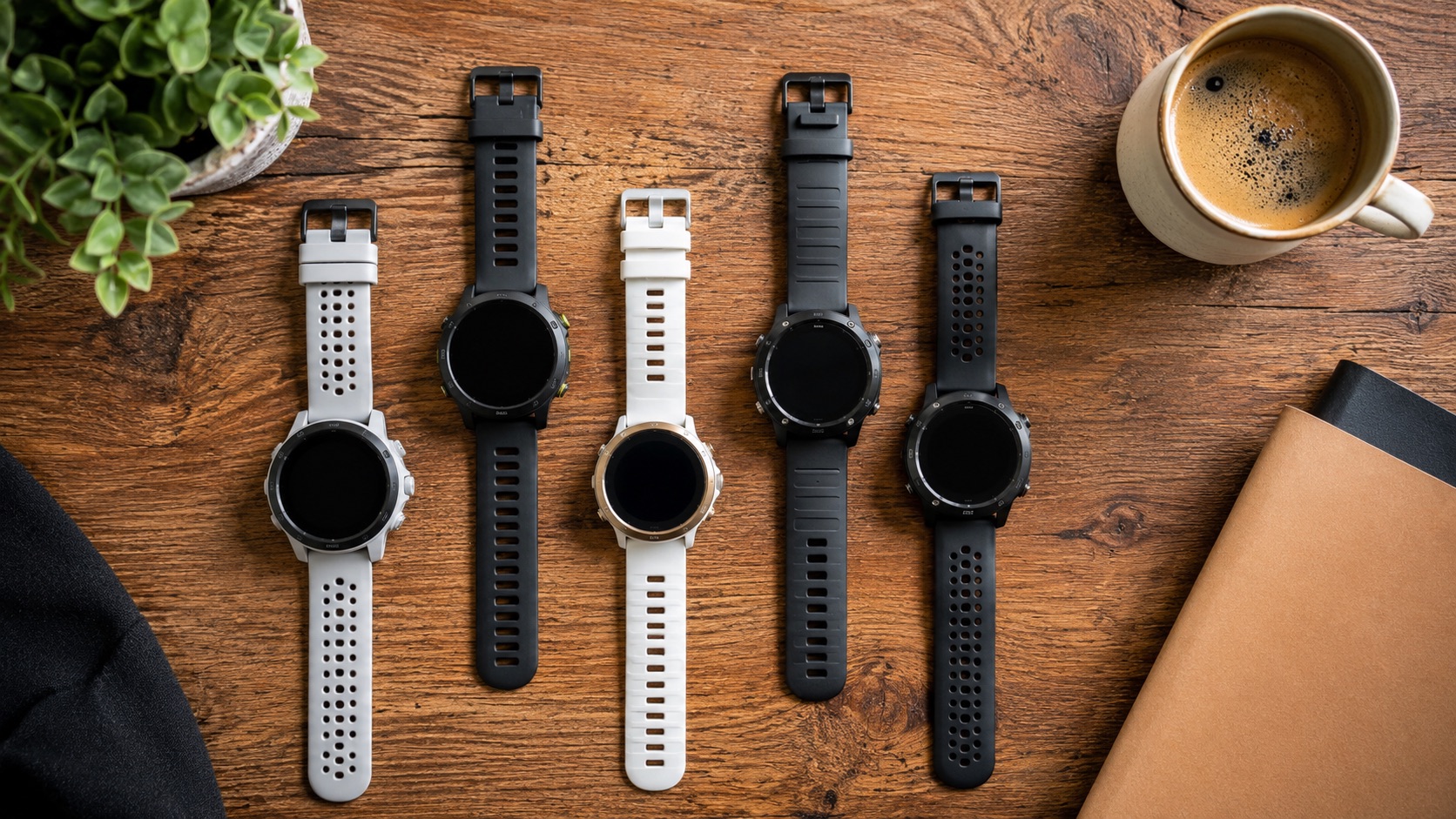
My $3,000 Running Tech Stack (Is It Worth It?)
I have a problem. I know I have a problem. My running tech drawer has more gadgets than a Best Buy display shelf, and my bank account has the scars to prove it.
Over the past two years, I’ve accumulated what I can only describe as an embarrassingly comprehensive running technology ecosystem. Garmin Fenix 8. Stryd power meter. Whoop 5.0. Oura Ring 4. Bone conduction headphones. Chest strap heart rate monitor. Theragun. Normatec recovery boots. The total? North of $3,000 (and that’s not counting subscriptions).
The question my wife asks monthly: “Is any of this actually making you faster?”
The honest answer: some of it, yes. Some of it, absolutely not. Let me break down every piece of my tech stack with brutal honesty about what’s essential, what’s nice, and what’s expensive anxiety fuel.
The Full Stack
Here’s everything I’m currently using, what it costs, and my verdict after extensive testing:
| Device | Price | Monthly/Annual Sub | Use Frequency | My Verdict |
|---|---|---|---|---|
| Garmin Fenix 8 | $1,000 | None | Every run | Essential |
| Stryd Power Meter | $220 | Free basic / $10/mo premium | Every run | Nice-to-have |
| Whoop 5.0 | $239/year | Included | 24/7 | Nice-to-have |
| Oura Ring 4 | $349 + $6/mo | $72/year | 24/7 | Redundant (but I love it) |
| Shokz OpenRun Pro 2 | $180 | None | 80% of runs | Essential |
| Garmin HRM-Pro Plus | $130 | None | Hard efforts | Essential for data nerds |
| Theragun Elite | $399 | None | 3-4x/week | Nice-to-have |
| Normatec 3 Legs | $799 | None | 2-3x/week | Overkill |
| Total | $3,316+ | $311/year |
Yeah. I see that total too. Let me justify (or condemn) each one.
The Breakdown
Garmin Fenix 8 ($1,000): The Command Center
This is the center of my running universe. GPS tracking, training load metrics, recovery advisor, maps, music, body battery, sleep tracking, HRV, and about 200 other features I’ve never touched.
Is it worth $1,000? For me, yes. I use it every single day for running, sleep, and daily activity tracking. It’s replaced my regular watch entirely. The mapping is excellent for trail running, the battery lasts a week of heavy use, and the training metrics (while not perfect) give me useful guidance.
Could you get 90% of the benefit from a $450 Forerunner 265? Absolutely. The Fenix premium is mostly for maps, battery life, and build quality. The training algorithms are identical. I reviewed this in depth in my Fenix 8 review.
Verdict: Essential (but the model is overkill for most people).
Stryd Running Power Meter ($220): The Data Nerd’s Toy
I clip this to my shoe and it gives me running power in watts. The theory: power is a more immediate and consistent effort metric than pace (which varies with terrain) or heart rate (which lags and fluctuates with fatigue, heat, caffeine, etc.).
In practice? Power is genuinely useful for two things: pacing on hilly terrain (power stays consistent while pace and HR fluctuate) and accurate treadmill distance/pace (since GPS doesn’t work indoors).
For flat road running? Pace and HR work fine. I’ve found power interesting but not transformative for my actual performance.
Verdict: Nice-to-have. Essential only for treadmill runners or ultra-distance athletes who pace by power.
Whoop 5.0 ($239/year): The Recovery Oracle
Whoop sits on my wrist (now also available as a clothing sensor) and tracks HRV, resting heart rate, respiratory rate, and sleep in enormous detail. Every morning it gives me a recovery score (green/yellow/red) and a strain score for training load.
What I like: the HRV trend analysis is the best I’ve used. The sleep coaching is genuinely helpful. Knowing my recovery score helps me decide between an easy day and a hard workout.
What I don’t like: it’s a subscription with no screen, no GPS, and no workout features. It’s purely a recovery and sleep tracker. At $239/year, that’s a steep ask. For a full comparison of recovery wearables, see my Whoop vs Oura vs Garmin breakdown.
Verdict: Nice-to-have. Useful data, but your Garmin also tracks most of this.
Oura Ring 4 ($349 + $6/mo): The Redundancy I Can’t Quit
I know. I know. I have a Garmin and a Whoop. I don’t need an Oura Ring too. But the ring form factor for sleep tracking is unbeatable (no bulky watch in bed), and I’ve found Oura’s sleep staging to be the most accurate of my three devices when compared against how I actually feel.
The readiness score correlates better with my subjective energy than either Garmin’s Body Battery or Whoop’s recovery score.
Verdict: Redundant if you have Whoop or a Garmin. But if forced to choose one sleep tracker, I’d pick Oura.
Shokz OpenRun Pro 2 ($180): The Non-Negotiable
Bone conduction headphones that sit on your cheekbones and leave your ears completely open. I can hear traffic, other runners, my own breathing, and still enjoy podcasts or music.
I won’t run without these. The safety factor alone (hearing cars, bikes, dogs) makes them essential for outdoor running. The sound quality is surprisingly good for what they are, though they can’t match in-ear buds for bass or isolation.
Verdict: Essential. The best running-specific audio solution I’ve found.
Garmin HRM-Pro Plus ($130): The Accuracy Upgrade
The Fenix 8’s wrist-based heart rate is… okay. It’s fine for easy runs but wildly inaccurate during intervals, especially in cold weather when blood flow to the wrist decreases.
The HRM-Pro Plus chest strap gives me accurate heart rate in all conditions, plus running dynamics (ground contact time, vertical oscillation, stride length). These metrics are interesting for form analysis.
More importantly, the accurate HR data means my Garmin’s Training Status and VO2 Max estimates are actually reliable. With wrist HR, they fluctuate unreliably. Check the heart rate monitor guide for alternatives if a chest strap doesn’t appeal.
Verdict: Essential if you care about accurate training metrics. Skip if you just want basic zone info.
Theragun Elite ($399): The Expensive Massage
A percussion therapy device that hammers my muscles at 2,400 RPM. I use it on my calves, quads, IT band, and glutes after hard runs. Does it speed recovery? Probably marginally. Does it feel incredible? Absolutely.
The honest truth: a $60 mini percussion gun does 80% of what the $399 Theragun does. The Elite is quieter, more powerful, and has better ergonomics. But the ROI compared to a budget option is questionable. I compared options in the Theragun vs Hypervolt comparison.
Verdict: Nice-to-have. Buy a $60-100 alternative and be perfectly happy.
Normatec 3 Legs ($799): The Guilty Pleasure
Pneumatic compression boots that squeeze your legs in a wave-like pattern. You sit on the couch for 20-30 minutes while they inflate and deflate. Feels amazing after a long run.
Does research support their recovery benefit? Sort of. There’s evidence for reduced perceived muscle soreness. There’s less evidence for actual performance improvement in subsequent sessions.
Do I love them? Yes. Are they worth $799? For a recreational runner who races maybe 4 times a year? Probably not. For a high-volume athlete training 10+ hours per week? Maybe.
Verdict: Overkill. A luxury item disguised as a training tool. I’m keeping them anyway.
The Truth: What Actually Helps Performance
After two years and $3,000+, here’s my honest ranking of what has improved my running:
- Garmin watch (any model with training metrics): Gives structure to training, prevents overtraining, tracks trends.
- Chest strap HR monitor: Makes all other data more accurate and reliable.
- Bone conduction headphones: Lets me enjoy runs more (which means I run more consistently).
- Theragun (any percussion device): Helps me feel better day-to-day, possibly allows slightly higher training load.
- HRV tracking (Whoop or Oura or Garmin): Occasional useful insight into readiness. Not a daily game-changer.
- Stryd power: Interesting data, marginal practical benefit for road running.
- Normatec: Feels great. Questionable performance ROI.
If I Were Starting Over
With the benefit of hindsight, here’s what I’d buy:
- Garmin Forerunner 265 ($450): 90% of Fenix 8 features at half the price
- Garmin HRM-Pro Plus ($130): Accurate HR is worth it
- Shokz OpenRun Pro 2 ($180): Non-negotiable
- Budget percussion gun ($80): Gets the job done
- Total: $840
That’s it. Everything else is bonus. The remaining $2,100+ I spent? Entertainment. Data hobby spending. Gadget enthusiasm that my running log confirms has not meaningfully changed my race times.
I don’t regret it (mostly). But I want to be honest with you: the gear that makes you faster is shoes, consistent training, and sleep. Everything else is optimization at the margins.
Frequently Asked Questions
Is the Garmin Fenix 8 worth it over the Forerunner 265?
For most runners, no. The Forerunner 265 has the same training algorithms, same accuracy, and a beautiful AMOLED screen. The Fenix 8 adds: offline maps (great for trails), longer battery life (a week vs 4-5 days), more durable build, and flashlight. If you don’t need maps and run roads, save $550 and get the 265.
Do I need both a Whoop and an Oura Ring?
Absolutely not. They measure largely the same things (HRV, sleep, readiness). If sleep tracking is your priority, Oura’s ring form factor wins. If you want training strain analysis and recovery coaching, Whoop is slightly better. Either one alongside a Garmin is redundant because Garmin tracks HRV and sleep too. I have all three because I’m an addict, not because it’s logical.
Are Normatec recovery boots actually backed by science?
The evidence is mixed. Multiple studies show reduced perceived muscle soreness and possibly reduced swelling after intense exercise. However, evidence for actual performance improvement (faster next workout, better race result) is weaker. They “feel” like they work, and perceived recovery has its own value. But at $799, you’re paying a premium for something a $15 foam roller also addresses (less comfortably but effectively).
What’s the one gadget you’d recommend if I could only buy one?
A GPS running watch with training load metrics. Specifically, the Garmin Forerunner 265 right now. It tracks your training, prevents overtraining, monitors fitness trends, and provides structured workout guidance. Everything else I own is supplementary to what the watch provides as a foundation.
How much does running tech actually improve your race times?
Honestly? The tech itself doesn’t make you faster. What it does is: prevent overtraining (avoiding injury is the #1 performance hack), provide motivation through data and progress tracking, and enable better training decisions (when to push, when to rest). If I had to quantify it: my Garmin and HR monitor together probably save me from one injury per year that would cost me 4-6 weeks of training. That consistency is worth way more than any marginal recovery benefit from expensive gadgets.
The Bottom Line
I love my tech stack. I’ll keep buying gadgets (my wife has accepted this). But I’m under no illusion that $3,000 of technology has made me meaningfully faster than the version of me who just ran consistently with a basic GPS watch and a chest strap.
The tech makes running more interesting, more data-rich, and more enjoyable for me. That has value. But if you’re looking for speed? Spend the $3,000 on a coach, new shoes every 500 km, and a year of race entries instead. You’ll get more for your money.
Now if you’ll excuse me, there’s a new COROS optical HR sensor I need to research…