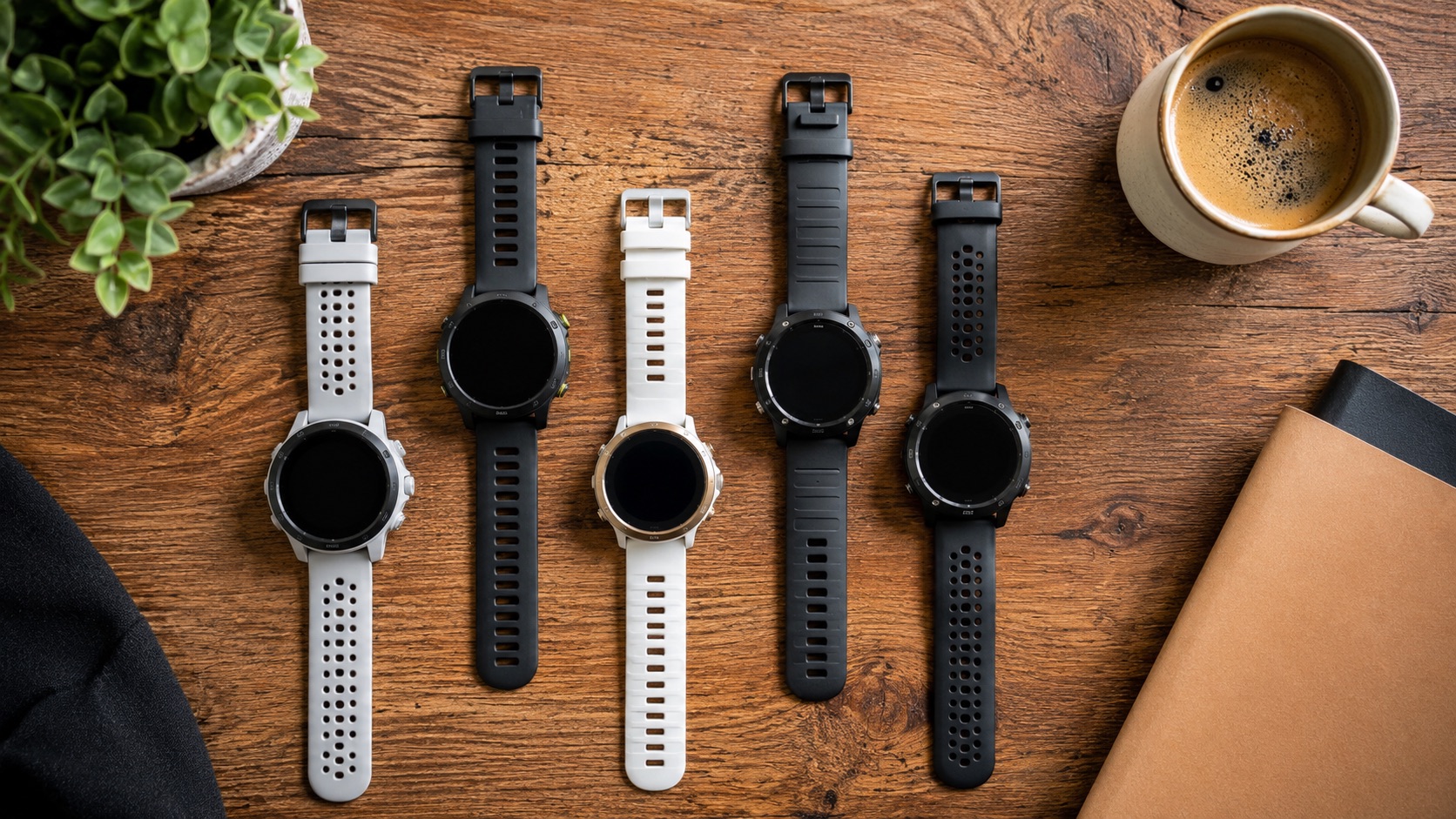
Garmin Fenix 8 vs Enduro 3 vs Epix Pro - Which Premium Garmin?
So you’ve decided to go premium Garmin. Smart move. But now you’re staring at three watches that all cost a small fortune and wondering which one actually makes sense for your running. The Fenix 8, Enduro 3, and Epix Pro overlap a lot - same ecosystem, same core software, same Garmin Connect app. The differences come down to philosophy: do you want the longest battery, the best display, or the most versatile package?
I’ve spent time with all three, and here’s my honest breakdown to help you decide.
Quick Comparison Table
| Feature | Fenix 8 | Enduro 3 | Epix Pro |
|---|---|---|---|
| Price | $1,000 | $900 | $900 |
| Case Size | 47mm | 51mm | 47mm |
| GPS Battery | 48 hours | 90 hours | 42 hours |
| Weight | 85g | 63g | 76g |
| Display | MIP + AMOLED option | MIP | AMOLED |
| Maps | Yes | Yes | Yes |
| Music | Yes | Yes | Yes |
| Solar | Available | Yes (built-in) | No |
All three share multi-band GPS, full topo maps, Garmin’s latest HRV and training readiness features, and the same suite of running dynamics. The differences are in how they deliver the experience.
Design & Durability
Fenix 8
The Fenix line has always been Garmin’s tank. The Fenix 8 continues that tradition with a titanium bezel option, sapphire crystal lens, and a build quality that screams “throw me at a mountain.” At 85g it’s the heaviest of the three, but it doesn’t feel unwieldy on wrist - the 47mm case is well-proportioned. The big news is the AMOLED option alongside the traditional MIP display, giving you a choice at purchase time.
Enduro 3
Here’s what surprises people: the Enduro 3 has the biggest case (51mm) but the lightest weight (63g). Garmin pulled this off with a polymer fiber case and a thin titanium bezel. It’s designed to disappear on your wrist during 100-milers. The trade-off? It feels less premium in-hand compared to the Fenix 8’s metal-and-glass construction. But when you’re 18 hours into a race, you won’t care about wrist jewelry - you’ll care about weight and battery.
Epix Pro
The Epix Pro splits the difference on build. At 76g with a 47mm case, it’s comfortable for daily wear and race day alike. Stainless steel or titanium bezel, sapphire lens - it’s built well. But its real design statement is that gorgeous AMOLED display that makes every other running watch look like a calculator screen.
Battery Life
This is where the three watches diverge most dramatically.
The Enduro 3 is the undisputed battery king at 90 hours of GPS tracking. With solar, you can push that even further in sunny conditions. For ultrarunners doing multi-day events, this is the only watch in the lineup that won’t need a mid-race charge. In smartwatch mode, you’re looking at weeks - not days - between charges.
The Fenix 8 lands at 48 hours GPS with the MIP display (less with AMOLED enabled). That’s still outstanding for most runners. You can run a 100-miler without charging if you manage settings, or comfortably cover a 50K without thinking about it. Solar adds a meaningful buffer in outdoor conditions.
The Epix Pro comes in at 42 hours GPS. That AMOLED display costs you battery, and there’s no solar option to offset it. For most training and racing up to marathon/50K distance, 42 hours is more than enough. But ultrarunners will feel the squeeze.
Bottom line: If battery anxiety keeps you up at night, the Enduro 3 wins by a massive margin. If you’re not running ultras, all three are fine.
Training & Navigation
Here’s the thing - all three run the same software. You get identical training features:
- Training Readiness and HRV Status
- Race Predictor and daily suggested workouts
- Running power (wrist-based)
- Real-time stamina tracking
- Full course navigation with turn-by-turn
- ClimbPro for elevation profiles
- Multi-band GNSS for accurate tracking
The hardware sensors are the same across the board: Elevate v5 optical HR, barometric altimeter, compass, thermometer. You’re not sacrificing training intelligence with any choice here.
Where navigation differs slightly: the Enduro 3’s larger 51mm screen gives you marginally more map real estate, which is nice when you’re navigating remote trails. The Epix Pro’s AMOLED makes map colors pop and is easier to read in dim forest conditions. The Fenix 8 with MIP is most readable in direct sunlight.
For structured training and racing, check our full best GPS running watches for 2026 guide if you want to see how these stack up against the broader market.
Display Comparison
This deserves its own section because it’s a genuine lifestyle decision.
MIP (Memory-in-Pixel) - used in Enduro 3 and base Fenix 8 - is always-on, sunlight-readable, and sips battery. It looks dated next to an AMOLED, but it’s functional and reliable. You never tap your wrist to wake the screen. Data is always visible.
AMOLED - used in Epix Pro and optional Fenix 8 - is vibrant, sharp, and makes the watch feel modern. Maps look incredible. But it uses more battery and typically uses a raise-to-wake or tap-to-wake gesture (always-on AMOLED mode destroys battery life).
If you primarily run outdoors in daylight, MIP is arguably better. If you want a watch that doubles as a sharp-looking daily wearable and you train at varying times, AMOLED wins the experience.
Which Watch Is Best For You?
Best for Ultrarunners: Enduro 3
The Enduro 3 was built for one thing: going long. The 90-hour GPS battery means you can run a 200-miler without mid-race logistics around charging. The 63g weight disappears on your wrist. Solar charging extends things further. If your races regularly exceed 50 miles or you do multi-day adventures, this is the obvious pick.
Pros:
- Unmatched GPS battery life (90h)
- Lightest in the lineup (63g)
- Solar charging built-in
- Large display for navigation
Cons:
- Biggest case may overwhelm smaller wrists
- MIP display feels dated
- Polymer build less premium feeling
- No AMOLED option
Best All-Rounder: Fenix 8
The Fenix 8 is the Swiss Army knife. It does everything well: solid battery, premium build, choice of display technology, solar option. It’s the watch for runners who also hike, ski, swim, and want one device that handles everything without compromise. The $1,000 price is steep, but you’re getting the most complete package.
Pros:
- Most versatile - handles any sport or scenario
- Choice of MIP or AMOLED display
- Premium titanium/sapphire build
- Strong 48h GPS battery with solar option
Cons:
- Most expensive at $1,000
- Heaviest of the three (85g)
- Jack of all trades, master of none
- AMOLED variant reduces battery significantly
Best for Display Lovers: Epix Pro
If you want the best screen experience on a Garmin, the Epix Pro is it. The AMOLED display makes training data, maps, and watch faces look stunning. It’s also the most “normal watch” looking of the three - people won’t immediately clock it as a sports watch. Great for runners who wear their watch all day and want it to look sharp at dinner too.
Pros:
- Best display in Garmin’s lineup (AMOLED)
- Comfortable 76g weight
- Looks great as daily wear
- Same full feature set as Fenix 8
Cons:
- Shortest GPS battery (42h)
- No solar charging option
- AMOLED always-on mode drains fast
- Not ideal for ultra-distance events
How These Compare to the Competition
Wondering how Garmin’s premium lineup stacks up against other brands? Our Garmin vs COROS vs Apple Watch comparison breaks that down. And if this price range makes you wince, there are excellent options in our best GPS watch under $300 guide.
Related reading: Garmin Forerunner 265 vs COROS Pace 4 - Mid-Range Running Watches Compared
See how we compare products for our full research methodology.
FAQ
Is the Fenix 8 worth $100 more than the Enduro 3 or Epix Pro?
It depends on what you value. The extra $100 gets you the most versatile build with display choice and solar option. If you want one watch to rule them all and don’t mind paying for it, yes. If you know you want pure battery (Enduro) or pure display (Epix), save the hundred bucks.
Can the Epix Pro handle an ultramarathon?
For races up to 100K, absolutely - 42 hours of GPS is plenty. For 100-milers where you might be out for 24-30+ hours, you’ll need to manage settings (lower GPS frequency, disable AMOLED always-on) or plan a quick charge. It’s doable but not ideal. The Enduro 3 removes that stress entirely.
Does the Enduro 3 have the same training features as the Fenix 8?
Yes. Same sensors, same software, same Garmin Connect integration. You’re not giving up any training intelligence by choosing the Enduro 3. The differences are physical: weight, display type, battery, and build materials.
Should I get the Fenix 8 MIP or AMOLED version?
MIP if you prioritize battery life and outdoor readability. AMOLED if you want the prettier experience and don’t mind charging more frequently. The MIP version also supports solar, which the AMOLED does not. For ultrarunners, MIP is the smarter pick. For daily-wear enthusiasts, AMOLED.
Are these watches overkill for someone who just runs road marathons?
Honestly? A bit. These are designed for multi-sport athletes, ultra-distance runners, and outdoor adventurers. If you primarily run road and don’t need multi-day battery or topo maps, you could get 90% of the training value from a Forerunner 965 at a lower price. But if you want the best and plan to grow into trail or ultra running, you won’t regret going premium now.
Final Thoughts
All three watches are exceptional. You genuinely cannot make a bad choice here - only a suboptimal one for your specific needs. The Enduro 3 dominates for ultra-distance. The Fenix 8 covers every base. The Epix Pro delivers the best daily experience.
Pick based on your longest regular activity, how much you value display quality, and whether weight matters to you on race day. Then stop overthinking it and go run.