
My Aerobic Base Is Stronger Than Ever (Here's the Proof)
My Aerobic Base Is Stronger Than Ever (Here’s the Proof)
I spent most of 2025 dealing with inconsistency, illness, and doubt. I thought I lost significant fitness. I was wrong. My aerobic base is measurably stronger than it has ever been, and I have the data to prove it. This post lays out the numbers, explains what I did differently in 2026, and shows why consistency beats perfection every single time.
The Hard Data: Before vs Now
I pulled two comparable long runs from my Garmin history. Same type of session, similar route profile, similar conditions. Here is what they show:
| Metric | Old Long Run | Recent Long Run | Improvement |
|---|---|---|---|
| Distance | 20.01 km | 23.01 km | +3 km |
| Pace | 5:40/km | 5:26/km | 14s/km faster |
| Avg HR | 140 bpm | 135 bpm | 5 bpm lower |
Let that sink in. I ran 3km further, 14 seconds per kilometer faster, and my heart was working less hard doing it. This is not a marginal improvement. This is what genuine aerobic base development looks like when you see it in raw numbers.
Every single metric moved in the right direction simultaneously. More distance. More speed. Less cardiac effort. That trifecta does not happen by accident. It happens because the aerobic engine genuinely got bigger.
Lactate Threshold: The Ceiling Is Rising
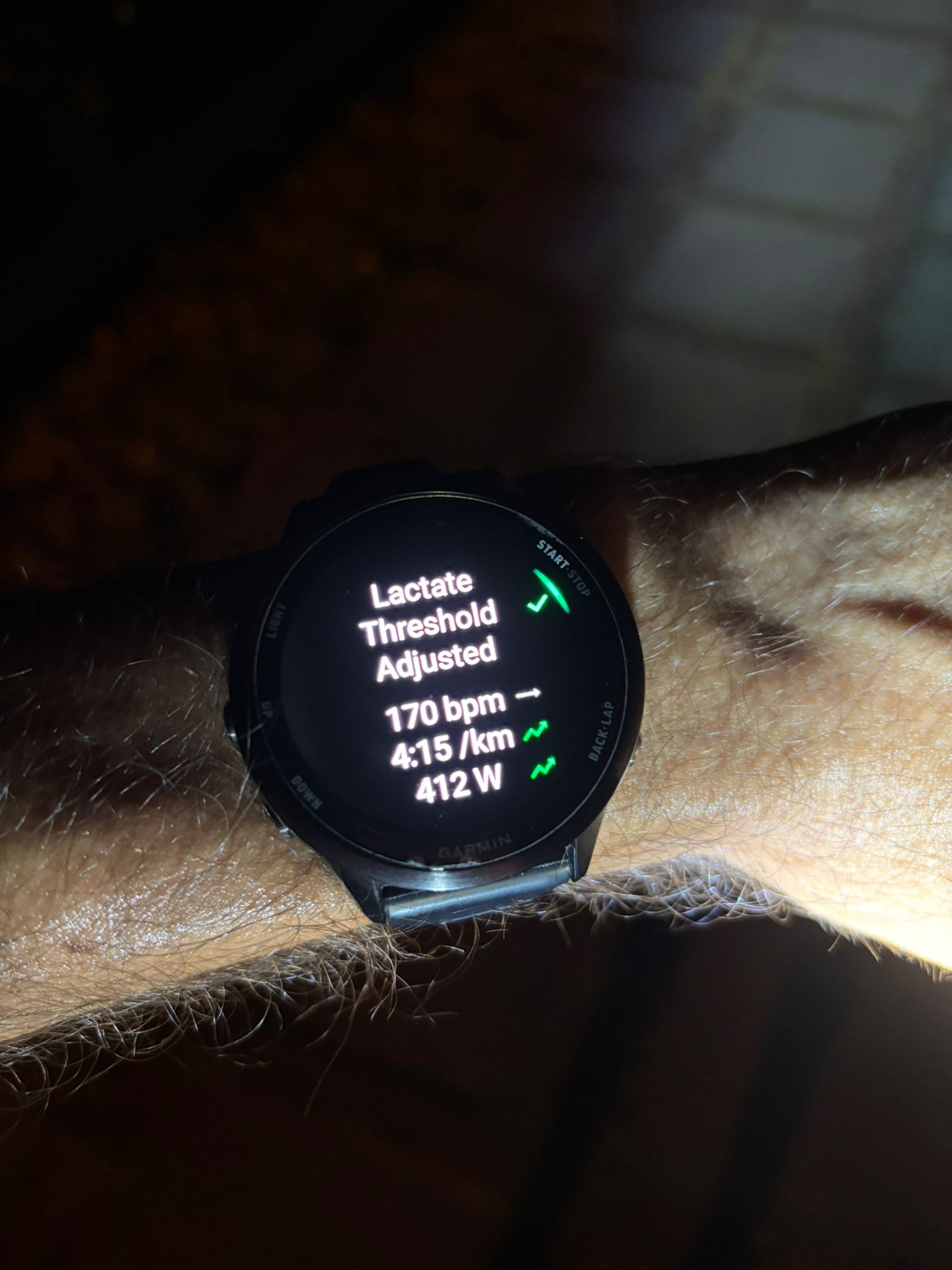
My Forerunner 570 currently shows my lactate threshold at 170bpm with a pace of 4:15/km. For those unfamiliar, lactate threshold is the intensity above which lactate accumulates faster than your body can clear it. A higher threshold means you can sustain faster paces before hitting that wall.
Six months ago, my threshold was sitting around 165bpm at 4:25/km. That is a significant improvement in both the heart rate ceiling and the pace I can hold at that ceiling. The practical result: I can sustain harder efforts for longer before blowing up.
This matters for racing. My disrupted 2025 left me wondering if I had lost these adaptations permanently. The answer is clearly no. They came back, and then some.
What My Weekly Volume Looks Like in 2026
The foundation of this improvement is boringly simple: consistent weekly volume. Here are my recent weeks:
| Week | Total Volume |
|---|---|
| Week 1 | 49 km |
| Week 2 | 46 km |
| Week 3 | 48 km |
| Week 4 | 37 km (recovery week) |
| Week 5 | 51 km |
| Week 6 | 44 km |
Average: approximately 46km per week with planned recovery weeks every 3 to 4 weeks. Compare this to 2025, where my weeks looked like: 45, 12, 0, 38, 52, 0, 22, 41. Wildly inconsistent. Missed weeks everywhere. No rhythm whatsoever.
The 2026 consistency is the entire story. I am not training harder. I am not doing exotic workouts. I am just showing up every week without large gaps.
My Training Structure
I use the Runna app for my training plan. It is AI-adaptive, meaning it adjusts based on how sessions go and how much volume I can handle. My typical week looks like:
- Monday: Intervals (speed work, usually 400m to 1km reps)
- Tuesday: Easy run
- Wednesday: Easy run or rest
- Thursday: Easy run
- Friday: Tempo session (sustained pace work)
- Saturday: Long run (20 to 26km)
- Sunday: Rest
Three quality sessions per week (intervals, tempo, long run) supported by easy volume. Nothing revolutionary. The magic is in the consistency, not the complexity.
Why Consistency Beats Perfection
I wrote about the feeling vs form disconnect recently. The core insight is the same: my body adapted faster than my brain believed possible, simply because I kept showing up.
Perfection would mean hitting every single session at the prescribed pace, never missing a day, always sleeping eight hours, always eating perfectly. That is not realistic. What IS realistic is running 5 to 6 days per week, most weeks, for months on end. Even if individual sessions are not perfect.
My 37km recovery week was not planned failure. It was smart loading management. But even in that lighter week, I still ran 4 times. I maintained the habit. I kept the stimulus present. That matters more than any single hero workout.
The Science Behind Base Resilience
Your aerobic base is built on years of accumulated adaptations:
- Increased capillary density in muscles
- Higher mitochondrial volume
- Improved cardiac stroke volume
- Better fat oxidation efficiency
- Enhanced blood plasma volume
These adaptations do not disappear in weeks or even months of reduced training. They diminish gradually and return quickly when stimulus resumes. My years of consistent training before 2025 built a foundation that was remarkably resilient to the disruption.
When I resumed consistent training in 2026, I was not building from scratch. I was reactivating existing adaptations. That is why the improvement came faster than expected. The infrastructure was already there, just underutilized.
How Garmin Tracks This Improvement
My Forerunner 570 gives me several metrics that confirm the base improvement:
- VO2 max estimate: Trending upward, currently matching my all-time high
- Training status: Consistently “Productive” rather than the “Detraining” or “Overreaching” I saw throughout 2025
- Race predictor: Suggesting times faster than my current PRs
- Recovery time: Shorter between sessions, indicating better overall fitness
For how accurate these Garmin estimates actually are over time, I have tracked and analyzed them in my VO2 max accuracy deep dive.
What This Means for My Racing Goals
A stronger aerobic base means higher potential race performance. My current base supports:
- 5K: sub-19:30 potential (current PR 19:28)
- 10K: sub-40 potential (current PR 41:42)
- Half marathon: sub-1:28 potential
The base is there. What I need now is race-specific sharpening. The hard sessions that teach my body to hold faster paces for longer. The tempo runs at goal race pace. The long intervals that simulate race demands.
But without this aerobic foundation, no amount of speed work would get me to those times. The base comes first. Everything else is built on top of it. I break down my speed development approach in my guide to running faster.
Lessons for Your Own Training
If you are coming back from a disrupted period, here is what my experience teaches:
1. Your base is more resilient than you think. Years of training create adaptations that persist through months of inconsistency. Trust that foundation.
2. Consistency of presence matters more than quality of individual sessions. Run regularly. Even if some sessions are mediocre. The accumulation is what drives adaptation.
3. Track objective data. Without my Garmin data, I would still think I am less fit than I was. Numbers do not have emotional bias. They simply record reality.
4. Plan recovery weeks deliberately. My 37km week was intentional, not a failure. Strategic rest within a consistent framework accelerates adaptation.
5. Simple structures work. Three quality sessions plus easy volume. No exotic periodization. No complicated phasing. Just show up, do the work, recover, repeat.
The Proof Is in the Pace
My aerobic base is the strongest it has ever been. The data is unambiguous. More distance, more speed, less effort. Lactate threshold climbing. VO2 max matching all-time highs. All of this from six months of boring, consistent, unremarkable training weeks.
If you are doubting your fitness after a rough period, look at the numbers. Compare recent sessions to older ones at similar efforts. You might be surprised at how much your body has adapted while your brain was still processing the chaos.
Consistency beats perfection. The data proves it.
FAQ
How long does it take to rebuild aerobic base after time off?
Based on my experience, meaningful improvements showed up within 6 to 8 weeks of consistent training after a disrupted period. However, I had years of previous training creating a foundation to return to. If you are building base from scratch, expect 3 to 6 months of consistent volume before seeing clear improvements in pace-to-heart-rate ratios.
What weekly mileage do you need for a strong aerobic base?
I run approximately 46km per week (about 28 to 30 miles). Research suggests most recreational runners see strong aerobic development between 40 and 60km per week. The key is sustainability. Better to run 40km consistently for 6 months than 60km for 3 weeks followed by burnout and a break.
How do you measure aerobic base improvement without a lab?
The best field test is comparing pace at a given heart rate over time. Run the same route at the same perceived effort monthly and track your average pace and heart rate. If pace goes up while heart rate stays the same or drops, your aerobic base is improving. A GPS watch makes this straightforward.
Does aerobic base really survive months of inconsistent training?
Yes, to a significant degree. My data shows that despite a very inconsistent 2025, my aerobic adaptations (capillary density, mitochondrial function, cardiac efficiency) persisted well enough that consistent 2026 training brought me back to and beyond previous levels within months. The longer your training history, the more resilient your base.
What is more important for aerobic base: volume or intensity?
Volume, without question. For building aerobic base, consistent easy-to-moderate running volume is the primary driver. Intensity helps raise the ceiling once the base is established, but you cannot shortcut base building with hard sessions alone. My improvement came from consistent 46km weeks, not from heroic workouts.