Running on 5 Hours Sleep: What My Garmin Data Shows
I have three kids. The youngest still wakes up at night. Some nights I get five hours of sleep, sometimes less. And then my alarm goes off at 5:45 because I have intervals scheduled.
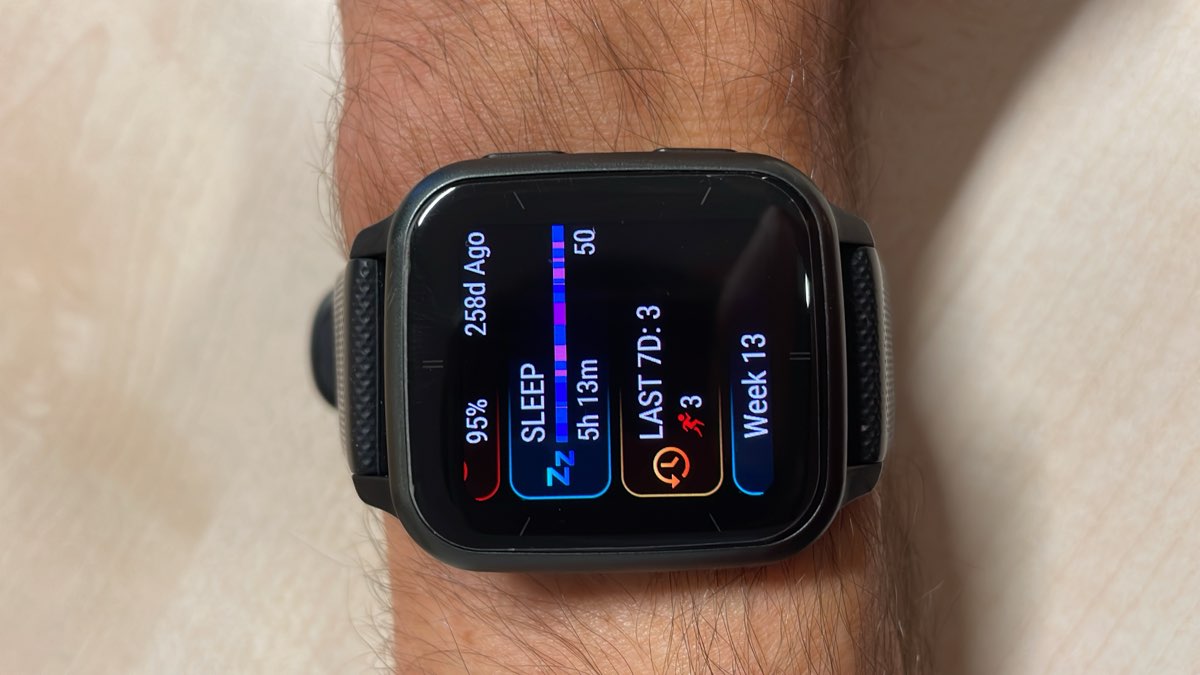
This is the reality of training as a parent. Not the Instagram version where you wake up refreshed and crush your morning run. The version where you drag yourself out of bed, check your Garmin sleep score, see a 50, and wonder whether you should even bother lacing up.
I have been tracking this pattern for over two years now. First on my Venu SQ, now on my Forerunner 570. And after hundreds of data points, I can tell you exactly what happens to my running when sleep drops below the threshold.
What Garmin Actually Tracks While You Sleep
Before I get into the data, let me explain what metrics I am looking at. The Forerunner 570 tracks several things during the night:
Sleep duration is the obvious one. Total time asleep, broken into light, deep, and REM stages.
Sleep Score is Garmin’s composite number from 0 to 100. It factors in duration, depth, restfulness, and REM time. Anything above 70 is “good.” Below 50 is “poor.”
HRV Status is the one that matters most for running performance. Heart Rate Variability during sleep tells you how recovered your autonomic nervous system actually is. A high HRV means your body handled yesterday’s stress (training and life) and is ready for more. A low HRV means it is still catching up.
Body Battery combines all of the above into a simple charge level. I wake up most mornings between 40 and 70. On bad nights, I wake up at 20 or 30.
The combination of these metrics paints a pretty clear picture before I even start running.
The Pattern: Bad Sleep Equals Bad Runs (Mostly)
Here is what I have observed over two years of data:
When sleep is under 5.5 hours:
- Resting heart rate is 5 to 8 bpm higher than normal
- HRV drops noticeably (my baseline is around 45ms, bad nights push it to 30 to 35ms)
- Easy pace feels like tempo pace
- Perceived effort is way higher than actual pace warrants
- Intervals feel impossible after rep 3
When sleep is 7+ hours with a score above 70:
- Heart rate stays low at easy pace
- Intervals feel sustainable
- I can actually hit negative splits on tempo runs
- Recovery between reps is noticeably faster
The correlation is strong. Not perfect, but strong. I would estimate that 80% of the time, a bad night directly leads to a bad run. The pace is slower, the effort feels harder, and my heart rate sits 8 to 12 beats higher at the same pace.
The Surprises: When Bad Sleep Does Not Matter
Here is what keeps things interesting. About 20% of the time, I have a terrible night and still run well. Sometimes even better than expected.
I have a theory about this. When sleep was bad but the previous three or four nights were solid, my body seems to handle one bad night without too much performance loss. It is the accumulated sleep debt that really kills performance. Two bad nights in a row and I am toast. Three and I might as well walk.
There have also been mornings where my sleep score was 48, my Body Battery was 25, and I went out and ran a tempo session that was faster than planned. No explanation. Sometimes the body just cooperates despite what the data says.
This is why I never skip a run purely based on sleep data. I go out, do the warmup, and assess from there. If I still feel terrible after 10 minutes of easy running, I cut the session short or convert it to an easy run. But I always start.
How I Have Adapted My Training Around Sleep
After tracking this for two years, I have made real changes to how I structure my training:
Key sessions get the best sleep nights. I schedule my hardest sessions (intervals, long runs with tempo finishes) on days where I have the most sleep control. Usually that means my wife handles bedtime the night before, or I go to bed at 9 PM no matter what.
Easy runs absorb the bad nights. When I see a sleep score below 55, that scheduled easy run stays easy. No “feeling good so let me push it” nonsense. I keep heart rate in zone 2 and accept the slower pace.
I track the trend, not individual nights. One bad night is noise. Three bad nights is a signal. If my HRV trends downward over a week, I take an extra rest day regardless of what my training plan says.
Naps are training tools. A 20-minute nap after lunch on a bad-sleep day genuinely improves my afternoon or evening run. My Garmin even tracks these and adds them to my Body Battery calculation.
2025 Was the Proof
Last year was my hardest running year, and sleep was a massive factor. Between the baby waking up, the older kids having phases of nighttime waking, and general life stress, I had weeks where I averaged 5.5 hours per night. My running suffered enormously. Paces dropped, motivation collapsed, and my VO2max estimate on Garmin actually declined for the first time.
That experience taught me that consistency matters more than any individual session. Missing a few runs because of exhaustion is fine. Pushing through terrible sleep for weeks and burning out is not.
What The Data Actually Shows: Numbers
Let me give you real numbers from my Garmin Connect data over the past six months:
Average easy pace on nights with 7+ hours sleep: 5:15/km at average HR 138 Average easy pace on nights with under 5.5 hours: 5:35/km at average HR 148
Same route. Same time of day. Same perceived effort level (moderate). That is a 20 second per kilometer difference and 10 bpm higher heart rate, just from sleep.
For intervals (1km reps at 4:00/km target): After good sleep: Average HR during reps: 172. Recovery HR between reps drops to 135 within 90 seconds. After bad sleep: Average HR during reps: 178. Recovery HR only drops to 148 in the same time.
The recovery between intervals is actually the biggest difference. My body just cannot bring the heart rate back down when it is running on empty.
Should You Trust Your Garmin Sleep Data?
The accuracy of Garmin’s tracking is a whole topic on its own. But for sleep specifically, here is my take: the absolute numbers might not be perfectly accurate, but the trends are reliable.
If Garmin says I slept 5 hours and got a score of 48, maybe the real number was 5.5 hours. Does not matter. What matters is that when that score is consistently low, my running consistently suffers. The correlation is what counts.
For more dedicated sleep tracking options, I have compared the main alternatives in my sleep tracker comparison for runners.
Tips For Running on Bad Sleep
After two years of dealing with this, here is what works:
-
Still run, but adjust expectations. Convert hard sessions to easy runs. Convert easy runs to even easier runs. Movement is better than nothing.
-
Caffeine timing matters. Coffee 30 minutes before a run on a bad sleep day makes a real difference. But not after 2 PM or you wreck the next night too.
-
Shorten the session. A 30-minute easy run on bad sleep beats a 60-minute run that leaves you completely drained for the rest of the day.
-
Track the trend. One bad night is fine. Multiple bad nights need a response: skip a session, nap, go to bed earlier.
-
Accept the season. Young kids do not sleep reliably. This is a phase. It will pass. Training through it imperfectly is better than not training at all.
The Bigger Picture
Running performance is not just about training volume and intensity. Recovery is where adaptation happens, and sleep is the foundation of recovery. My Garmin data has made this impossible to ignore.
But here is the thing: knowing this does not fix the problem. I cannot make my two-year-old sleep through the night. I cannot always go to bed at 9 PM. Life with three kids is chaotic, and sleep will remain inconsistent for a few more years.
So I train around it. I do my best. I use the data to make smarter decisions rather than pushing through every bad night like a machine. And I remind myself that even on 5 hours of sleep, a mediocre run is better than no run at all.
The Garmin data just helps me be honest about what is realistic on any given day. And that honesty, more than any training plan or fancy shoes, is what keeps me consistent week after week, month after month.
FAQ
Does one night of bad sleep ruin a training block?
No. One night of bad sleep barely registers in the bigger picture. Your body can handle isolated bad nights without meaningful performance loss. It is cumulative sleep debt over several nights that actually hurts your training adaptations and recovery.
What sleep score should I skip a run?
I never skip purely based on a number. But if my sleep score is below 40 and my Body Battery is under 20, I will convert any hard session to an easy one. I only fully skip if I have had three or more consecutive bad nights and feel genuinely unwell.
Is Garmin sleep tracking accurate enough to base decisions on?
The absolute numbers may be slightly off, but the relative trends are very reliable. If your Garmin consistently shows low scores and you consistently feel terrible on those days, that pattern is real and actionable. Do not obsess over whether it was exactly 5h13m or 5h30m.
Does napping actually help running performance?
Yes, noticeably. A 20-minute nap between a bad night and an afternoon or evening run gives my Body Battery a measurable boost. My Garmin tracks these naps and I can see the recovery in the data. Even 15 minutes helps.
How many hours of sleep do runners actually need?
Research suggests 7 to 9 hours for most adults, with athletes potentially needing the higher end. Personally, I perform best on 7.5 to 8 hours. Below 6 hours, my running suffers clearly. Between 6 and 7, I can get by. Above 7, everything clicks.