ASICS Novablast 4 After 1000km: How Much Shoe Is Left?
ASICS Novablast 4 After 1000km: How Much Shoe Is Left?
One thousand kilometers on a single pair of ASICS Novablast 4. That is roughly 9 months of regular use as part of my rotation, handling mostly easy runs and some longer efforts. The shoe that ASICS markets as a bouncy daily trainer has now gone well beyond its expected lifespan. Here is exactly what 1000km of running does to a shoe, documented in photos.
The Honest Rating: 7/10
Let me be upfront. The Novablast 4 is a good daily trainer. Not exceptional. Not bad. Good. It does its job without any wow factor that makes you excited to lace it up. I rated it 7/10 in my complete shoe collection ratings and I stand by that after 1000km of experience.
“Good daily trainer, no wow” is the most accurate three-word review I can give. It cushions your landings, it is stable, it lasts forever. But it never gives you that feeling of bouncing off the ground that makes certain shoes special. It is the Toyota Corolla of running shoes: reliable, durable, never exciting.
What 1000km Looks Like: The Photos
The Overall State
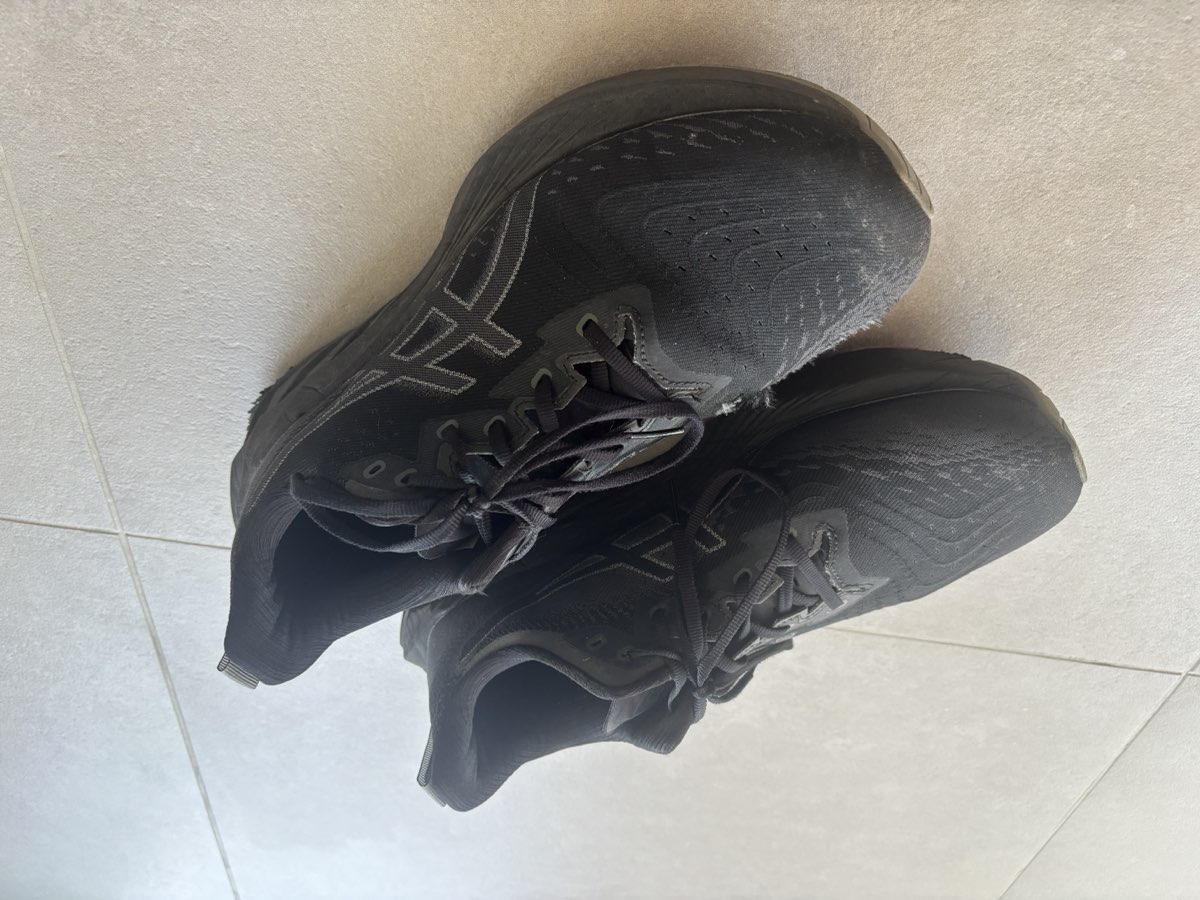
The shoe is visibly worn but structurally intact. No holes in the upper, no separation between midsole and outsole, no dramatic collapse. If you saw these on a shelf without context, you would guess maybe 500-600km. They are aging gracefully.
The Sole
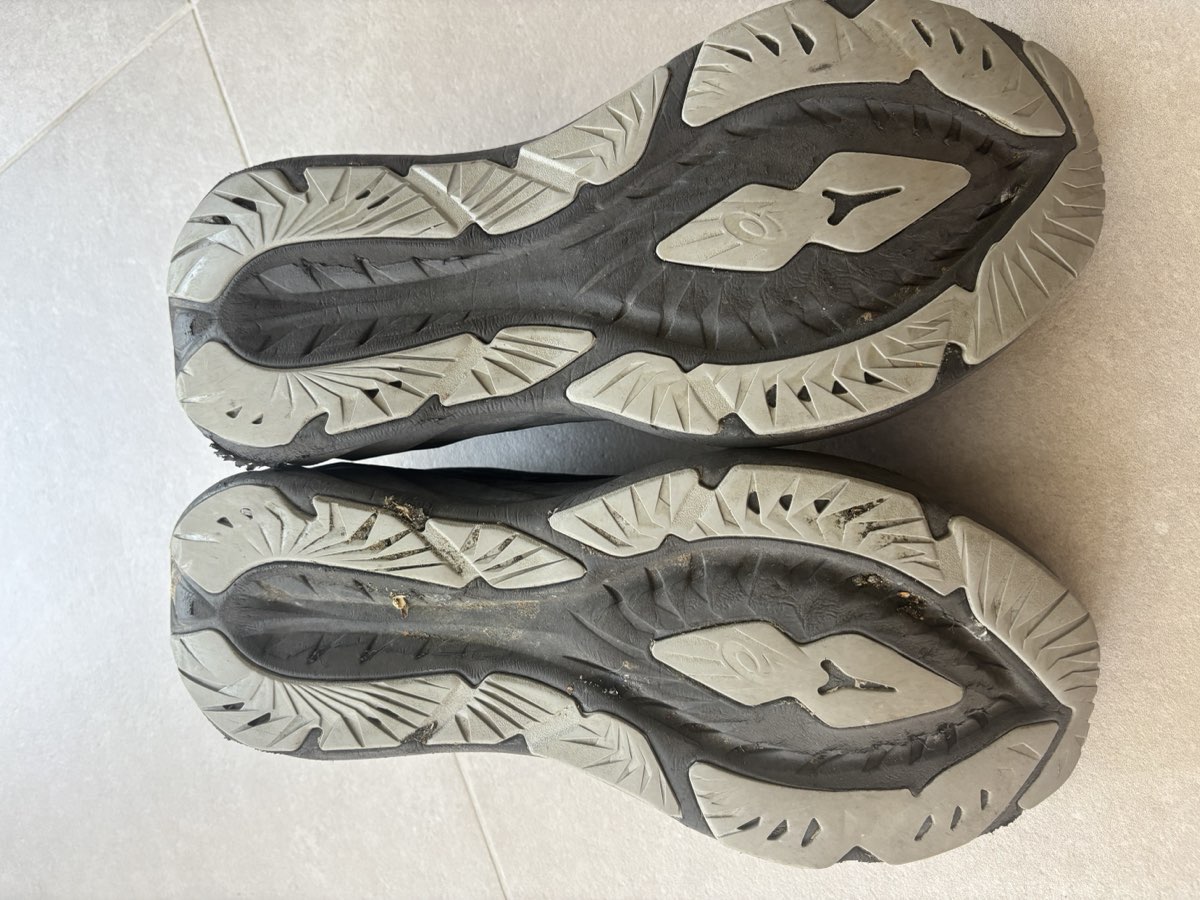
The outsole tells the real story. The rubber compound ASICS uses (AHAR+) has worn smooth in the heel and forefoot strike zones. The textured tread pattern is completely gone in high-wear areas. On the lateral heel where I first contact the ground, the rubber is thin enough to see the midsole foam through it in one spot.
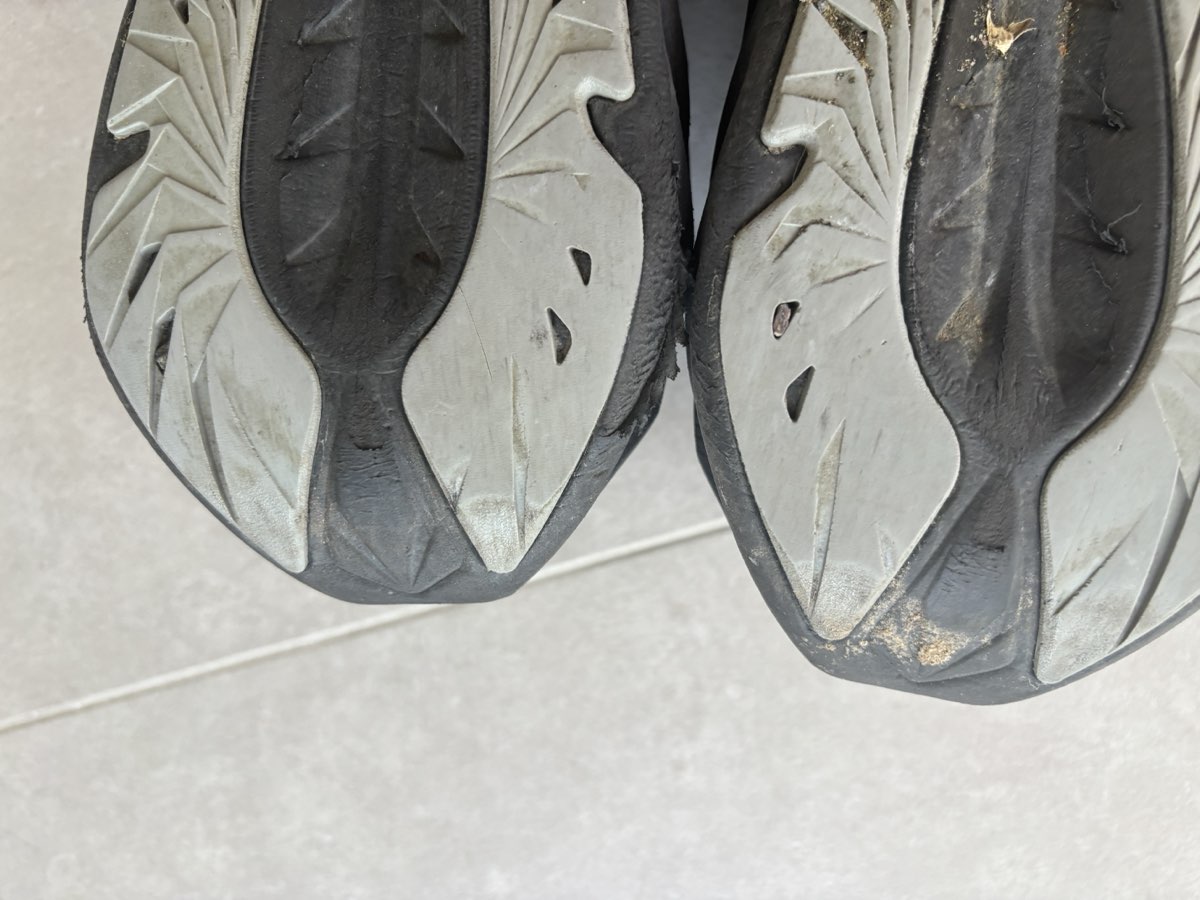
Zooming in on the forefoot: the AHAR+ rubber still has life in lower-contact areas (medial forefoot, midfoot arch), but the primary push-off zone is smooth as a worn tire. Grip on wet surfaces has noticeably decreased. I would not trust these on a rainy day anymore.
The Side Profile
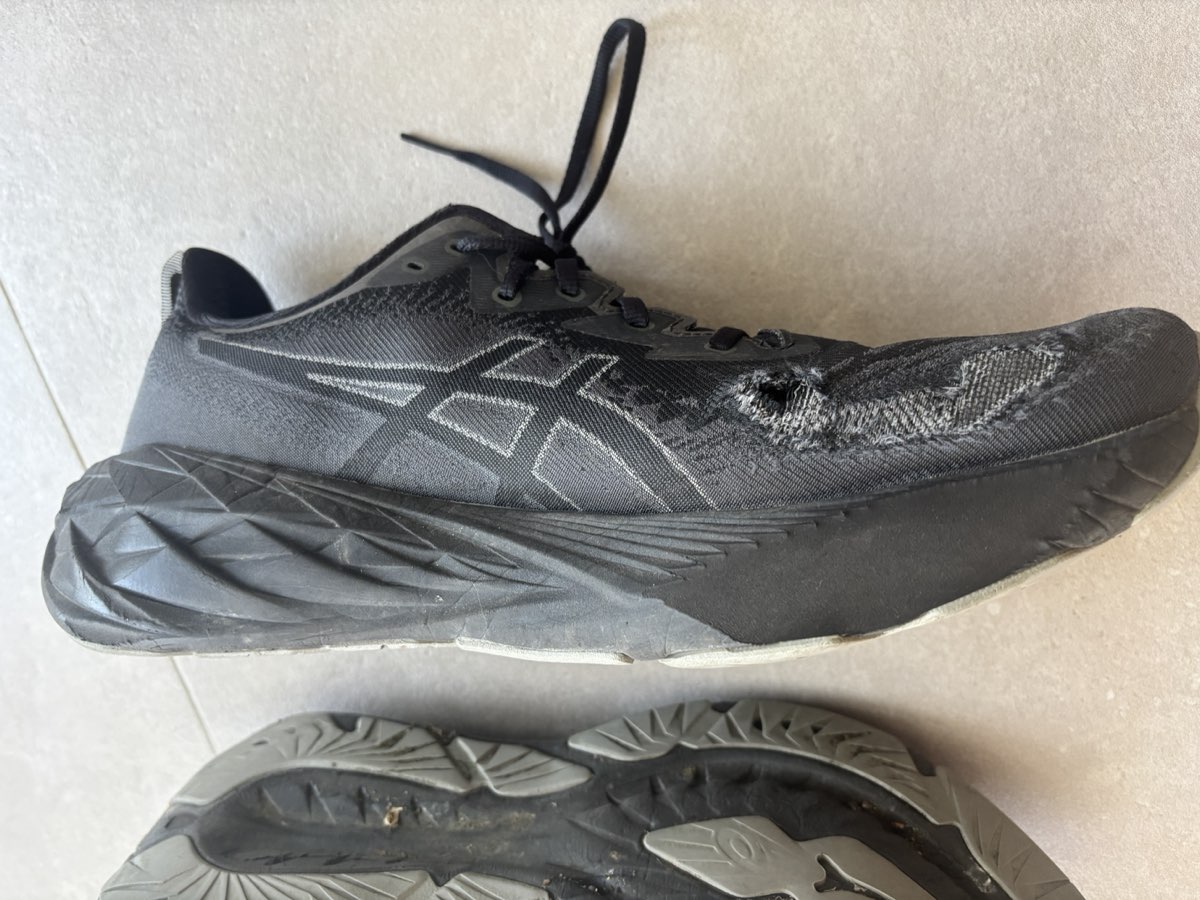
Looking at the midsole from the side reveals compression that photos struggle to capture. The FF Blast Plus foam has compressed approximately 2-3mm in the heel compared to when new. You can see creasing along the medial wall that was not there at 500km. The foam looks tired.
The midsole lean is minimal though. No significant inward or outward collapse. The shoe has maintained its geometric integrity even as the foam has softened. This is impressive for 1000km.
Cushion Degradation Timeline
Here is how the FF Blast Plus foam aged:
0-200km: Fresh, bouncy, responsive. The Novablast 4 at its best. Heel landings felt cushioned and the forefoot had a noticeable spring. This is when people write their glowing initial reviews.
200-500km: Peak broken-in feel. Foam had molded slightly to my foot shape. Still responsive, slightly less “new shoe” bounce. Best riding window.
500-700km: The decline begins. Bounce reduced noticeably. Landing felt more like “cushioned” and less like “springy.” Still comfortable for easy runs.
700-900km: Clearly past its performance window. The foam absorbs impact but returns very little energy. Each step feels flat rather than propulsive. I started limiting these to shorter easy runs only.
900-1000km: The current state. Functional in the sense that it does not hurt to run in them. But the cushioning is purely protective, not performance-enhancing. I feel ground contact more than I should in a shoe with this stack height. These are now beach runs and short recovery jog shoes only.
Durability Verdict: Exceptional
A 7/10 shoe that lasts 1000km is genuinely remarkable. Most shoes in the daily trainer category are finished between 600-800km. Getting 1000km from the Novablast 4 means:
- Cost per kilometer: approximately EUR 0.09/km (bought at EUR 90 on sale)
- That is half the cost-per-km of my Endorphin Speed 3 (EUR 0.12/km)
- And one-third the cost-per-km of carbon plate race shoes
For budget-conscious runners who prioritize longevity, the Novablast 4 delivers exceptional value. You sacrifice some performance sparkle for reliability that just keeps going.
What Made It Last This Long
Three factors contributed to the Novablast 4’s longevity:
1. Thick midsole stack. More foam means more material to compress before it bottoms out. Even after significant degradation, there is still enough foam between your foot and the ground.
2. AHAR+ outsole compound. The high-abrasion rubber on the Novablast 4 is genuinely tough. Even at 1000km, only small sections have worn through completely. The majority of the outsole still has rubber coverage.
3. Rotation usage. I did not run exclusively in the Novablast 4. It was one of 3-4 shoes in my rotation, getting 2-3 runs per week. Shoes that get 24-48 hours between uses bounce back better than shoes used daily. The foam recovers between sessions.
Comparison to Other Shoes at High Mileage
Having pushed several shoes past 600km, here is how the Novablast 4 compares:
| Shoe | Retirement Km | State at Retirement | Rating |
|---|---|---|---|
| ASICS Novablast 4 | 1000km (ongoing) | Flat but functional | 7/10 |
| Saucony Endorphin Speed 3 | 740km | Foam still decent, outsole gone | 9/10 |
| Adidas Boston 12 | 600km | Bounce dead, upper holed | 8/10 |
| Nike Pegasus 40 | 700km | Foam flat, heel worn | 7/10 |
The Novablast 4 outlasts everything else in my rotation by a significant margin. The trade-off is clear: it was never the most exciting shoe in the first place, so the degradation from “good” to “okay” is less dramatic than a high-performance shoe going from “amazing” to “dead.”
Who Should Buy the Novablast 4
Based on 1000km of experience, the Novablast 4 is ideal for:
High-mileage runners who need a durability workhorse. If you run 60-80km per week and go through shoes fast, the Novablast 4 saves money by lasting.
Easy day shoes in a rotation. It is comfortable without being fast, which makes it a good companion to more aggressive shoes for quality days.
Budget runners. At sale prices (EUR 90-100), the cost per kilometer is exceptional. You could run a full year on one pair if needed.
Heavier runners. The thick foam stack and stable platform handle higher body weights well without bottoming out prematurely.
It is NOT ideal for:
Runners who want one shoe for everything. The Novablast 4 does not handle tempo or speed work well. It is too heavy and too soft (early on) or too dead (later) for faster efforts.
Runners who care about ride quality over longevity. Other shoes in the same price range feel better on a run-to-run basis even if they do not last as long.
Would I Buy It Again?
Probably not as my primary daily trainer. I prefer the Adidas Evo SL for its more engaging ride, and the Endorphin Speed 3/5 for versatility. But as a pure easy-day durability shoe at a sale price? It made financial sense and it did not let me down.
The Novablast 4 is the shoe I recommend to friends who ask “what is a reliable shoe that will not break the bank per kilometer?” It is not the shoe I recommend when they ask “what shoe will make running more fun?” Those are different questions with different answers.
What Replaces It Now
The Novablast 4 at 1000km is now relegated to:
- Beach runs (sand is gentle on worn foam)
- Very short recovery runs (under 4km)
- Walking around when I do not care about shoe condition
For actual training, it has been replaced in my rotation. I am eyeing the Novablast 5 if it goes on sale, but I am in no rush. Its slot in my rotation is currently filled by shoes that bring more energy to each run.
For a proper comparison of daily trainers in this space, check the ASICS vs Nike brand breakdown I put together.
FAQ
How many kilometers should ASICS Novablast 4 last?
Based on my experience, 700-800km is the comfortable performance lifespan where the foam still provides meaningful cushioning. You can push to 900-1000km if you accept reduced performance and limit the shoe to easy runs. Beyond 1000km, the injury risk from degraded cushioning outweighs the savings from extended use.
Is the Novablast 4 a good first running shoe for beginners?
Yes. The generous cushion, stable platform, and durable construction make it forgiving for new runners who are still developing form and building joint resilience. It will last long enough that a beginner can develop their preferences before needing to buy again. Just be aware it is not particularly exciting, which some beginners need for motivation.
Does rotating shoes really make them last longer?
Research and my personal experience say yes. Giving foam 24-48 hours between runs allows the material to recover from compression. In my rotation, shoes used every other day consistently outlast shoes used daily by 15-25%. The Novablast 4’s 1000km lifespan was partly enabled by having 2-3 other shoes sharing the workload.
When should I replace the Novablast 4 based on feel rather than kilometers?
Replace when you notice: legs feeling heavier after easy runs, joint soreness that was not there at lower mileage, or the sensation that you are landing “into” the shoe rather than “on” it. These are signs the foam has degraded below protective levels. For me, that happened around 800km, but I kept using them at reduced duty.
Is the Novablast 5 significantly better than the 4?
Early reviews suggest the Novablast 5 has updated foam with better energy return and a revised geometry. The improvement is likely incremental rather than transformative. If you can find the Novablast 4 on heavy clearance (40%+ off), it remains excellent value. If buying at full price, the Novablast 5 is worth the upgrade for the updated ride.