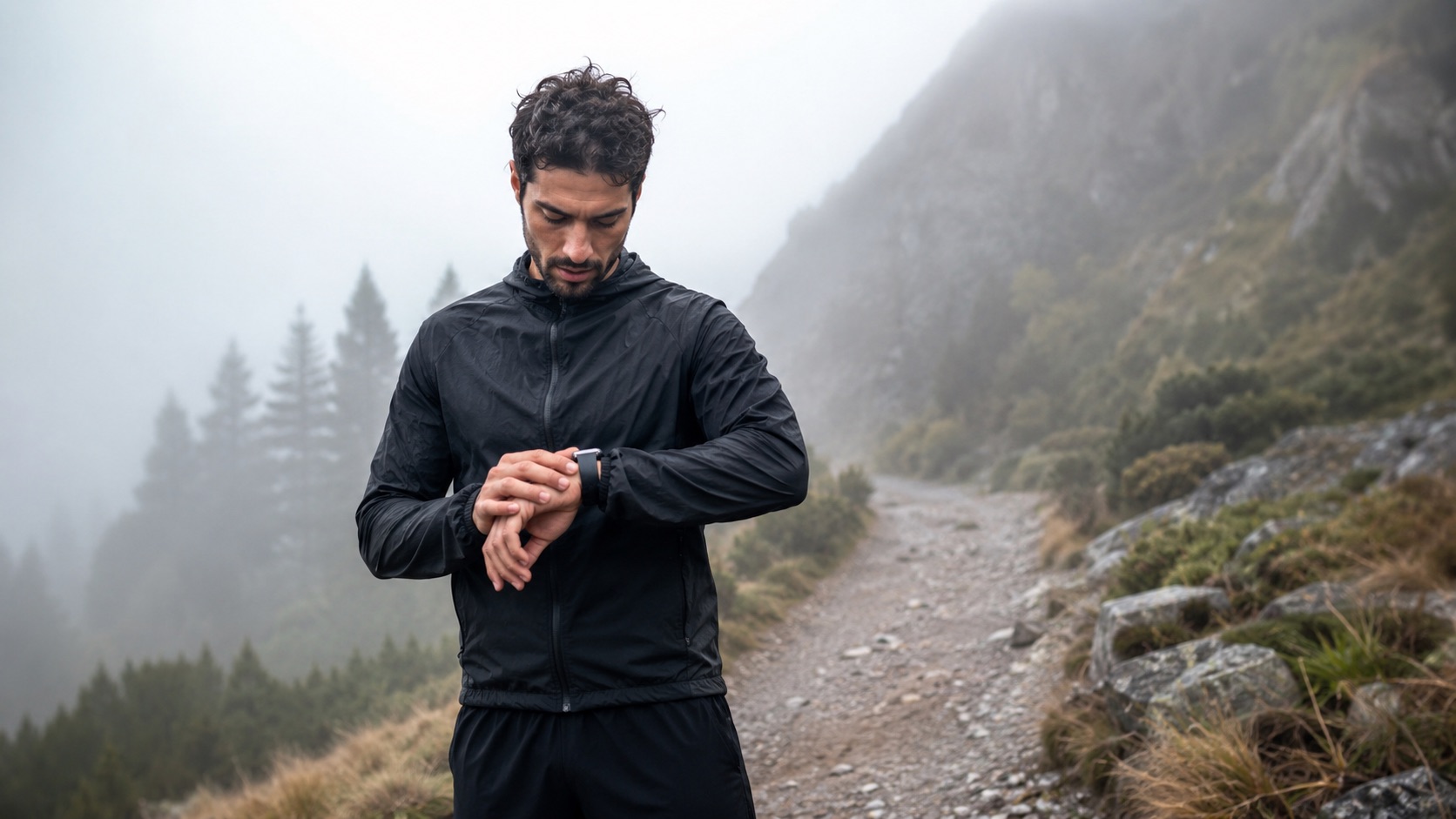
Running Watch vs Phone GPS - Which Is More Accurate?
It’s one of the most common questions from runners thinking about upgrading from a phone app to a dedicated GPS watch: is it actually more accurate, or am I paying hundreds of dollars for the same data in a different form factor? The short answer is yes, a GPS watch is more accurate. The longer answer is that the gap depends on where you run, how you carry your phone, and what kind of accuracy actually matters for your training.
Let’s break down the real differences with data, not marketing claims.
How GPS Works (Quick Version)
Both your phone and your watch use signals from satellites orbiting Earth to calculate your position. The more satellites they connect to, and the cleaner those signals arrive, the more accurate your position fix. Errors creep in from signal reflection (multipath), atmospheric interference, and satellite geometry.
Modern GPS watches use multi-band GNSS - meaning they connect to multiple satellite constellations (GPS, GLONASS, Galileo, BeiDou) on multiple frequency bands. This dramatically reduces error, especially in challenging environments like forests, cities, and mountains.
Phones also access multiple constellations, but typically on a single frequency band, and their GPS chipset shares processing power with a hundred other tasks your phone is doing simultaneously.
The Accuracy Comparison
Here’s how dedicated GPS watches and smartphones compare across common running scenarios:
| Scenario | GPS Watch (Multi-band) | Phone (Single-band) | Typical Difference |
|---|---|---|---|
| Open road, clear sky | ±1–2% distance error | ±2–3% distance error | Minimal - both fine |
| Urban streets (low buildings) | ±2–3% error | ±3–5% error | Watch slightly better |
| Urban canyon (tall buildings) | ±3–5% error | ±5–12% error | Watch significantly better |
| Dense forest / tree cover | ±2–4% error | ±4–8% error | Watch noticeably better |
| Track (400m oval) | ±2–4% per lap | ±5–15% per lap | Watch much better |
| Treadmill (no GPS) | Accelerometer-based | Accelerometer-based | Both inaccurate without footpod |
| Mountain trails (elevation) | ±3–5% error | ±5–10% error | Watch better, especially with barometer |
| Pace consistency (live) | Smooth, 3–5s lag | Jumpy, 5–15s lag | Watch far more usable live |
Key Takeaway
In open, flat environments with clear sky, both are acceptable. The real difference shows up in challenging GPS conditions and in live pace data quality. If you run primarily on open roads in suburban areas, a phone gets you within 3% accuracy - good enough for general training. If you run in cities, forests, or trails, a watch gives you meaningfully better data.
Why Watches Are More Accurate
Antenna Position
This is the biggest factor. A GPS watch sits on your wrist, exposed to the sky with minimal body obstruction. Your phone sits in a pocket, armband, or vest - surrounded by your body, fabric, and potentially other electronics. The body blocks and reflects satellite signals, degrading accuracy.
Armband positioning helps (compared to a pocket), but still can’t match a wrist-mounted antenna that’s designed solely for GPS reception.
Dedicated GPS Chipset
GPS watches contain chipsets designed exclusively for position tracking. They’re optimized for continuous satellite lock, low-power GPS acquisition, and signal processing. Your phone’s GPS chipset shares silicon with cellular, WiFi, Bluetooth, camera processing, and whatever apps you’re running. It works well, but it’s not purpose-built for movement tracking.
Multi-Band GNSS
Most premium GPS watches in 2026 use dual-frequency (L1+L5) GNSS, which dramatically reduces multipath error in urban and forested environments. Most phones still use single-frequency GPS. The L5 band is newer, more accurate, and less susceptible to signal reflection off buildings and surfaces.
For detailed testing of specific watch models, our GPS accuracy testing article covers real-world results.
Sampling Rate
GPS watches typically record position points every second. Many phone apps record every 2–5 seconds to save battery, then interpolate between points. On a straight road, this barely matters. On winding trails or track curves, fewer sample points mean the recorded path cuts corners, shortening measured distance.
Where Phones Actually Do Fine
Let’s be fair - for many runners, phone GPS is perfectly adequate:
- Easy runs where precise pace doesn’t matter - if you’re running by feel and just want approximate distance afterward, a phone works
- Straight, open roads - suburban neighborhoods and bike paths give phones clean signal
- Casual runners tracking weekly mileage - 3% error on a 5-mile run means 0.15 miles off, which rarely matters for general fitness
- Budget-limited runners - any GPS is better than no GPS when starting out
Where Watches Pull Ahead Significantly
- Interval training - live pace needs to be responsive and accurate for hitting splits
- Trail and mountain running - winding paths, tree cover, and elevation changes compound phone errors
- City running - tall buildings create multipath errors that single-frequency phones struggle with
- Racing - when you’re trying to execute a specific pace strategy, accuracy matters
- Track workouts - GPS watches still aren’t perfect on tracks but are meaningfully closer to actual lap distance
The Live Pace Problem
Even if total distance is similar over a full run, live pace data differs enormously. A GPS watch provides smooth, responsive pace readings with 3–5 second lag. Phone apps often show pace jumping erratically between 5:30/mi and 7:00/mi when you’re actually running a steady 6:15/mi.
This matters for tempo runs, interval training, and race execution. If your pace display is unreliable, you either ignore it (defeating the purpose) or chase numbers that aren’t real (leading to uneven efforts).
What About Apple Watch?
The Apple Watch Ultra 2 and Series 9 have improved GPS accuracy substantially, using dual-frequency GPS. They land somewhere between a phone and a dedicated running watch - better than a phone in your pocket, but still not quite matching Garmin or COROS for live pace smoothness and deep GPS optimization. Our full GPS watch comparison covers where Apple Watch fits in the ecosystem.
Do You Actually Need a GPS Watch?
Ask yourself these questions:
- Do you train with pace targets? If yes, a watch gives more reliable live data.
- Where do you run? Urban, forest, or trail runners benefit most from watch accuracy.
- Does 3–5% distance error bother you? If you’re meticulous about logging accurate mileage, a watch helps.
- Do you race and want pace strategy? Reliable real-time pace is essential for execution.
- Is budget a concern? Great watches exist under $200 now.
If you answered yes to 2+ questions, a GPS watch is worth it. If you run casually on open roads for general fitness, your phone is probably fine.
Maximizing Phone GPS Accuracy
If you’re sticking with your phone for now, these tips help:
- Use an armband - keeps the phone exposed to sky, better than a pocket
- Close background apps - gives the GPS chipset more processing power
- Enable high-accuracy mode - usually in location settings, uses more battery but better signal
- Avoid starting in GPS-challenged spots - let the app acquire signal in an open area before entering tree cover
- Use a phone with dual-frequency GPS - newer flagship phones (iPhone 15+, Pixel 7+) have L5 support
Frequently Asked Questions
How much distance error does a phone typically have compared to a watch?
On average, phones measure 3–5% less distance than actual on challenging routes (forests, cities, winding paths) due to corner-cutting from lower sampling rates and signal reflection. On open, straight roads, the error drops to 1–3% - closer to watch-level accuracy. Over a 10K, that could mean your phone shows 9.7 km while a watch shows 10.0 km and the actual distance is 10.0 km. On an easy loop around your neighborhood, you might not notice any difference.
Is a cheap GPS watch better than an expensive phone for running accuracy?
Generally yes, for running-specific accuracy. Even a $150 GPS watch has a dedicated GPS chipset, wrist-mounted antenna, and continuous satellite tracking optimized for movement. An $1100 phone has better general computing but its GPS shares resources and sits in a suboptimal position. The watch will give more consistent distance, smoother live pace, and better performance in challenging GPS environments. The phone wins at everything else (music, calls, maps, apps).
Why does my phone show a shorter distance than my running watch?
Three reasons: lower sampling rate (phone records fewer GPS points, cutting corners on curved paths), signal reflection in challenging environments (buildings and trees cause larger errors for single-frequency phone GPS), and position on your body (a phone in a pocket or vest gets partial signal blockage from your body). The combination typically means phone-measured distances run 2–5% short, with the gap widening on curvy or GPS-challenged routes.
Can I improve my phone’s GPS accuracy with a specific app?
Some apps perform better than others. Apps that use raw GPS data at higher sampling rates (like some paid running apps) outperform those that aggressively smooth or downsample data. However, the fundamental hardware limitations remain regardless of app choice. The biggest improvements come from phone placement (armband vs pocket) and ensuring your phone has a clear view of the sky. No app can overcome a weak satellite signal caused by your body blocking the antenna.
Do I still need a phone if I have a GPS watch?
For safety, many runners still carry a phone - especially on trails, early morning runs, or in unfamiliar areas. But for data tracking, a GPS watch replaces the phone’s running app entirely and does it better. Most watches sync wirelessly to your phone after the run anyway, so you still get the data in your preferred app (Strava, Nike Run Club, etc.) without needing the phone on your body during the run.
Related reading: Garmin vs COROS vs Apple Watch - Which Brand for Runners?