
Running as a Family: How We Make Training Work with 3 Kids
Running as a Family: How We Make Training Work with 3 Kids
Two parents. Both training for half marathons. Three kids: ages 2, 6, and 8. Zero babysitter during most training sessions. And somehow, we both run 3-4 times per week consistently. This is our complete system for making it work, every week, without resentment, without missing key sessions, and without the kids suffering for our hobby.

It is not easy. It requires planning, communication, flexibility, and the willingness to occasionally run at 5:30 AM in the dark. The schedule below is our default, not a perfect week we reproduce mechanically. School events, illness, bad sleep and work regularly move or cancel sessions. What has lasted for more than a year is the way we negotiate the week, not every individual slot.
The Schedule System: Morning/Evening Split
The foundation of everything is a shared calendar with non-negotiable running slots. Here is what a typical week looks like:
Monday:
- Jos: morning run before kids wake (6:00 AM)
- Sarah: rest day
Tuesday:
- Sarah: morning run (6:00 AM, Jos handles breakfast)
- Jos: rest day or strength work at home after bedtime
Wednesday:
- Jos: evening run after kids’ bedtime (8:30 PM)
- Sarah: rest day
Thursday:
- Sarah: evening run (8:30 PM, Jos on bedtime duty)
- Jos: rest day
Friday:
- Rest for both (family dinner, no running obligations)
Saturday:
- One parent does their long run early morning (5:30-7:30 AM)
- Other parent handles kids’ morning routine
- Alternates weekly
Sunday:
- Other parent does their long run early morning
- Or: family activity day (kids’ run included)
Total: Jos gets 3-4 runs. Sarah gets 3-4 runs. Nobody runs during active family time. Nobody resents the other person’s training.
The Rules That Prevent Resentment
After some early friction (one person always feeling like they sacrifice more), we established explicit rules:
Rule 1: Running slots are pre-agreed, not ad hoc. Nobody suddenly announces “I’m going for a run” and walks out. Sessions are on the shared calendar. Both people know in advance when they are solo-parenting.
Rule 2: Equal opportunity. If Jos gets three runs this week, Sarah gets three runs this week. No excuses about “I have a race coming up so I need more.” Both people’s training matters equally.
Rule 3: Flexibility without guilt. If a kid is sick and one parent’s session gets cancelled, it gets rescheduled, not lost. “I owe you one” is a valid arrangement.
Rule 4: Key sessions are protected. The tempo run and the long run are the ones that cannot move easily. Easy runs are flexible. If something has to give, it is always the easy day, never the quality session.
Rule 5: Kids come first. Always. If both kids are crying and the baby will not sleep, nobody runs. Period. Training plans are not more important than family stability. We have both missed runs for this reason, and neither keeps score.
The Morning Slot: 5:30-6:30 AM
The early morning is the single best hack for parent-runners. Benefits:
- Kids are asleep. No childcare needed.
- No impact on family time.
- Done before the day starts. Cannot be displaced by unexpected events.
- Cooler temperatures in summer.
- Mental health benefit: starting the day with something accomplished.
Downsides:
- Requires going to bed earlier (9:30 PM most nights for us).
- Dark and cold in winter.
- Alarm clock discipline on tired mornings.
Both Sarah and I have built the early morning habit over time. It was miserable for the first two weeks. Now it is automatic. The alarm goes at 5:30, the running clothes are laid out from the night before, and the door is open by 5:40.
For long runs (Saturday/Sunday), one of us starts at 5:30 and is back by 7:15-7:30. The other parent sleeps until 6:30, then handles the kids’ morning routine. This works because the kids rarely wake before 6:45.
The Evening Slot: After Bedtime
The 8:30 PM slot works when the kids actually go to sleep on time (not guaranteed). Benefits:
- All parenting duties complete for the day.
- Can be social (running club, partner runs, group track sessions).
- No time pressure (if bedtime runs late, you just start later).
Downsides:
- If kids will not sleep, the run gets pushed later or cancelled.
- Harder to motivate after a long day.
- Summer heat can still be present at 8:30 PM.
- Need to eat dinner early enough to digest.
I use the evening slot for my tempo/interval sessions because they happen at our running club (8:30 PM track session on Wednesdays). Sarah uses it for her third weekly run when the morning is not possible.
Weekend Long Runs: The Alternating System
The weekend long run is the most logistically complex session. It needs 60-90+ minutes of uninterrupted running time, which means someone is solo with three kids for that duration.
Our system: strict alternation. If Jos does Saturday long run, Sarah does Sunday long run. Next week, swap. The non-running parent genuinely gets to sleep in (relatively) on the other day.
If weather or events force both long runs onto the same day, we sequence: Jos runs 5:30-7:00, then Sarah runs 7:30-9:00. The two-hour-old-wake gap means someone is always home. This only works because our oldest can entertain the middle child while one parent handles the toddler.
Getting the Kids Involved
Making running a family identity (not just a parent hobby) reduces friction enormously. When kids feel included rather than excluded by your training, they stop seeing running as “the thing that takes mommy/daddy away.”
How we include them:
Family run outings: Once or twice a month, the whole family goes to a park. Kids run their own mini-course. Sarah and I take turns doing loops around the park perimeter while one of us stays with the kids. Getting kids to love running has the specific games we use.
Family events: We sign up for races where parents and kids both participate. Parents run the half marathon. Kids do 1km. Same morning, same medals, shared celebration. The 8-year-old trains for “our race” with genuine enthusiasm.
Race day involvement: When one parent races, the whole family comes to cheer. Kids make signs. They wait at the finish line. The runner crosses and immediately it is a family moment, not an individual one.

Kids’ gear: Both older kids have proper running shoes (we went with the Kiprun K500 Fast) and “running outfits.” Looking the part helps them feel included in the family running culture.
The Toddler Problem
Our 2-year-old cannot participate in running activities. Cannot be left alone. Cannot be taken on routes in a jogger stroller easily (we do not have one and the terrain is not stroller-friendly). The toddler is the primary logistics challenge.
Solutions:
- Morning runs before toddler wakes (works 90% of the time)
- Evening runs after toddler sleeps (bedtime is 7:30, earlier than the older kids)
- Weekend runs while other parent handles all three kids (including toddler)
- Occasionally: grandparents visit and one parent does a rare mid-morning run
The toddler phase is temporary. In a year, the logistics get significantly easier. We accepted that this season of life requires more creativity and more sacrifice of ideal training times.
What Sarah Learned Starting Later
Sarah started running consistently about 18 months ago. Her learning journey happened while already being a mother of three. That means she never had the luxury of unlimited training time. Every running habit she built was within the family constraint from day one.
Her advice: “Start with what is realistic, not ideal. Two runs per week consistently beats four runs per week that collapse after two weeks because the schedule is unsustainable.”
She started at two runs per week, then built to three after proving it worked within family logistics. Now she does 3-4 consistently. The gradual build prevented the boom-bust pattern that derails many parent-runners.
Race Day Logistics with Three Kids
When both parents race the same event (we aim for this 2-3 times per year), the logistics require outside help:
- Grandparents arrive the night before
- Kids sleep at normal time
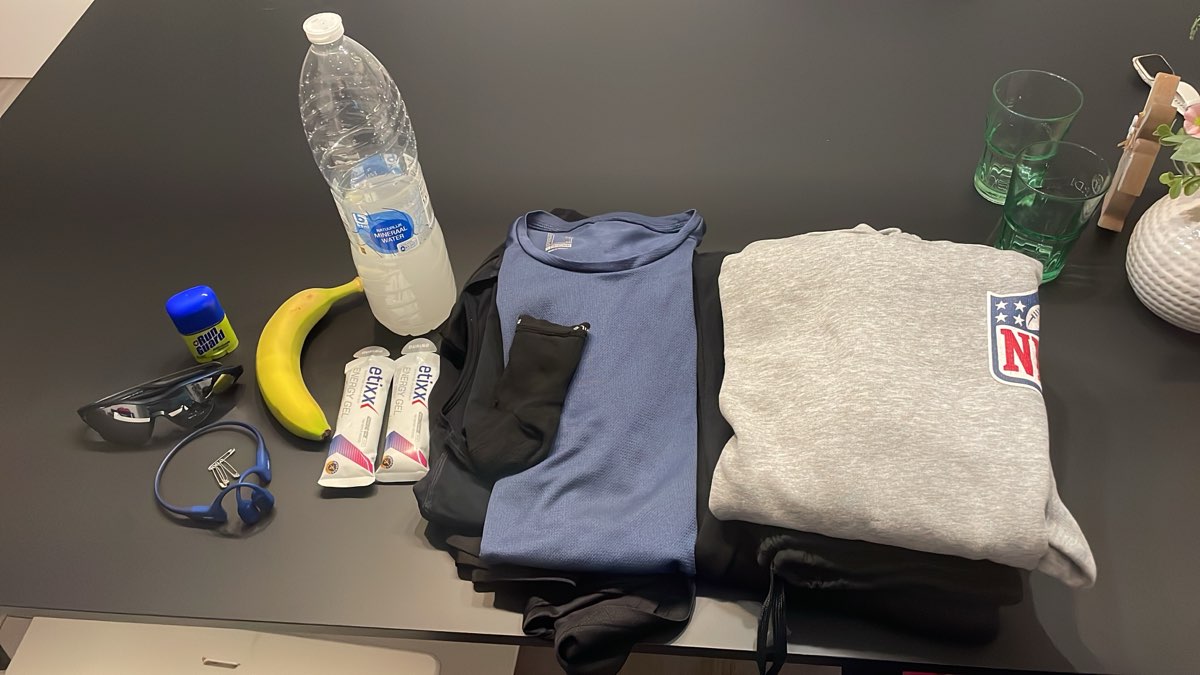
- Parents eat race breakfast early (5:30 AM for a 9:00 start)
- Grandparents manage kids at the start/finish area
- Kids do their event (usually 1km) while grandparents supervise
- Parents cross finish line and family reunites
When only one parent races, the other brings the kids to spectate. This is easier but means one parent has no weekend run that week (they take their long run another day).
For races requiring travel, we bring the whole family and make it a mini-trip. Hotel with a pool, sightseeing the day before, race morning, then family activity the afternoon after. Running never exists in isolation from family life.
The Gear That Makes It Work
Practical equipment for parent-runners:
Headlamp: Essential for 5:30 AM winter runs and 8:30 PM evening sessions. A good one costs EUR 25 and enables 6 months of dark training.
Minimal-fuss outfits: Clothes laid out the night before. Shoes by the door. Garmin on the charger. When you only have a 60-minute window, spending 10 minutes finding gear is unacceptable.
Phone with route loaded: For morning runs on auto-pilot when your brain is barely awake.
Three runs per week gear that eliminates decision fatigue: one easy shoe, one fast shoe, done.
When It Does Not Work
There are weeks where the system fails:
- Kid illness (someone always home, no running for either parent)
- Work travel (solo parent cannot run without childcare)
- Sleep deprivation (toddler teething, nobody wakes at 5:30)
- School holidays (routine disrupted, no morning window)
These weeks, we both accept reduced running or zero running. No guilt. No attempts to “make up” missed sessions. The training adapts to life, not the other way around. Consistency over months matters infinitely more than any single week.
We also do not treat a missed run as a debt that the other parent must repay. We look at fairness over several weeks. That distinction matters: a shared calendar helps, but keeping score turns a useful system into another source of pressure.
The Results
Despite all constraints, both of us are running PBs and improving:
- Jos: targeting sub-40 10K and a half marathon PB this season
- Sarah: went from zero to half marathon in 18 months while managing three kids
The system works not because it is perfect, but because it is sustainable. We can maintain it week after week, month after month. A 90% adherence rate to a realistic plan beats 100% adherence to an unsustainable plan for three weeks before collapse.
Running as a family is not about individual performance optimization. It is about two parents supporting each other’s health and goals while raising three kids who grow up seeing physical activity as normal, positive, and shared.
FAQ
How do you handle one parent wanting to train more than the other?
We revisit the schedule every 4 weeks and adjust. If one parent has a race approaching and needs a fourth quality session, the other gets compensated (an extra sleep-in, a solo outing, or a future training priority). Communication is everything. Silent resentment kills both the relationship and the motivation.
What if your kids wake up before your morning run?
It happens maybe once per week. If it is the toddler, the running parent pauses to settle them (usually 5 minutes), then leaves. If the older kids wake, they know the rule: stay in bed or play quietly until the non-running parent gets up. This required explicit training and boundary-setting when we started.
Is it realistic for both parents to train for a marathon simultaneously?
With three kids under 8, probably not at our current life stage. Marathon training requires 4-5 runs per week including one very long run (2.5-3 hours). That is significantly more time than half marathon training. We made the conscious choice to target half marathons until the toddler is older and logistics become easier. Maybe in two years.
How do you stay motivated when sleep-deprived from kids?
The 80% rule: if I am only at 80% capacity, I still run but adjust expectations. Shorter easy runs. Lower intensity. No tempo sessions on bad sleep nights. The run still happens but it is kinder. Running at 80% is better than not running. The exception: if I had less than 5 hours of sleep, I skip and rest.
Does your running schedule ever cause relationship tension?
Yes, sometimes. Usually when one person feels they are sacrificing more (handling bedtime solo too often, always being the one whose run gets cancelled). The solution is always communication: checking in monthly about whether the split feels fair, being willing to adjust, and remembering that the shared goal (both being healthy, both being happy) matters more than any individual training week.