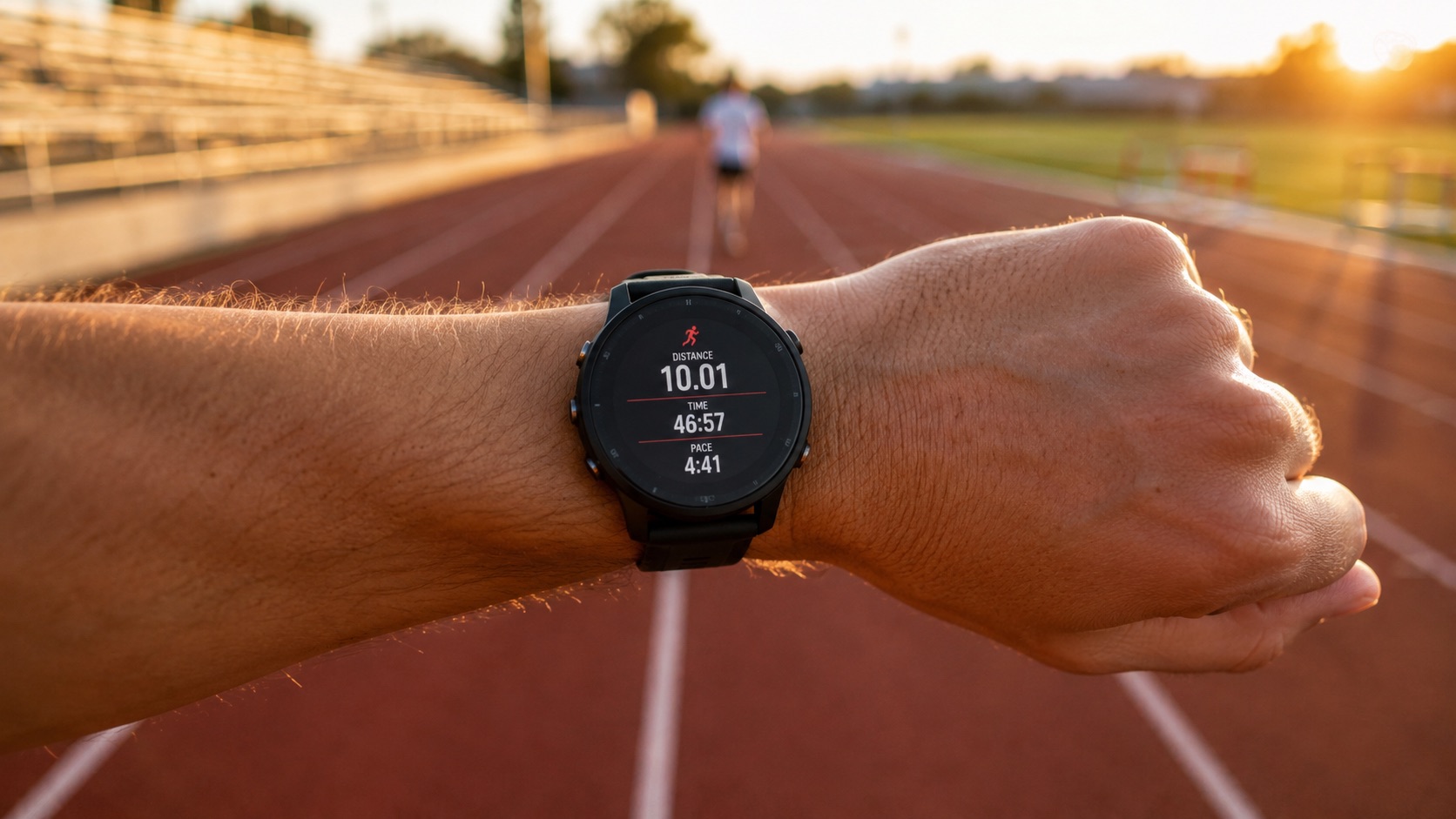
Best GPS Watch for 5K and 10K Racing 2026
Best GPS Watch for 5K and 10K Racing 2026
If you’re racing short distances, you need a watch that thinks as fast as you run. A bulky multisport beast with week-long battery life? That’s not what matters when you’re toeing the line at a 5K. What matters is weight on your wrist, how quickly the GPS locks on, and whether the watch can keep up with your interval workouts during training.
I’ve researched dozens of GPS watches over the years, and for 5K and 10K racing specifically, the priorities are different from marathon or ultrarunning. You want something light enough that you forget it’s there, accurate enough to nail your splits, and smart enough to guide your speed sessions. Let me walk you through the best options in 2026.
What Makes a Great 5K/10K Racing Watch?
Before diving into specific models, here’s what actually matters for short-distance racing:
Weight. Every gram counts when you’re pushing pace. Heavier watches bounce on your wrist and become a distraction during fast efforts. Anything under 40g is ideal for racing.
GPS lock speed. Standing at the start line with 200 other runners, you don’t want to miss the gun because your watch is still searching for satellites. Multi-band GPS and caching systems help enormously here.
Interval features. Most 5K and 10K training plans revolve around track repeats, tempo runs, and fartleks. Your watch needs to handle structured workouts without fumbling through menus mid-session.
Screen readability at pace. When you’re running 4:00/km or faster, you get maybe half a second to glance at your wrist. High-contrast displays and customizable data fields make or break this.
Accurate instant pace. Nothing is more frustrating than a watch showing wildly fluctuating pace during a race. The best watches smooth this data without lagging behind reality.
Comparison Table
| Watch | Price | Weight | GPS Type | Battery (GPS) | Best For |
|---|---|---|---|---|---|
| COROS Pace 4 | $350 | 32g nylon / 40g silicone | Dual-band | 41h (All Systems High) | Lightest option, serious racers |
| Garmin FR265 | $450 | 47g | Multi-band | 20h | Best all-rounder with AMOLED |
| Garmin FR165 | $300 | 39g | Multi-band | 17h | Budget-friendly with great features |
| Apple Watch Series 10 | $399 | 36g | L1 + L5 | 8h | iPhone users who want simplicity |
| Polar Pacer Pro | $280 | 41g | Assisted GPS | 35h | Training load insights on a budget |
The Picks, Ranked for 5K/10K Racing
1. COROS Pace 4 - Best Overall for Racing
At just 33 grams, the COROS Pace 4 is genuinely the lightest full-featured GPS watch you can buy in 2026. When you’re sprinting the final 400 meters of a 5K, you won’t even notice it’s there.
The dual-band GPS is accurate and locks on fast - typically under 10 seconds even in new locations. COROS has refined their satellite algorithms significantly, and the accuracy during track workouts has been excellent based on available data. Splits are consistent with known track distances.
The interval workout builder in the COROS app is straightforward and syncs instantly to the watch. You can build complex sessions with warmup, repeats, recovery, and cooldown blocks, then just follow the prompts during your session. The watch vibrates at each transition, so you can stay focused on running rather than staring at your wrist.
One minor downside: the screen isn’t AMOLED, so it’s not as vibrant as the Garmin FR265. But in bright sunlight - where most races happen - the MIP display is actually easier to read.
2. Garmin Forerunner 265 - Best Feature Set
The FR265 is heavier at 47g, but it packs features that serious runners will appreciate. The AMOLED screen is gorgeous and incredibly readable, even at a glance during fast running. You get Training Readiness scores, race predictor, and the best running dynamics in the business (with an HRM strap).
For 5K/10K racing specifically, the FR265 shines with its PacePro feature. You can load a course and get recommended pacing guidance throughout the race. The real-time stamina metric also helps you understand exactly how much you have left in the tank.
GPS accuracy is top-tier with multi-band support, and lock time is typically under 5 seconds thanks to satellite caching. The watch also supports Connect IQ apps and data fields, so you can customize your race screen exactly how you want it.
The weight is noticeable compared to the COROS Pace 4, but for most runners it’s not a dealbreaker. If you want the most complete training ecosystem for short-distance racing, this is the one.
3. Garmin Forerunner 165 - Best Value
The FR165 brings most of the FR265’s running features to a lower price point. You still get multi-band GPS, the AMOLED display, structured workouts, and Garmin’s training metrics. What you lose is mainly storage space, some advanced training features, and a few grams.
At 39g and $300, it hits a sweet spot for runners who want Garmin’s ecosystem without the premium price. The interval workout experience is identical to the FR265, and GPS accuracy is just as good. For pure racing purposes, the differences between the 165 and 265 are minimal.
If you’re primarily a 5K/10K runner and don’t need deep training analytics, this saves you $150 while still delivering race-day performance.
4. Apple Watch Series 10 - Best for Casual Racers
The Apple Watch Series 10 at 36g is lighter than you’d expect, and Apple has significantly improved their running metrics over the past few years. You get ground contact time, stride length, vertical oscillation, and solid GPS tracking.
The dual-frequency GPS (L1 + L5) provides good accuracy, though it still trails Garmin and COROS in challenging environments like tree-lined courses. Battery life is the big limitation - 8 hours in GPS mode means you’re fine for racing, but you’ll be charging frequently during heavy training weeks.
The integration with Apple Music and the iPhone ecosystem is unmatched. If you’re already deep in the Apple world and want one device for life and running, it works well. But dedicated runners will find the workout customization more limited than Garmin or COROS.
5. Polar Pacer Pro - Best Training Insights Per Dollar
Polar doesn’t get the attention it deserves. The Pacer Pro at $280 offers genuinely useful training load tracking, recovery insights, and running power from the wrist - no extra accessories needed.
At 41g it’s mid-pack for weight, and the GPS (while not dual-band) is reliable and accurate for road racing. The FuelWise feature is more useful for longer distances, but the Training Load Pro system is excellent for managing the intensity that 5K/10K training demands.
The watch faces and interface feel slightly dated compared to AMOLED competitors, but functionality-wise it’s solid. If you care more about smart training guidance than flashy screens, Polar delivers.
Quick Tips for Race Day
- Lock GPS before lining up. Start your activity 2-3 minutes before the gun, then use the pause feature. This ensures satellites are tracked and your first split is accurate.
- Simplify your data screen. During a 5K, you only need current pace and elapsed time. Maybe distance. Remove heart rate and other distractions.
- Use auto-lap at 1km/1mi. The vibration gives you free split feedback without looking down.
- Turn off notifications. Nothing ruins a PR attempt like a text message buzzing your wrist at kilometer 4.
Which Watch Should You Pick?
If weight is your top priority and you want the best racing experience, go with the COROS Pace 4. It’s purpose-built for fast running and the 33g weight is remarkable.
If you want the deepest feature set and don’t mind a bit more weight, the Garmin FR265 is the complete package. If budget matters, the FR165 gets you 90% of the way there for $150 less.
Apple Watch users who race occasionally will be perfectly happy with the Series 10, and data-driven runners on a budget should look at the Polar Pacer Pro.
For a broader look at GPS watches across all distances, check out our complete GPS running watch guide. If budget is your main constraint, we’ve also ranked the best GPS watches under $300. And if you’re deciding between the two top picks here, our Garmin FR265 vs COROS Pace 4 comparison goes deep on the differences.
Related reading: Garmin vs COROS vs Apple Watch - Which Brand for Runners?
See how we compare products for our full research methodology.
FAQ
Is a lighter watch actually faster for racing?
Not directly - a few grams won’t change your finishing time. But lighter watches bounce less, distract less, and feel more comfortable during fast running. It’s a psychological and comfort advantage rather than a measurable speed one. That said, many elite runners specifically choose the lightest option available for race day.
Do I need multi-band/dual-frequency GPS for 5K and 10K races?
For most road races on open courses, single-band GPS is perfectly fine. Multi-band helps in challenging GPS environments - think city centers with tall buildings, heavily wooded trails, or courses near cliffs. If you race in open parks or standard road courses, you might not notice a difference. But for track accuracy and general consistency, multi-band is worth having.
Can I use my watch without a phone during a race?
Yes, all five watches on this list have standalone GPS and don’t require a phone connection during your run. They’ll track distance, pace, time, and heart rate independently. You only need your phone for syncing data afterward (and during setup). The Apple Watch can even do cellular if you have that model.
How accurate are GPS watches for track workouts?
Modern multi-band watches are typically accurate to within 1-2% on a standard 400m track. That means your 400m repeat might show as 395-405m. For the most precise track data, some runners use the track mode feature (available on Garmin and COROS) which uses the accelerometer to measure laps instead of GPS, giving near-perfect 400m splits.
Should I buy a separate racing watch and training watch?
Unless you’re an elite athlete optimizing every detail, no. Any watch good enough for racing is good enough for training. The COROS Pace 4 and Garmin FR265 both have enough battery life and features for daily training plus race day. Buying two watches only makes sense if you want something like a Fenix for ultras and a Pace 4 for track races.