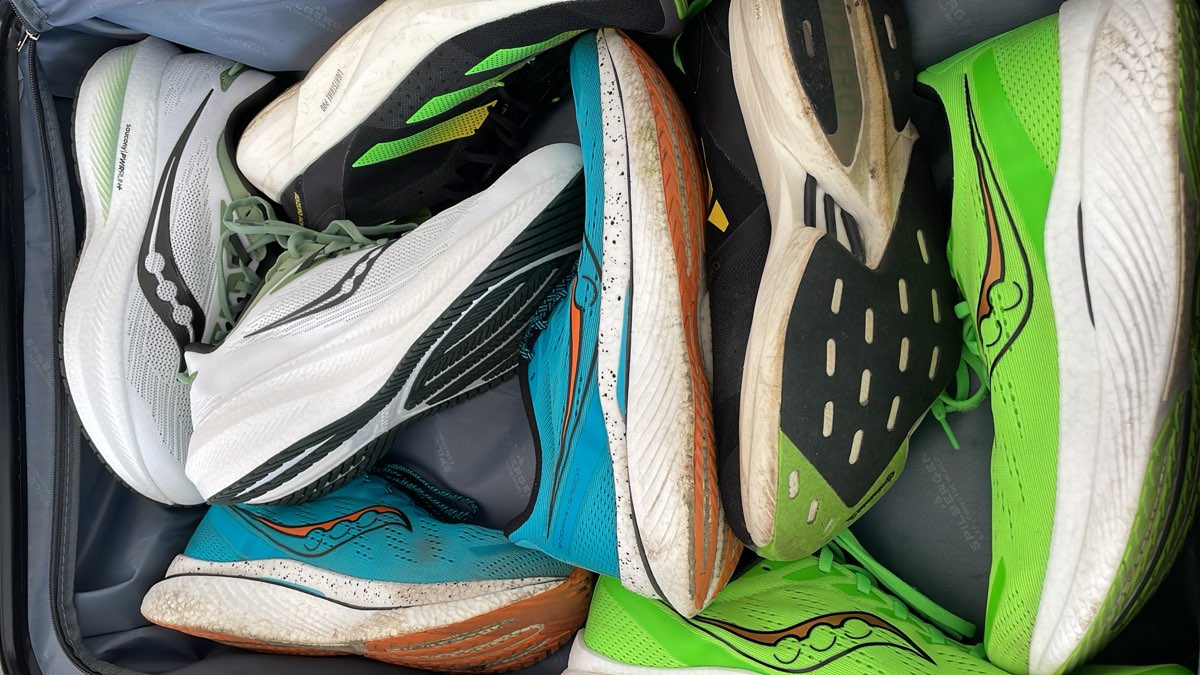
Traveling with Running Shoes: How I Pack 4 Pairs for a Trip
I opened my suitcase at the Mallorca apartment and my wife looked at me like I had lost my mind. Four pairs of running shoes. For a one-week holiday.
She had a point. Four pairs is excessive by any normal standard. But I was three weeks out from a half marathon, and this trip fell right in the middle of my peak training block. Skipping the most important training week of my cycle was not an option. And Mallorca’s terrain is varied enough that one shoe would not cover everything I needed.
Was it overkill? Probably. Would I do it again in the same circumstances? Absolutely.
Why I Packed 4 Pairs
Let me explain the logic, because there is logic behind the madness.
Pair 1: Trail shoes. Mallorca has incredible mountain trails and offroad paths. With the Serra de Tramuntana right there, I was planning at least two trail runs on rocky, technical terrain. My road shoes would have been destroyed or, worse, unsafe on loose gravel descents.
Pair 2: Carbon racer (Vaporfly). Three weeks before a half marathon means at least one race-pace session during the trip. I was not going to do a 12 km tempo run at goal pace in heavy trainers. The Vaporfly was coming whether I liked the suitcase situation or not.
Pair 3: Daily trainer. For easy runs and recovery runs. The bulk of any training week is easy volume, and I needed a shoe that could handle 40 to 50 km of relaxed running on Mallorca’s roads and paths.
Pair 4: Backup daily trainer. This one is the debatable inclusion. My reasoning was that if I was running 60+ km during the week (peak week), having a rotation option for my daily trainer would keep both pairs fresher and reduce injury risk from repetitive loading in one shoe.
In retrospect, pair 4 was probably unnecessary. Three would have been fine. But I had space in the bag and the peace of mind was worth the extra weight.
My Normal Travel Approach
Let me be clear: four pairs is not normal for me. This was an exception driven by specific circumstances. Here is what I normally pack for trips:
Standard holiday (no race within 4 weeks):
- One versatile shoe (currently Saucony Endorphin Speed or NB SC Evo SL)
- Reduced training intensity
- 2 to 3 easy runs during the trip, maybe one faster session
- Total: 1 pair
The Endorphin Speed works perfectly as a single travel shoe because it can handle easy pace comfortably but also has enough responsiveness for tempo efforts. It is light enough to pack without filling half the suitcase, and durable enough to handle varied terrain (light gravel, boardwalks, mixed surfaces you find in tourist areas).
Trip during training block (race within 6 weeks):
- Daily trainer for volume
- Carbon racer or tempo shoe for key sessions
- Total: 2 pairs
This is my most common travel setup. Two shoes covers everything without being excessive.
This Mallorca trip (race in 3 weeks, trail terrain available):
- All four as described above
- Total: 4 pairs (exception, not repeatable unless same circumstances)
How I Actually Pack Running Shoes
Shoes are bulky. Four pairs of running shoes take up enormous suitcase volume. Here is how I manage it:
Stuff shoes with socks and small items. Every shoe gets rolled-up socks or underwear stuffed inside. This saves space and maintains shoe shape during transit.
Use shoe bags. I keep each pair in a separate drawstring bag. This prevents dirty soles from touching clothes and keeps pairs together.
Bottom of the suitcase. Shoes go flat on the suitcase bottom, soles down, alternating toe direction. This creates a stable base layer for clothes on top.
Wear the heaviest pair during travel. On the flight to Mallorca, I wore my heaviest daily trainers. One less pair in the bag, and the bulkiest shoe does not eat suitcase space.
Gear rolls around shoes. Running shorts, singlets, and compression socks are thin enough to fill gaps between and around shoes. I pack all running clothes in the same section of the suitcase as shoes.
Running Gear Packing List (Beyond Shoes)
For a one-week trip with 5 to 6 planned runs, here is my full gear list:
- Running shoes (as discussed)
- 4 pairs of running socks (lightweight, quick-dry)
- 3 singlets/shirts (they dry overnight in warm climates)
- 2 pairs of shorts
- 1 pair of calf sleeves (for the race-pace session)
- Watch charger (critical, easy to forget)
- Sunglasses
- Sunscreen (sport-specific, sweat-resistant)
- Anti-chafe balm
- 2 to 3 gels for the tempo session
- Flip flops for post-run (double as beach shoes)
Everything running-related fits in one packing cube plus the shoe layer at the bottom of the suitcase. It is a system that works whether I am packing 1 pair or 4.
Running in Mallorca: What I Found
Since I brought all this gear, let me briefly share what running in Mallorca was like:
Road runs: Flat coastal paths along the promenades. Perfect for easy pace and tempo efforts. Good footing, relatively car-free, nice views. My daily trainer handled these perfectly.
Trail runs: The Serra de Tramuntana mountain trails are spectacular but technical. Loose rock, steep gradients, uneven footing. Trail shoes were absolutely necessary. I would have twisted an ankle in road shoes.
Heat: July in Mallorca means 30+ degrees Celsius by 9 AM. I started every run at 6:30 or earlier. By 8 AM the heat was already limiting. Hydration planning was essential.
Distance options: Plenty of routes from 5 km to 20+ km available. The coastal paths can be extended almost indefinitely. Mountains offer shorter but more intense options.
The variety of terrain is exactly why multiple shoes made sense for this specific destination. A flat resort with only pavement running would need only one pair.
The Decision Framework: How Many Shoes to Pack
Here is my framework for deciding how many pairs to bring on any trip:
Pack 1 pair if:
- No race within 6 weeks
- Terrain is uniform (all road or all path)
- Trip is less than 5 days
- You are intentionally reducing training load during travel
Pack 2 pairs if:
- Race within 6 weeks (need tempo/race shoe)
- Mixed terrain but manageable with road shoes plus one trail option
- Trip is 5 to 10 days
- You are maintaining normal training
Pack 3+ pairs if:
- Race within 3 to 4 weeks (peak training, cannot compromise)
- Highly varied terrain (road, trail, technical)
- Trip is 7+ days with high training volume
- You are slightly obsessive (guilty)
Most runners will never need more than 2 pairs on a trip. I am in the minority because of the race timing coincidence, and I acknowledge that.
Shoe Rotation Philosophy on Trips
Even when traveling, I maintain my shoe rotation philosophy. Different shoes stress different parts of the foot and lower leg. Rotating between shoes reduces repetitive strain and has been linked to lower injury rates in research.
On this Mallorca trip, my rotation looked like:
- Monday: easy 10km in daily trainer
- Tuesday: trail run 8km in trail shoes
- Wednesday: tempo 12km in Vaporfly
- Thursday: easy 8km in backup trainer
- Friday: trail run 10km in trail shoes
- Saturday: easy 6km in daily trainer
- Sunday: rest (travel day)
Every shoe I own is rated and documented with photos and use cases. That article covers my full rotation at home, which is larger than what travels with me.
Tips For Running While Traveling
Beyond the shoe question, here are practical tips from years of running on holiday:
Plan routes before you arrive. I use Strava Global Heatmap and Komoot to find popular running routes at the destination. This saves fumbling with maps on morning one.
Run early in warm climates. Before 7 AM if possible. The temperature difference between 6:30 and 9:00 in southern Europe is enormous.
Bring your own nutrition. You might not find your preferred gels or hydration mix locally. Pack enough for all planned sessions.
Adjust expectations. Heat, altitude, jet lag, unfamiliar terrain: all of these affect performance. Accept that travel runs might be slower and harder than identical sessions at home.
Do not ruin the holiday. If your partner or family is waiting for you, keep runs efficient. Get up early, run before others wake. Do not disappear for 2 hours during prime family time.
For beginner-friendly gear recommendations that are also travel-friendly, I have a separate guide. And if you are looking at trail-specific options for mountain destinations, check my trail shoe recommendations.
Was It Worth It?
The four-shoe Mallorca trip was worth it for me. I completed every planned session during peak week, on appropriate terrain, in appropriate shoes. I arrived at the half marathon three weeks later feeling fully prepared rather than undertrained.
Would I recommend it to everyone? No. For most people, most trips, one or two pairs is plenty. Reduce intensity, enjoy the scenery, and accept that a week of lighter training is actually good for your body.
But if you are deep in a training block for a goal race and life puts a holiday in the middle of it, pack what you need. The suitcase will survive. Your training block matters more than luggage aesthetics.
FAQ
How do you prevent running shoes from smelling in a suitcase?
Stuff them with dryer sheets or cedar shoe inserts during transit. Keep them in separate shoe bags so odor does not transfer to clothes. On arrival, take them out of the suitcase immediately and let them air out. If they are particularly bad, a sprinkle of baking soda inside overnight helps.
Should I bring my expensive carbon race shoes when traveling?
Only if you have a specific race-pace session planned during the trip. Carbon shoes are fragile and expensive. If the trip is purely easy running, leave them home. I only brought my Vaporfly because I had a critical tempo session scheduled and the race was three weeks away.
Can one shoe really handle everything on a trip?
For most trips, yes. A versatile daily trainer with moderate cushioning and some plate responsiveness (like the Endorphin Speed or similar) handles easy runs, moderate tempos, and light trail equally well. You sacrifice optimization at the extremes but gain simplicity.
How do you run safely in an unfamiliar place?
Share your route with someone (Garmin LiveTrack works well for this). Run on popular paths (check Strava Heatmap for traffic). Carry your phone. Run during daylight. Start with shorter, out-and-back routes before attempting loops where you might get lost. Download offline maps.
Is it okay to reduce training while on holiday?
Absolutely. One week of reduced training does not materially affect fitness. In fact, a slight deload during travel can leave you fresher for the training block that follows. Unless you are in peak week before a race (my situation), lighter training on holiday is perfectly fine and often beneficial.