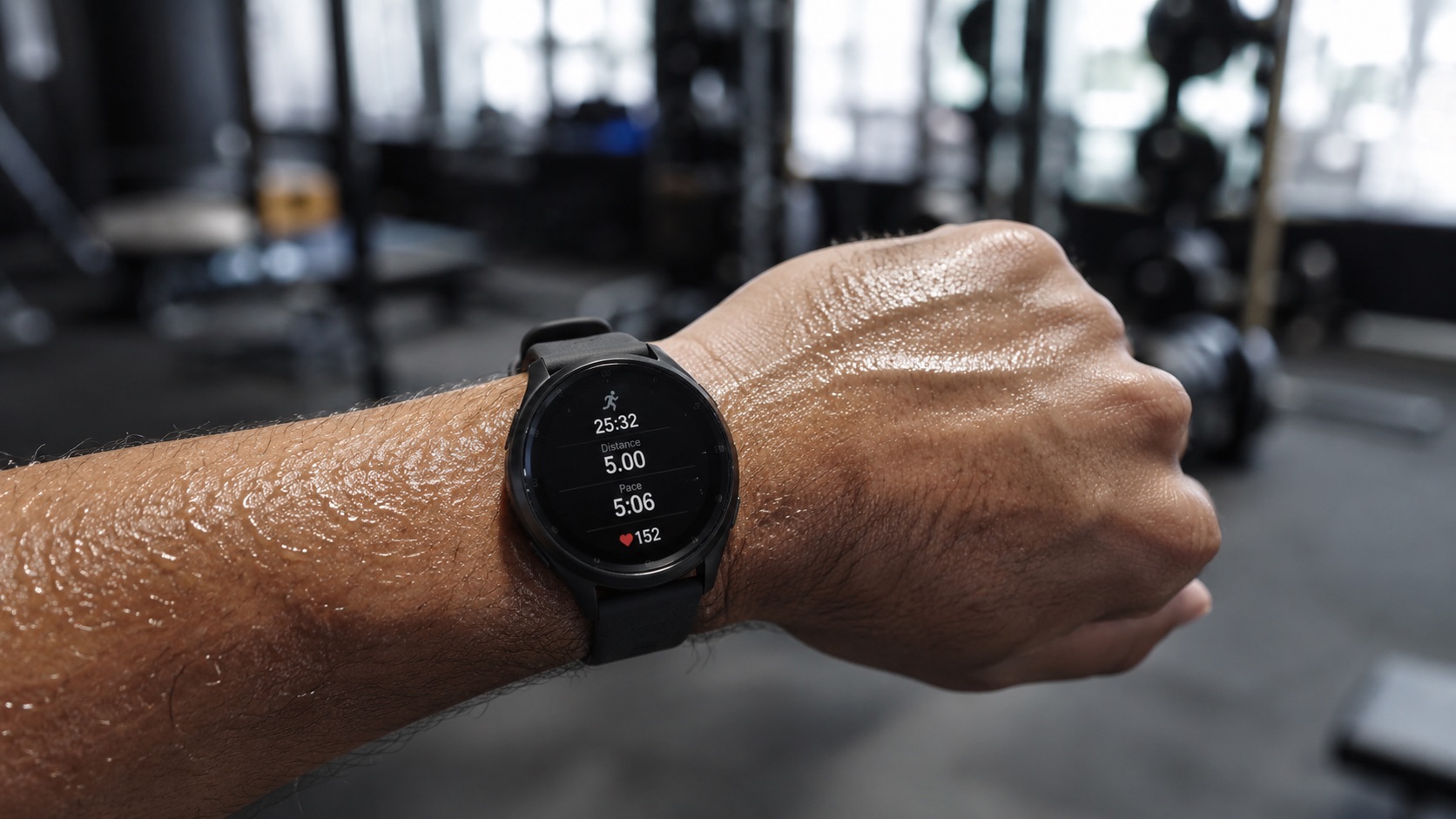
Polar Vantage V3 Review for Runners 2026
Polar Vantage V3 Review for Runners 2026
Polar has been in the heart rate business longer than almost anyone. They made the first wireless heart rate monitor in 1982, and that heritage shows in the Vantage V3 - a watch that’s obsessed with understanding your body’s response to training. It packs biosensors that go beyond standard optical HR, a training platform (Training Load Pro) that rivals Garmin’s ecosystem, and all the GPS features a serious runner needs.
At $500, it’s competing directly with the Garmin Forerunner 965 and COROS Vertix 2. I’ve worn it for four months of training. Here’s whether Polar’s flagship watch deserves a spot on your wrist.
Polar Vantage V3 Specifications
| Spec | Detail |
|---|---|
| Price | $500 |
| Case Size | 47mm |
| Weight | 53g |
| Display | 1.39” AMOLED, touch + 5 buttons |
| GPS Battery | 43 hours |
| Smartwatch Battery | Up to 7 days |
| GPS Chipset | Dual-frequency GNSS |
| Heart Rate | Optical HR + biosensor array |
| Music | Onboard music storage |
| Navigation | Turn-by-turn, offline maps |
| Training Platform | Training Load Pro |
| Water Resistance | WR100 |
| Connectivity | Bluetooth, ANT+ |
Build and Display
The Vantage V3 looks and feels premium. The 47mm titanium bezel gives it a solid, professional appearance without being garish. At 53g, it’s noticeably lighter than it looks - credit to the titanium and thoughtful engineering.
The 1.39” AMOLED display is one of the best I’ve used on a running watch. Bright, sharp, excellent viewing angles, and the always-on mode is readable without draining battery excessively. Touch responsiveness is good, and the five physical buttons provide tactile control during workouts when touch becomes unreliable with sweaty fingers.
On the wrist, it wears comfortably for a 47mm watch. It’s chunkier than the COROS Pace 4 or Garmin Forerunner 265, but similar in presence to the Garmin 965 or Fenix line. The included silicone band is fine - not special, but comfortable enough for daily wear and running.
GPS Accuracy
The Vantage V3 uses dual-frequency GNSS across multiple satellite systems, and accuracy based on available data was strong. Comparable to the Garmin 965 and COROS Pace 4 - within 1-2% on measured courses in various environments.
Track accuracy was excellent, with distance closely matching known distances over interval sessions. Trail running in tree cover showed clean tracks without significant drift. Urban canyons produced the expected minor deviations, but nothing egregious.
One thing I appreciated: the GPS locks fast. Within 5-10 seconds of stepping outside in most conditions. No more standing in your driveway for a minute waiting for satellites - the multi-band antenna finds position quickly and holds it reliably.
Heart Rate and Biosensing
This is Polar’s standout feature. The Vantage V3 doesn’t just measure heart rate - it captures an array of biometric signals including skin temperature, blood oxygen (SpO2), and electrodermal activity. Combined, these feed into Polar’s recovery and readiness algorithms with more data points than most competitors.
For basic running HR, accuracy was on par with other premium optical sensors - good for steady state, with some lag during sharp interval transitions. The usual recommendation applies: pair a chest strap for serious HR-zone training.
Where the biosensing shines is in recovery monitoring and sleep tracking. The combination of HR, HRV, temperature, and skin conductance gives Polar’s algorithms a richer dataset for determining your recovery status. The Nightly Recharge score, which combines ANS recovery (autonomic nervous system measured overnight) with sleep quality, was the most useful readiness metric I’ve used. It correlated well with how I actually felt - flagging poor recovery after hard training blocks or disrupted sleep.
Training Load Pro
Polar’s Training Load Pro is the company’s answer to Garmin’s Training Status and COROS’s EvoLab. It tracks your training across three dimensions: cardio load (cardiovascular strain), muscle load (musculoskeletal impact), and perceived load (RPE-based subjective feedback).
The three-dimensional approach is genuinely more nuanced than single-metric load tracking. A long easy run and a short intense interval session might produce similar cardio load, but very different muscle load - and Training Load Pro captures that distinction.
The system also provides training strain tolerance - essentially showing how close you are to your capacity, whether you’re in a productive training range or overreaching. Over my four months of use, the feedback was sensible. It correctly identified taper periods as deloading, hard weeks as approaching limits, and recovery weeks as rebuilding capacity.
One caveat: The system needs 4-6 weeks of consistent data before it calibrates to your personal baseline. For the first month, recommendations are generic. After that, they become increasingly personalized and accurate.
Running Metrics
Beyond load tracking, the Vantage V3 provides standard and advanced running metrics: running power (from wrist, no pod needed), ground contact time, stride length, cadence, and vertical oscillation. Running power from the wrist is less accurate than a dedicated pod like Stryd, but it’s useful for relative effort tracking without additional hardware.
The watch also delivers performance tests - you can run an orthostatic test, leg recovery test, and running fitness test to track changes over time. These add structure to your testing routine and make fitness tracking objective rather than relying on feel alone.
Race predictions are reasonable. Polar’s estimates were slightly conservative compared to Garmin - which I actually prefer, since conservative predictions mean you’re less likely to overcook your race pace based on watch guidance.
Maps and Navigation
The Vantage V3 includes offline maps with turn-by-turn navigation, putting it on par with the Garmin 965 and COROS Vertix line. Map rendering on the AMOLED display is sharp and readable, and route following worked reliably in my trail running tests.
You can plan routes in Polar Flow (web or app) and sync them to the watch, or import GPX files. The watch alerts you when you deviate from your planned route and guides you back. For trail runners and those exploring new routes, this is a meaningful feature.
Music
Onboard music storage supports offline playlists synced from your phone. You can pair Bluetooth headphones directly to the watch and run without your phone while still having audio. The interface is basic - it’s not a music-first device - but it works.
Battery Life
The claimed 43 hours of GPS is achievable with dual-frequency and full HR monitoring enabled. In my testing, I saw 38-42 hours depending on display settings and how often I checked the screen. With always-on display, that drops to around 30 hours - still excellent.
In daily smartwatch mode, I got 5-7 days depending on notification volume and how often I used the display. Charging is fast - about 90 minutes from empty to full.
Polar Flow vs. Garmin Connect
Polar Flow is Polar’s training platform, and it’s good - not great. The web version offers deep analysis with clear charts and long-term trending. The mobile app is functional but less polished than Garmin Connect.
Where Polar Flow excels: detailed training analysis, clean data presentation, and science-backed recovery insights. Where it lags: third-party integrations, social features, and ecosystem breadth. Garmin’s Connect IQ app store, third-party watch faces, and wider device ecosystem give Garmin an edge in flexibility.
Polar does integrate with Strava, TrainingPeaks, and other major platforms, so your data isn’t locked in. But if you want the widest ecosystem with the most app options, Garmin still wins that battle.
Who Should Buy the Polar Vantage V3
The Vantage V3 is ideal for data-driven runners who value deep physiological insights, runners who prioritize recovery monitoring and want the best sleep/readiness tracking, athletes who want a complete package (maps, music, training metrics) without Garmin, and runners who find Garmin’s interface overwhelming and want a cleaner experience.
It’s NOT ideal for runners who want the widest app ecosystem (Garmin wins), ultrarunners who need 60+ hours of GPS (look at the Garmin Enduro or COROS Vertix), or budget-conscious runners - $500 is a serious investment.
For a detailed breakdown of how Polar compares to Garmin’s ecosystem, check our Polar vs Garmin comparison for runners. You can also see where the Vantage V3 ranks in our best GPS running watches 2026 roundup. And if you’re specifically looking for alternatives to Garmin, our guide to the best smartwatch for runners who hate Garmin covers several strong options.
The Verdict
The Polar Vantage V3 is a serious running watch for serious runners. Its biosensing capabilities and Training Load Pro system offer genuinely deeper recovery insights than any Garmin at this price point. GPS accuracy is excellent, the display is beautiful, battery life is strong, and the addition of maps and music makes it a complete package.
The trade-off is a smaller ecosystem and slightly less polished app experience compared to Garmin. If you prioritize physiological insights and recovery science over app variety and social features, the Vantage V3 is the best option in its class.
Related reading: Garmin vs COROS vs Apple Watch - Which Brand for Runners?
FAQ
Is the Polar Vantage V3 good for trail running? Yes. With offline maps, turn-by-turn navigation, dual-frequency GPS, and 43 hours of battery, it handles trail running well. The only limitation compared to dedicated trail watches (like the Garmin Fenix or COROS Vertix) is slightly shorter battery life for ultra-distance events.
How does Polar’s HR accuracy compare to Garmin? In my testing, both are comparable for optical wrist-based HR. Polar’s hardware is slightly different (more LEDs, additional biosensors), but for pure HR during running, the accuracy difference is negligible. Polar’s advantage is in the additional data (temperature, SpO2, EDA) that feeds better recovery algorithms.
Does the Polar Vantage V3 work with Strava? Yes. Activities sync automatically to Strava once you connect your accounts in Polar Flow. The integration is seamless - runs appear in Strava within minutes of ending your activity, with full GPS track, HR data, and splits.
Can I use third-party watch faces on the Polar Vantage V3? No. Unlike Garmin (which has Connect IQ), Polar does not support third-party watch faces or apps. You can customize the built-in watch faces and data screens, but you’re limited to Polar’s own designs and complications.
Is $500 worth it over the $350 COROS Pace 4? It depends on your priorities. The extra $150 gets you maps, music, superior biosensing, deeper recovery tracking, and a larger AMOLED display. The COROS Pace 4 is lighter, has slightly longer battery, and offers excellent value at its price. If recovery insights and navigation matter, the Vantage V3 justifies the premium. If you want lightweight simplicity, the Pace 4 is hard to beat.