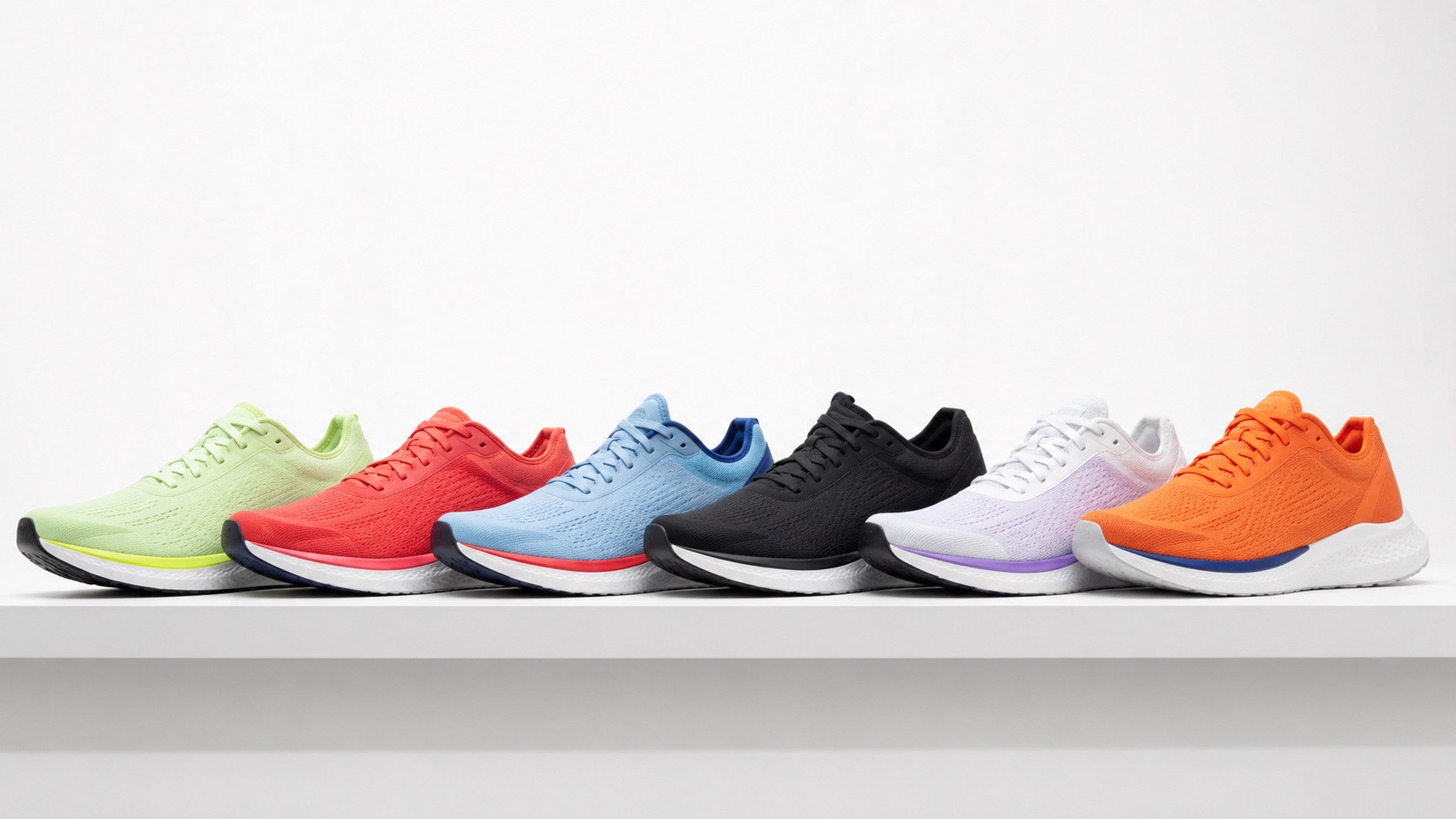
My 6-Shoe Rotation for Marathon Training (And Why Each Matters)
I currently own six pairs of running shoes. They all serve different purposes, and none of them is redundant. When you are running 80-100 kilometers per week, shoe rotation is not a luxury or a marketing trick. It is an injury prevention strategy backed by research showing that runners who rotate between multiple shoes have a 39% lower injury risk compared to single-shoe runners.
I have arrived at this exact rotation after three years of experimentation, tracking every run against the shoe I used, monitoring injury patterns, and systematically eliminating pairs that did not serve a clear biomechanical purpose. Each shoe in my rotation addresses a specific training stimulus, and together they create a system that keeps my legs healthy under extreme training load.
Let me explain the logic behind each choice.
The Complete Rotation
| Shoe | Role | Weekly Km | Why This Shoe | Replace At |
|---|---|---|---|---|
| Hoka Clifton 9 | Easy days | 22-24 km | Light cushion, neutral, low fatigue | 800 km |
| Hoka Bondi 9 | Recovery | 8 km | Maximum cushion, ultra-soft landing | 700 km |
| Saucony Endorphin Speed 4 | Tempo runs | 16 km | Nylon plate pop, not too aggressive | 500 km |
| Nike Vaporfly 4 | Intervals | 14 km | Carbon plate, maximum energy return at speed | 300 km |
| Adidas Adios Pro 3 | Long runs | 28-32 km | Carbon plate, stable at marathon pace for 2+ hours | 350 km |
| Nike Pegasus 41 | Daily workhorse | 10 km | Versatile, firmer platform, variety stimulus | 800 km |
Total weekly mileage across all shoes: 98-104 km. No single pair absorbs more than 32km in a week, which dramatically extends their lifespan and maintains consistent cushioning properties.
Easy Day Shoe: Hoka Clifton 9
The Clifton handles the plurality of my easy mileage. At 248g, it is light for a cushioned shoe. The stack height (33mm heel, 28mm forefoot) provides ample protection without feeling disconnected from the ground. The meta-rocker geometry encourages a smooth heel-to-toe transition at slow paces.
Why specifically the Clifton and not something else? I have tried the New Balance Fresh Foam 1080 (too heavy at this volume), the ASICS Gel Nimbus (too soft, loses structure), and the Brooks Glycerin (excellent, but I prefer the Clifton’s lighter weight). The Clifton hits the sweet spot between protection and responsiveness for easy efforts.
I replace it at around 800km, which at 22-24km per week means roughly 8-9 months per pair. By 800km, the midsole compression becomes noticeable and the cushioning asymmetry between left and right foot starts to emerge.
Recovery Shoe: Hoka Bondi 9
Friday recovery runs get the most cushioned shoe in my rotation. The Bondi 9 is 30% heavier than the Clifton (307g), with a massive 37mm of stack height. It feels like running on pillows. That is exactly the point.
Recovery runs are not about efficiency or ground feel. They are about minimizing eccentric loading on already-fatigued muscles. The Bondi’s ultra-soft EVA foam absorbs impact forces that would otherwise add cumulative stress before Saturday’s long run.
Some runners think a recovery shoe is overkill. At 50km per week, they might be right. At 100km per week, the difference between running recovery in a firm shoe versus a maximally cushioned one is the difference between arriving at Saturday’s long run with fresh legs or with lingering tightness.
Tempo Shoe: Saucony Endorphin Speed 4
The Endorphin Speed occupies a critical middle ground. It has a nylon plate (not carbon fiber), which provides propulsive assistance without the aggressive geometry that makes carbon racers hard on your calves and Achilles.
I use it for Thursday tempo runs: 4km warm-up, 8km at marathon pace plus 15 seconds, 4km cool-down. The Speed helps me hold tempo pace with less perceived effort while being forgiving enough that I am not accumulating excessive musculoskeletal stress.
The PWRRUN PB foam is responsive without being unstable, and the nylon plate flexes with a less abrupt snap-through than carbon. After 16km at tempo effort, my calves feel fine. After 16km at tempo effort in a full carbon plate shoe, they do not.
I replace the Speed at around 500km because the nylon plate seems to lose its responsiveness faster than the foam. You can read more about shoes in this category in my best daily training shoes roundup.
Interval Shoe: Nike Vaporfly 4
This is my speed weapon. The Vaporfly comes out exclusively for Tuesday interval sessions and tune-up races. At 3:30-3:35/km pace, the ZoomX foam and carbon plate combination delivers measurable energy return that I can feel in my split times.
Some coaches argue against training in carbon plates. I understand the concern: if you always train with assistance, you never develop the muscular strength to run fast without it. But my intervals are neuromuscular sessions. The goal is to rehearse race pace mechanics, and I race in the Vaporfly. Training in it ensures my body is adapted to its geometry and rocker profile.
The tradeoff: carbon plates load the calves and Achilles differently than conventional shoes. This is why I limit Vaporfly usage to one session per week (14km), not every fast run. Strategic deployment, not daily reliance.
I replace it at 300km, which is earlier than most trainers. At that point, the ZoomX foam has compressed enough that the ride quality noticeably changes. For the full breakdown of carbon plate options, see my carbon plate racing shoe comparison.
Long Run Shoe: Adidas Adios Pro 3
Saturday’s long run (28-32km) gets the Adios Pro 3. This is also my marathon race day shoe, so long runs serve double duty: training the body and rehearsing the race day experience.
Why the Adios Pro over the Vaporfly for long runs? Two reasons. First, the Lightstrike Pro foam in the Adios Pro is slightly firmer and more stable than ZoomX, which matters over 2+ hours when form fatigue starts to creep in. Second, the five-rod carbon plate system (versus the Vaporfly’s single spoon plate) distributes force differently and feels more supportive at marathon pace over long distances.
I have raced in both shoes. The Vaporfly feels faster for efforts under 90 minutes. The Adios Pro feels better for efforts over 2 hours. Since my marathon takes approximately 2:54, I go with the Adios Pro.
For a detailed comparison, check Nike Vaporfly vs Adidas Adios Pro.
Daily Workhorse: Nike Pegasus 41
The Pegasus fills my Wednesday easy day. It is deliberately different from the Clifton: firmer, lower stack, more ground feel. I use it to vary the mechanical stimulus on my feet and lower legs throughout the week.
The React foam in the Pegasus is denser than the Clifton’s EVA, which means my foot muscles work slightly harder to stabilize. This is controlled stress: not enough to fatigue me, but enough to maintain foot strength that pure cushion shoes might let atrophy.
The Pegasus is also my “feel check” shoe. Because it is less cushioned, I notice residual fatigue from Tuesday’s intervals more readily. If Wednesday feels heavy in the Pegasus, I know to be more conservative with Thursday’s tempo.
Building Your Own Rotation
You do not need six shoes from day one. Here is how I would build progressively:
Starting point (40-50km/week): Three shoes. One cushioned easy day shoe (Clifton or Ghost), one uptempo shoe (Endorphin Speed), one for long runs (can be the same as the easy day shoe initially).
Intermediate (60-80km/week): Add a dedicated recovery shoe and consider separating your long run shoe from your easy day shoe.
Advanced (80-100km/week): Full rotation. At this point, the cost is justified by the injury prevention and performance benefits.
The initial investment is significant. Six pairs of shoes represents roughly 800-1000 euros. But when you amortize that over their combined lifespan of approximately 3,500km of running, the cost per kilometer is around 0.25 euros. For injury prevention at high mileage, that is a bargain.
How I Track Shoe Mileage
I log every run in Strava with the shoe tagged. Strava tracks cumulative distance per shoe, and I set mental thresholds for replacement. When a shoe hits 80% of its replacement mileage, I order the next pair so I can transition gradually.
I also pay attention to how each shoe feels. Sometimes the numbers say 500km but the shoe feels dead at 400km. Trust your feet over the spreadsheet. If the cushioning feels flat or asymmetric, it is time regardless of the number.
The Injury Prevention Mechanism
Why does rotation work? Three mechanisms:
-
Varied load distribution. Different stack heights, drop measurements, and foam densities mean different muscle groups absorb impact on different days. No single tissue gets overloaded repeatedly.
-
Midsole recovery. Foam needs 24-48 hours to fully recover its shape after compression. By rotating, each shoe gets adequate rest between uses.
-
Proprioceptive variety. Different ground feels challenge your neuromuscular system in slightly different ways, building more robust stabilization patterns.
A 2015 study in the Scandinavian Journal of Medicine and Science in Sports found that runners using multiple pairs of shoes during a 22-week period had 39% fewer running-related injuries than single-shoe runners. That finding alone justified my rotation investment.
Common Rotation Mistakes
Too many similar shoes. Three cushioned neutral trainers is not a rotation. You need mechanical variety: different stacks, different firmness, different plate configurations.
Using race shoes for easy runs. Carbon plates belong in specific sessions. Using them daily accelerates wear and can overload your calves.
Never replacing worn shoes. A shoe past its lifespan provides false confidence. The cushioning you think is there has degraded. I have seen runners get injured because they kept a beloved pair 200km past its useful life.
Check my earlier article on rotation philosophy for faster runners for more on how to think about shoe selection by training purpose.
FAQ
Can I rotate with just 2 shoes instead of 6?
Yes, and you should if you are running under 50km per week. Two shoes with meaningfully different characteristics (one cushioned, one lighter/faster) still provide the varied stimulus that reduces injury risk. Six shoes becomes necessary at very high mileage where each session type has genuinely different demands.
How do you decide when a shoe is “dead”?
Three signals: visible midsole compression (creasing that does not bounce back), asymmetric wear between left and right shoe, and subjective feeling of reduced cushioning. I weigh these against the mileage logged. If any signal appears before expected replacement mileage, the shoe is done.
Is it worth buying the same shoe model twice?
I buy two Cliftons at a time since it handles the most mileage in my rotation. Having a backup means no disruption when one pair hits replacement mileage. I stagger their introduction by about 300km so they are never both at end-of-life simultaneously.
Do different shoes affect your running form?
Subtly, yes. Higher stack shoes encourage a slightly longer stride, while lower stack shoes promote a higher cadence. I have measured this difference at about 2-3 steps per minute between the Bondi and the Pegasus at the same pace. This subtle variation is part of why rotation works.
What about trail shoes in the rotation?
I do not include them here because my marathon training is entirely road-based. If I were including trail runs, I would add a seventh pair (something like the Hoka Speedgoat) and assign it to one easy day per week on softer surfaces. Trail shoes are a separate biomechanical category entirely.
Summary
A 6-shoe rotation is my framework for staying healthy at 100km per week. Each shoe addresses a specific training need, and together they distribute mechanical stress across different tissue groups while allowing each pair adequate recovery time between uses. Start with three shoes, build as your mileage grows, and always ensure mechanical variety rather than duplicating similar designs.